The complete story
PHOTO : NICOLAS MESLY is called for by a right-wing president, Nicolas Sarkozy, who takes a speech on his left: 20% of the French territory will be cultivated organic by 2020 and producers, here, will have to use 50% less pesticides. French people, concerned about their health, applaud. So Terrena puts the health of consumers and sustainable development at the heart of its business strategy. "The development "L-environment is our lever of competitiveness"
Terrena The sentence is by Christophe Couroussé, Communications Director of the Terrena Group, France's largest agricultural cooperative: 25,000 members, 3.9 billion euros in combined turnover (2008). In the Grenelle de l'Environnement trail, a new social pact between farmers, ecologists and citizens, concluded in 2007, the cooperative embraces the concept of Environmentally intensive agriculture (EIA). S By Nicolas Mesly durable, the consumer perceives it as a health asset in the product he consumes.
This is the driving force behind our approach," explains Christophe Courrousé. "This is also why the cooperative does not market DWMO, the majority of which are neither for nor against, but can very well do without their possible technical and economic gains as long as the French and the Euro-regions do not want to. u APRIL 2010
Of which lands suitable for rain-fed crops already exploited* Sub-Saharan Africa East Asia South Asia Near East and North Africa Where is there land left to cultivate? Agricultural land, in millions of hectares Terrena is based on an agriculture that keeps a course on yields, but based on eco-logy and biology rather than chemistry. Curved, will be "with or without us. I cannot tell you the exact date, but within 10 or 30 years, nitrogen fertilizers linked to fossil fuels will cost very much.
At worst, chemical fertilizers will disappear."The cooperative's bet: Inventing technologies and production methods that will be the solution of tomorrow, a way to regain added value for farmers.A pump for innovation The cooperative has therefore created a shock team of six R&D researchers. Their mission: to capture all innovations in agricultural production and to transpose them to farmers with an objective of envi- nal and economic gain.
The six researchers are working on eight themes: 1- Nutrition and plant health. This is the most complicated area. Terrena researchers are trying to combine cereals with legumes, wheat with peas, for example, so as to reduce the need for nitrogen fertilization.
The company is also working on blends of varieties to reduce susceptibility to fungal diseases, plant micorhyzation, biocontrol and stimulation of the plant immune system; 2- Agricultural machinism. The aim is to capture innovations including those of equipment developed for organic farming and to transpose them to the machinery of the future traditional agriculture. Terrena also wants to develop geo-positioning; 3- Animal nutrition. The cooperative wants to develop the use of essential oils to reduce the use of antibiotics in livestock farms.
It indicates that it has reduced the amount of medication used in livestock production by 50% for 4-5 years, in poultry, pigs and cattle. Reduction of methane by cows; 4- Water management. Terrena works on the quality of the vital liquid, notably by reducing plant residues and the use of drip systems in field crops (corn); 5- Soil management. The cooperative intends to promote the use of no tillage: direct seedlings and plant covered.
Terrena works on crop mixtures (interlayers) through her seed society to structure the soil, increase its water retention capacity, and restore nitrogen to the following crop; 6- Biodiversity. The cooperative builds on work done in arboriculture: integrated management, use of auxiliary insects, maintenance of biodiversity on a land - to limit pest pressure.
Terrena aims to ensure that farms are producing and non-consumer energy: wind, photovoltaic, methanization. The 58 Agricultural Co-operators: APRIL 2010 The cost of the Liberty MD herbicide is now under $12/acre* for excellent control of a wide range of weeds in all your Herculex MD corn hybrids, Agrisure MD and SmartstaxTM containing the LibertyLink MD line. It is part of the LibertyLink herbicide tolerant family of crops. Always read and comply with the label guidelines.
Liberty® and LibertyLink® are registered trademarks of Bayer. Bayer CropScience is a member of CropLife Canada. 01/10-11716F-02 All other products mentioned are trademarks of their respective companies. *Based on a 1.0 litre/acre dose at MSRP. 10 The only Group 10. 11716-02 Liberty_SpringCorn_LCA.indd 1 3/9/10 10:03 AM cooperative is also looking for the use of biomaterials made from hemp for example; 8- Livestock buildings. Terrena wants to reinvent the livestock building, a major investment, to make it a producer and not a mere hangar.
Example: improving animal health by reducing salmonella by controlling the atmosphere and composition of building materials. The first prototypes will be ready next spring. Terrena bets on the discovery of cost-effective solutions where the environment is not perceived as a constraint and costs, but as a lever of competitiveness."Decrease in nitrogen requirements on a farm is protecting it from a number of variations in world prices.
The biggest frailties for farmers are to be faced with variations that they do not control, but are completely insane," says Mr. If the cooperative sells seeds, plant covers and new solutions, it will ensure the transition of its own economic model, he believes. He believes that the latter foresees a transition period of ten years, a period deemed relatively short. The cooperative organizes the first World Meeting of Intensive Ecology on May 27 and 28, to demonstrate its first technologies in a farmer who has allocated an area of 14 hectares.
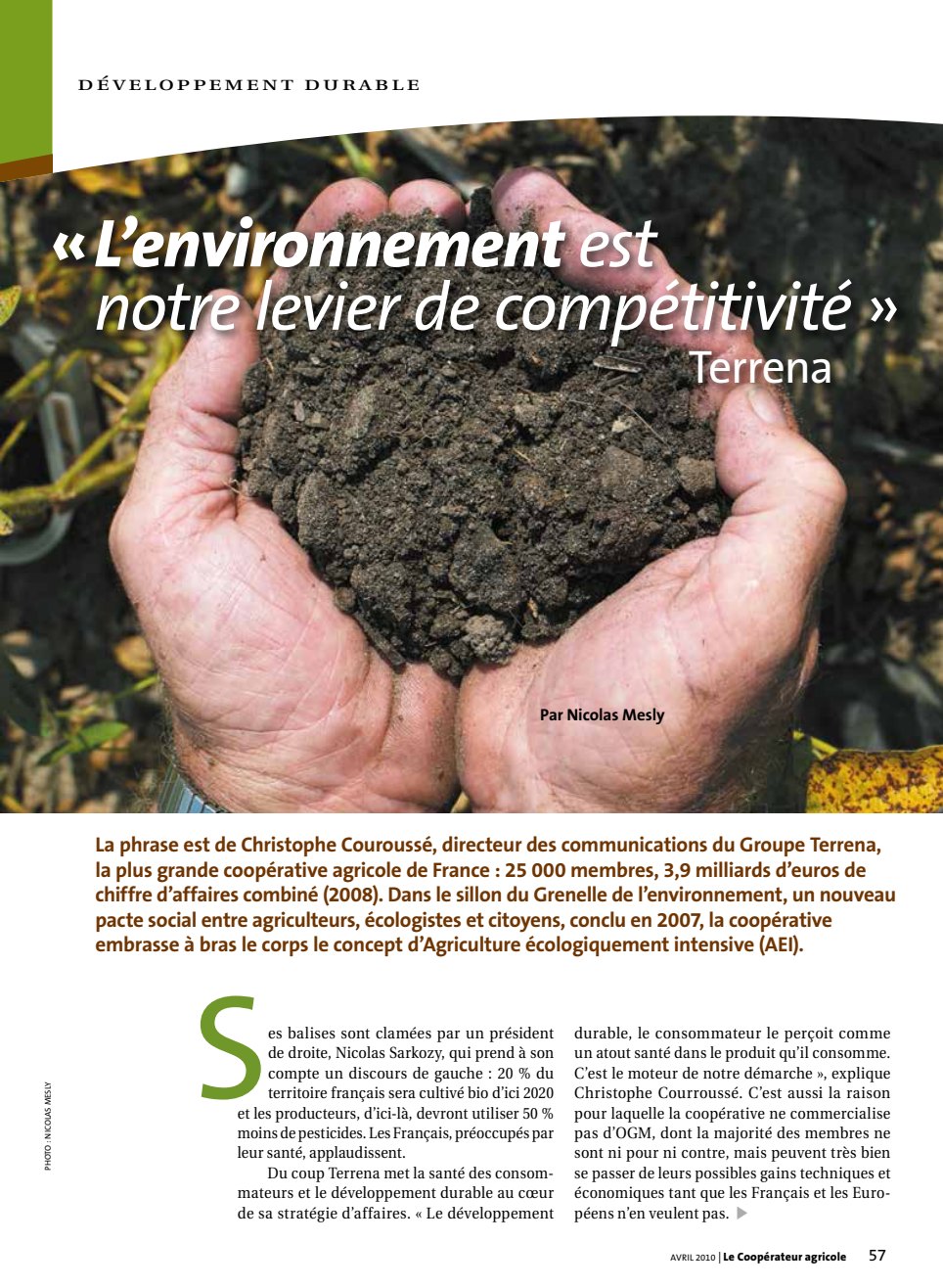
Terrena cooperative aims to promote non-labour: direct planting and plant cover. APRIL 2010
Complete original publication
The complete facsimile presents the publication in its original editorial design.
Open original PDF ↗