LONG-FORM REPORT · 2015
Technology is shaping a new agricultural planet
4 pages · 4343 words
Open original PDF ↗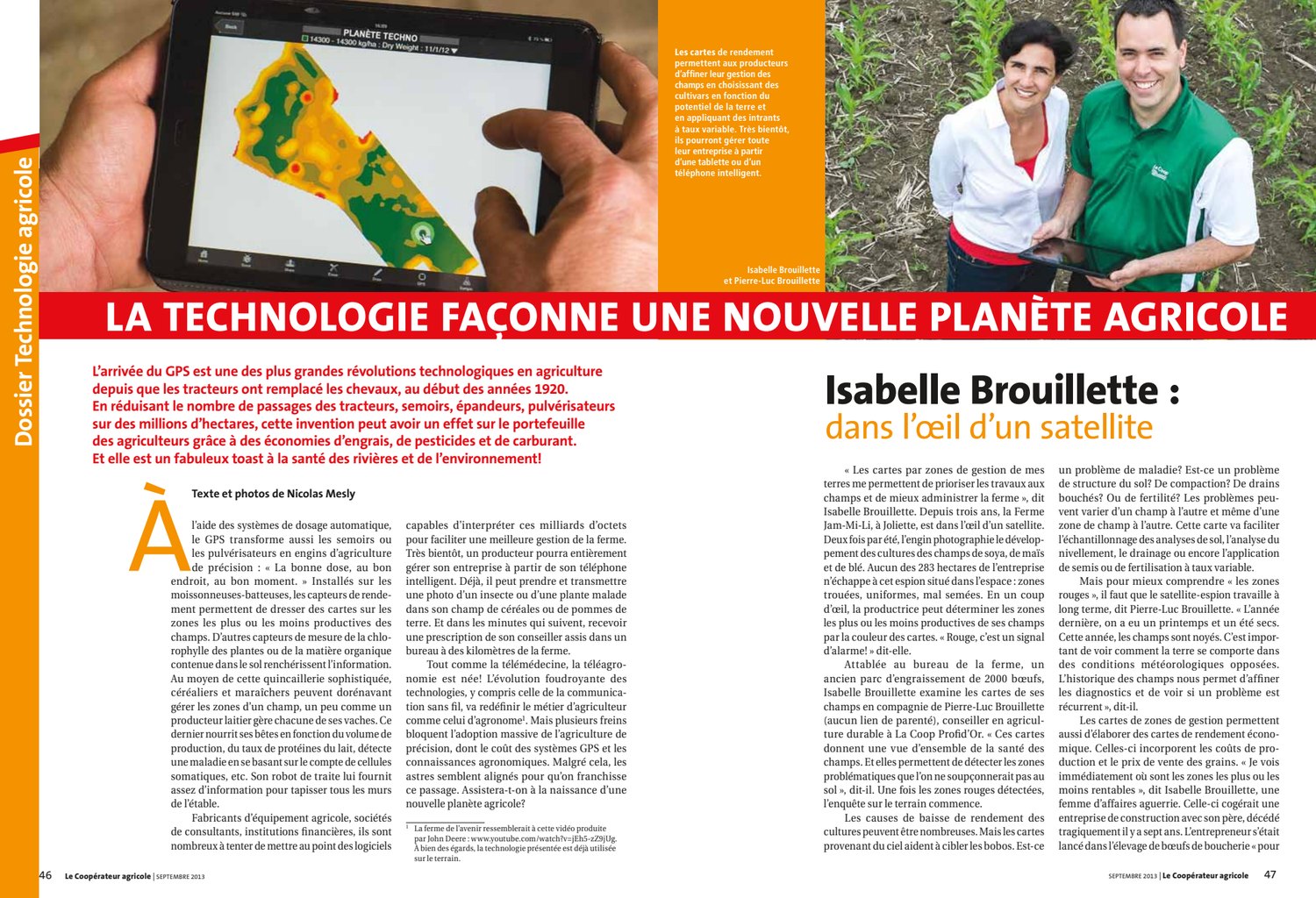
The complete story
The arrival of GPS is one of the biggest technological revolutions in agriculture since tractors replaced horses in the early 1920s. By reducing the number of passages of tractors, sowers, spreaders, sprayers on millions of hectares, this invention can have an effect on farmers' portfolio thanks to savings in fertilizers, pesticides and fuel. And it is a fabulous toast to the health of rivers and the environment! able to interpret these billions of bytes to facilitate better farm management.
Soon a producer will be able to manage his business entirely from his smartphone, and already he can take and transmit a picture of an insect or a sick plant in his field of cereals or potatoes, and in the following minutes receive a prescription from his adviser sitting in an office miles away from the farm, just like telemedicine, teleagro - nomie was born!
The overwhelming evolution of technologies, including wireless communication, will redefine the farmer's profession as agronomist.1 But several obstacles prevent the massive adoption of precision agriculture, including the cost of GPS systems and agronomic knowledge. Despite this, the stars seem aligned to get through this passage. Will we attend to the birth of a new agricultural planet? 1 The future farm would look like this video produced by John Deere: www.youtube.com/watch?v=jEh5-zZ9jUg.
In many ways, the technology presented is already used in the field. Using automatic dosing systems, GPS also transforms seeders or sprayers into precision farming machines: "The right dose, in the right place, at the right time." Installed on combine harvesters, the rendering sensors allow maps to be drawn on the most or least productive areas of the fields.
Through this sophisticated hardware, grain and market gardeners can now manage the areas of a field, a bit like a dairy producer manages each of his cows. The cow feeds his animals according to the volume of production, the protein level of the milk, detects a disease based on the somatic cell count, etc. Its milking robot provides him enough information to line all the walls of the stable. Manufacturers of agricultural equipment, consulting companies, financial institutions, many of them are trying to develop software to text and photos by Nicolas Mesly The yield cards allow producers to refine their field management by choosing cultivars according to the potential of the land and applying inputs at variable rates.
Very soon, they will be able to manage their whole business from a tablet or smartphone. Isabelle Brouillette: in the eye of a satellite a problem of disease? Is it a problem of soil structure? Problems can vary from one field to another and even from one field to another.
This map will facilitate soil sampling, levelling analysis, drainage, or the application of variable rate seedling or fertilization. But to better understand "red zones", the satellite spy must work in the long term, says Pierre-Luc Brouillette. "Last year, we had a dry spring and summer. This year, the fields are drowned.
It is important to see how the earth behaves in opposite weather conditions. Field history allows us to refine the diagnosis and see if a problem is recurring," he says. Management area maps also allow us to develop economic yield maps, which incorporate production costs and grain sales prices.
"I see immediately where the most or least profitable areas are," says Isabelle Brouillette, a seasoned businesswoman who was co-operating with her father in a construction business, tragically deceased seven years ago. "The entrepreneur had started to farm beef cattle "for "The maps by land management areas allow me to prioritize the work in the fields and better administer the farm," says Isabelle Brouillette. "For three years now, the Jam-Mi-Li Farm in Joliette is in the eye of a satellite.
Twice a summer, the machine photographes the development of crops in the soy, corn and wheat fields. None of the 283 hectares of the company escapes from this spy located in the space: holes, uniform, poorly sown areas. At a glance, the producer can determine the most or least productive areas of his fields by the color of the cards. "Red, it's an alarm signal!" she says.
Isabelle Brouillette, a former 2000-bread feeder park, is looking at the maps of her fields with Pierre-Luc Brouillette (no kinship), a sustainable farm advisor at La Coop Profid. "These maps give an overview of the health of the fields, and they allow us to detect problematic areas that we would not suspect on the ground," he says. Once the red areas are detected, the field investigation begins.
The causes of crop yield declines may be numerous. But maps from the sky help target bobos. Is Isabelle Brouillette and Pierre-Luc Brouillette LogIe is shaping a new one LThe pLanete agr IcoSEPTEMBER 2013 − The agricultural co-operator 4746 The agricultural co-operator − SEPTEMBER 2013 File Agricultural technology characterIstIques des dIfférents systems gps gps dgps Wass rtK 3 m 1 m 1 m 2 cm Satellites Satellites Coast Guard Satellites Ground Base Satellites Antenna RTK radio Cellular antenna network 15-20 cm between each passages +- 1 m repeatable Omnistar 7-12 cm between each passages +-20 cm repeatable 15-20 cm between each passages +- 1 m repeatable 2 cm between each passages 2 cm repeatable year in year Soil sampling Soil sampling Field sampling Self-guiding Semis Fertilization Soil sampling Field sampling Field conditions Self-guiding Fertization Ferming
Her daughter now runs both businesses, not counting her family, two boys aged 6 and 10 years.This access to yield cards and the consulting services of La Coop Profid, "is an economic way to make precision farming," says Isabelle Brouillette. "The tenant has abandoned beef farming, a business decision, to devote himself to culture, and, in order not to have to invest in expensive machinery, she has her sprays and her thrifts done.
Launched in 2011, this turnkey service of "performance cards – consulting services" allows "to democratize technology," says Alain Brassard, a specialist in precision agriculture at La Coop federated. Not all producers or contractors with packages own a combine harvester equipped with geo-refined efficiency sensors - re-enacted. These sensors can easily cost $20,000 and the speed of technological progress makes them obsolete in a few years, according to him. "In several fields, rendering cards developed using satellite photos have been compared with those produced from a combine harvester equipped with a geo-refined efficiency sensor.
The result has been very similar," he says. "Moreover, Alain Brassard believes, the vast majority of producers are not calibrating their output sensor properly. And above all, they do not use the information provided by this sensor to their full potential. The annual cost of the service offered by the La Coop network varies between $900 and $1200 depending on the size of the farm.
In all, more than 100,000 hectares of land in the St. Lawrence Plain, from the Ontario border to Rivièredu-Loup, are being searched for the magnifier. But from this year onwards, this service is being offered throughout the province. At the Jam-Mi-Li Farm, the work of the satellite sepion - swimming begins to bear fruit. Isabelle Brouillette and Pierre-Luc Brouillette are carefully examining the management area maps when Sylvain Rocheleau, the farm manager, bursts into the office.
And he predicted: "The Lafortune field, which was levelled last year, well I expect almost double yield at the next corn harvest."Somewhere, we have to thank the sky. danny messier: the GPS system patent The agricultural Quebec was heavily watered from mid-May to the end of June 2013, one of the most execrable seasons. In such conditions, we have to play against the clock to carry out work in the fields. "The GPS system allowed us to apply nitrogen precisely, day and night.
In 48 hours, with two tractors, 50,000 gallons were applied on 607 hectares of corn. Ten years ago, it would have taken us more than a week," says Danny Messier. "This producer of Saint-Pie de Bagot cultivates 809 hectares of family land, makes seeding and spreading of nitrogen on a lump sum of 1456 hectares, not counting spraying activities on 3642 hectares. Speed of execution, precision, better input management, Danny Messier swears only by GPS.
His introduction dates back to 1998, when he bought a combine harvester with a georeferenced yield sensor. The maps of his fields he obtained with this emerging technology give him a good idea of the most and least productive areas. He also undertook the levelling and drainage fixes. The following year he equipped a tractor with a GPS system with manual spraying guidance.
And in 2007, he equips a tractor with an automatic guidance system. No more maize rows sown in zigzag and horse - cuts. Today, the six tractors of his company are all equipped with a GPS system with automatic guidance, "which removes a tremendous stress on the driver's shoulders. When there are no bugs or failures!" he says.
He buys all his used tractors, aged two to four years, with 800 to 2500 hours under the hood, and he extends their useful life to more than 10,000 hours."I prefer to invest in variable-rate technology than in new machinery. It's not long that you put $50,000 on a seed drill," he says. "This graduate in field crops from ITA Saint-Hyacinthe (1994) has become a high-tech patent.
By taking English courses, to better peel the manuals of the devices sold on the market. He has equipped his used seeder with liquid GPS commands of fertilizer. These are small black boxes filled with electrical wires that act as a nervous system. This precisely regulates the nitrogen fertilizer deposited near the corn seed and the liquid starter dose deposited under the grain.
Next step: to equip the seeder with a Danny Messier pressure control on board its self-propelled sprayer. Soon instead of having several computer screens to control different machines in a cabin, there will be only one GPS screen, which can be switched from one tractor to another. It is not excluded that it is an iPad tablet or even a smartphone. GPS systems will be more or less accurate as needed.
Their price ranges from $1,000 to $45,000. (Source: Alain Brassard, La Coop fedéréée) 48 The agricultural co-operator: SEPTEMBER 2013 SEPTEMBER 2013: The agricultural co-operator: 49 Inflatable agricultural technology for sowing grains to the desired profon - the desired thickness according to the texture of the soil. These controls are all linked to the GPS screen, a computer located in the trac - the trac - the driver's cabin that takes place as a brain. And each machine – sowing or spraying, for example – is equivalent to a hard drive housed in this computer. "It's a little more complicated than programming the video machine in the living room," says Danny Messier, smiling around.
Its latest DIY: the conversion of an old fertilizer spreader, about 30 years old, into a modern applicator with variable potash or ray-grass rates. The machine is calibrated to spread 28 kg/ha (62 lb/ha) of ray-grass and between 84 kg/ha and 875 kg/ha of potash. Danny Messier insists: a poorly calibrated machine sows silver at the four winds. The patentee estimates the cost of its home spreader at $7500.
Nine, he said, would be worth almost $60,000. "Technology, yes, but not at any price," he concludes. 1 www.youtube.com/watch?v=zU4liQvrcm4 In a video broadcast on YouTube1, a tractor is seen pulling a corn seeder. The producer is comfortably sitting on a chair at the end of his field. Water bottle in hand, he watches his robotised machinery make a turn on his own right in front of him.
When the tractor turned, it lifted the seeder, before it touched the ground again to resume the seeding. Manufacturers quickly developed GPS self-piloting of the farm machinery fleet. To overcome a staggering shortage of labour, on the one hand, and to remove stress from the driver, on the other.
Driving a tractor or a combine harvester for 10 to 12 hours a day is not a rest. But the day when agriculture will be without human beings is not for tomorrow. For safety reasons, among other things: if the machine goes crazy, how do we stop it? And for legal reasons.
"If you have a tooth, who would be responsible?" asks Joshua Hétu, a consultant at Lagüe/John Deere. "There is no doubt that manufacturers are working on the autonomy and better communication between machines. For example, from their combine harvester, a producer can take control of a tractor and its grain cart to transfer corn or soybeans without fear of collision, without stopping or slowing down.
The accuracy of GPS systems, to the nearest centimeter, means that the operation will be carried out within the safe distances between the machines. This technology of total equipment control will be available in Quebec this fall. In the future, from a tractor or a "master" harvester, a producer will be able to operate several machines. Under the regulatory pressure, manufacturers have put double bites to design ultra clean diesel engines.
These same manufacturers are developing engines that are running on expensive, alternative fuels and oil pollutants. CASE is focusing on biodiesel made with soy. The company also plans to replace the current oil with a soy-based product to operate hydraulic systems. "We are developing a tractor with a hydrogen engine for the European market," said Abe Hughes, representative of New Holland.
In 10 or 15 years, it is not impossible to see electric tractors carbide! All manufacturers agree to sound the gigantism of tractors, sowing houses and combine harvesters, which have reached their limits due to the problems of soil compaction. Future machines will be lighter and faster.
The goal: to do maximum work in a very short time span on larger areas. This time constraint is exacerbated by climate change, because the good weather periods for sowing, watering or harvesting are irregular and unpredictable. All these operations are already a race against time, with the company's profitability as a challenge. Manufacturers also promise that the future farm machinery fleet will be offered at an affordable price.
No matter how much color the team is, it remains man-made. How much will the sophisticated defective piece cost? How long will the repair take, since a breakdown always occurs at the wrong time? That's where the revolution of wireless data transfer comes in.
Some manufacturers already offer, through their concessionaires, a preventive maintenance service of their customers' machinery fleet. By having access to the computer of the machine, the technician can collect diagnostic records and identify anomalies, which avoids costly repairs.
On this windy day, the producer adds a product to add more droplets to Roundup's application, so as not to water the nearby soybean field. With the arrival of precision farming, Danny Messier believes that Quebec should be inspired by the United States to redefine its agri-environmental policy."Quebec has a punitive approach. While the United States is financially rewarding producers who have good conservation practices," he believes.
Jean-François Messier leads the old fertilizer spreader converted into a modern applicator with variable rates of potash or ray-grass. Will tractors grow only fields within 15-25 years? SEPTEMBER 2013
Images: Hi-Rez FPO Bleed: Y N Urban & Co. Inc. 905-403-0055 Monsanto Company is a member of the Excellence Through Stewardship® (ETS) group. Monsanto's products are marketed in accordance with the responsible product marketing standards of the ETS and Monsanto's policy for the marketing of biotechnology-based plant products in basic crops. Importation of this product has been approved in key export markets with relevant regulatory systems.
Any crop or material obtained from this product may only be exported, used, processed or sold in countries where all necessary regulatory approvals have been granted. It is illegal under national and international laws to export products containing traits derived from biotechnology to a country where the importation of such goods is not permitted. Producers should contact their grain dealer or product buyer to confirm their policy on the purchase of this product.
Excellence Through Stewardship® is a registered trademark of Excellence Through Stewardship. ALWAYS READ AND FOLLOW THE GUIDELINES OF PESTICIDE LABELLERS. Roundup Ready® crops have genes that give them tolerance to glyphosate, the active ingredient in Roundup® herbicides for agricultural use. Roundup herbicides for agricultural use will destroy crops that do not tolerate glyphosate.
Acceleron® seed processing technology for corn is a combination of four separate individually registered products that, together, contain the active ingredients metalaxyl, trifloxystrobin, ipconazole, and clothianidine. Acceleron® seed processing technology for canola is a combination of two separate individually registered products that, together, contain the active ingredients difenoconazole, metalaxyl (M and S isomers), fludioxonil, thiamethoxam, and Bacillus subtilis.
Acceleron and logo®, Acceleron®, DEKALB and logo®, DEKALB®, Genuity and logo®, Genuity, Genuity®, Integrated Refuge and logo®, Integral Refuge®, Roundup Ready 2 Technology and logoTM, Roundup Ready 2 PerformanceTM, Roundup Ready®, Roundup Transorb®, Roundup WeatherMAX®, Roundup®, SmartStax and logo®, SmartStax®, Transorb®, VT Double PROMD, YieldGard VT Chrysomèle/RR2MC, YieldGard Pyrale and logo and YieldGard VT Triple® are trademarks of Monsanto Technology LLC. Licensed use.
LibertyLink® and the water drop logo are trademarks of Bayer. Licensed use. Herculex® is a registered trademark of Dow AgroSciences LLC. Licensed use.
Respect Les Refuges and the logo is a registered trademark of the Canadian Seed Trade Association. Licensed use. ©2013 Monsanto Canada Inc. Notice to Producers on Responsible Use of Characters Before opening a seed bag, you must read, understand and accept responsible use practices, including rules for insect resistance management shelters, biotechnological characters expressed in the seed, as stipulated in the Monsanto Technology Management Agreement you sign.
By opening the bag and using the seed it contains, you agree to comply with the principles of responsible use in force.Sell shelters. Preserving technology. RESPECT REFUGEES MD The Agricultural Co-operator Where is Quebec in the adoption of precision farming techniques? viacheslav adamchuk One of the first elements of precision farming is the drainage of land. Quebec is one of the first places in North America to have raised this problem.
Fortunately, because it was watered a lot in 2013! CA Is there a delay compared to the United States? goes Yes, in terms of soil conservation practices, i.e., without tilling. In Nebraska, 80% of producers grow without tilling, of which 30% are direct seeding. In Quebec, according to a 2007 survey, 38% of producers practice a form of reduced tillage.
This means that 62% of Quebec farmers plow their fields, an obsolete practice known to cause erosion and pollution.
In this sense, Quebec is more like the states of Vermont and New York. CA Will precision farming change the farming profession? Yes. It will make the farmer a business manager, as well as a large-scale store owner, especially in terms of product traceability. The latter manages precisely the origin of its products, its stocks and shipments by radius, its employees, its truck fleet, etc.
A graduate of the National School of Agronomy of Ukraine and a master's and PhD degree from Purdue University in Indiana, USA, Professor Viacheslav Adamchuk taught precision agriculture in field crops for 10 years at the University of Nebraska, where he was also part of the extension service for farmers. In 2010, he joined the Agricultural Engineering Department of Macdonald Campus (McGill University). He met with the Co-operator.
Is Quebec lagging behind in precision farming? According to Professor Viacheslav Adamchuk, the price of GPS technology will decrease so that it is more accessible to smaller farms. It is important for farmers, he says, to choose the GPS systems according to their needs and to properly calibrate their machinery. Uncalibrated, a sprayer requires twice as much water.
Technology challenges agronomic knowledge "There is a gap between technology hardware and agronomic knowledge," says Nicolas Tremblay, Chair of the Soil Chemistry and Fertility Commission and head of the CRAAQ Reference Guide on Fertility. "The primary focus of the project is on crop governance and nutrition at Agriculture and Agri-Food Canada, which challenges current knowledge about nitrogen application, a vital fertilizer for growing food on the globe.
"We've always believed that the more organic matter in a soil, the more nitrogen available for plants, and there are situations where it's completely the opposite," says the researcher. "We're now equipped with accurate technologies, but if the recommendations aren't adequate for this level of precision, we can miss the train!" said Athyna Cambouris, Chair of the Commission on Geomatics and Precision Agriculture (CGAP) and a researcher in precision agriculture and agrosystem fertilization at Agriculture and Agri-Food Canada.
In addition to soil texture, the climate influences the availability of nitrogen depending on whether the year is rainy or dry."We need to know how climatic conditions are in our field to better understand soil life and plant needs."The two researchers are working on new CRAAQ fertilization grids in conjunction with MAPAQ. With the introduction of precision agriculture, instead of relying on a heterogeneous average application, the recommendations tend to be "case by case".
The President of CGAP 1 is organizing a conference on precision agriculture on November 25, 2014 in Victoriaville. It will bring together experts in geomatics (marriage of earth sciences and computer science), soil chemistry and agrometeorology, and farmers. _______________________ 1 Athyna Cambouris is also working on a continuous training project in precision agriculture in collaboration with the Ordre des agronomes du Québec. The barriers to precision agriculture According to a study published in 20101, the adoption rate of precision farming technologies is 70.2% on Québec's largest farms.
Among the obstacles to its development are: • the cost of GPS equipment and its components to farmers; • the gap between technological hardware and agronomic knowledge; • the enormous amount of information to be treated in a manner that is intelligible to farmers; • the lack of training in precision agriculture in Quebec educational institutions (universities, CEGEPs and ITA) for agronomists and technicians; and • the lack of state support for a transition to precision agriculture. _______________________ 1 "The factors influencing the adoption of precision farming technologies by farmers in Quebec", master's report, Jonatan Grimaudo, HEC Montréal, January 2010 List of websites in precision agriculture Precision Ag: precisionag.com AgTalk: newagtalk.com Precision Country: precision pays.com ACES Precision Ag: alabamaprecisionagonline.com SEPTEMBER 2013
Complete original publication
The complete facsimile presents the publication in its original editorial design.
Open original PDF ↗