The complete story
34 35 COOPERATOR.COOP – MAY- JUNE 2015 COOPERATOR.COOP – MAY- JUNE 2015 What is the link between the agricultural enterprise and big data? Soon, a miniature probe can be incorporated into each seed of corn and one can follow the growth of a plant in real time. Probes placed at regular intervals in a field already provide continuous data. This information can give an accurate overview of the amount of nitrogen or water available for harvest, from an early infestation of insects or disease in a specific plot.
The producer can remedy this by sending a drone to spray a suitable leaf product at a specific location without having to process the entire field. Each farm will produce a phenomenal amount of data! This is the starting point of the big data. These data issued by each farm will have a value for which will be able to digest them usefully for the producer or the society in general.
Big data will provide the information needed to make crucial economic decisions and increase productivity on the farm, while improving the quality of streams and air. Big data will also have beneficial effects on society as a whole? My company's data, for example on carbon sequestration and the emission of oxygen from a crop, could be added to those of my neighbours, which has potential value in improving air quality in the Montreal or Chicago area.
In Australia, based on this information, the government pays for producers whose crops are located within the perimeter of coal-fired power plants. Same for rivers? If I have installed probes in the ground near the streams of my farm, I will know the concentration of dry nitrogen. I will know if I am a polluter or, on the contrary, a good environmental guardian.
I can correct my management by keeping nitrogen on my land and saving money while increasing my productivity. If we count the information from many farms and pass it on to government agencies, they could set up programs to reward good practices, such as reducing property taxes.
The courts, both in the United States and Canada, have ruled that, in the case of Monsanto, for example, the law recognizes ownership of its patent and technology and the information it generates, but most people believe that the information a producer collects about the agronomic returns of his harvest belongs to him. Would the information generated by an agricultural business be of financial value? If John Deere obtains information about the performance of my tractor or harvester, this information can help me manage my machinery and prevent a breakdown, for example.
But John Deere may wish to buy my information to aggregate and develop a better series of tractors or harvesters. Equipment vendors like seeders can reward their customers for their loyalty, a little like airlines do for passengers who In an exclusive interview, the Dean of the College of Agriculture, Consumer and Environmental Sciences (New Mexico State University) explains the big data revolution. Co-operator / How will big data change the agricultural planet?
Lowell Catlett / One of the inventors of the Internet said it was easier to create this tool than to predict its use. Who could have predicted that this platform, developed by National Defence and American security laboratories to communicate with each other, would change how we buy, inform and even marry? Internet revolutionized our way of communicating. It's the same with big data in the agricultural field.
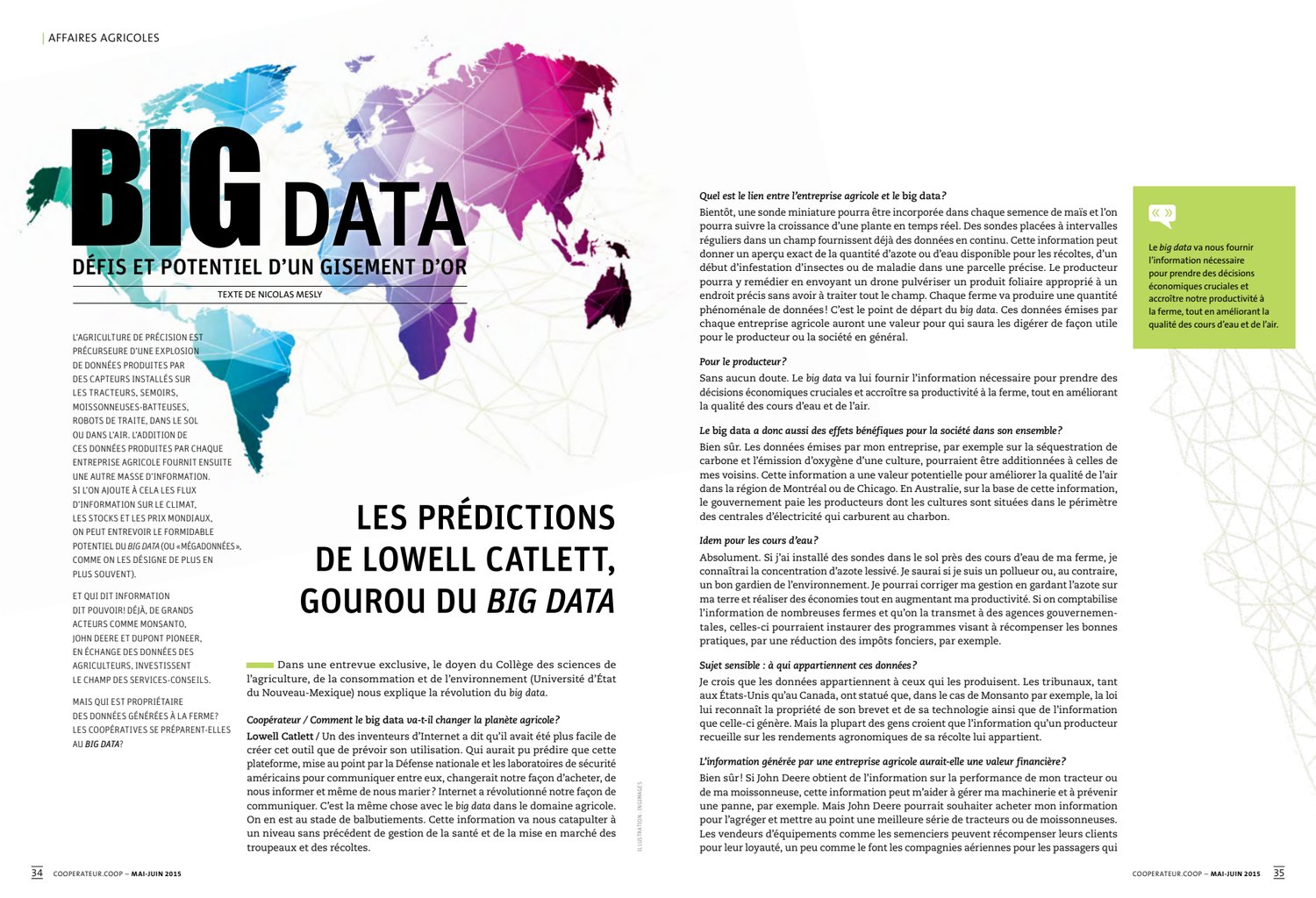
This information will be used to provide us with the information necessary to make crucial economic decisions and increase our productivity on the farm, while improving the quality of the streams and air. ILLUSTRATION: BIG DATA INGIGES CHALLENGES AND POTENTIEL OF A PRECISION GROWING INDICATORS, INSTALLED IN TRACTORS, SEMOIRS, MOISSONOUS-BATTERS, ROBOTS, IN SOLOR OR IN L-AIR.
If the information on climat, stoCKS AND global prices is added to this, the POTENTIEL FORM OF THE DATA BIG (or "MEGADONNATED" ), as they are more and more marked, and which is meant to be able to! Already, great actors such as MONSANTO, JOHN DEERE AND DUPANT PIONEER, in exchange for the data of the agro-ulturists, are invesiring the CHAMP OF THE CO-CONSEIL SERVICES.
BUT WHO IS PROPERTARY OF THE DATA GENDERED TO THE FERM? DO THE COOPERATIVES PREPARE TO THE BIG DATA? TEXT OF NICOLAS MESLY
This exchange of services is a completely new and yet to be cleared. Don't you worry that the real-time crop status information sent by thousands of combine harvesters will not allow a company or a mutual fund to speculate on the commodity market, well before the US Department of Agriculture (USDA) or Agriculture Canada reports are published? You need to have safeguards to prevent the use of this data for speculative purposes.
Whether Monsanto or John Deere has access to this information, it will never be local. There are plenty of green harvesters, but also red and blue ones. Perhaps a company could influence a local market. But the positions of the major players in the Chicago or Winnipeg Stock Exchanges are extremely monitored.
And our market regulators would quickly detect non-Catholic behaviour. Does big data sound like the end of reports on the commodity market of the USDA or Statistics Canada? For example, in both the United States and Canada, beef prices are no longer determined in public auctions. Beasts no longer trample on the ground, but are sold via video in private transactions.
The information on commodity prices is increasingly coming from the private sector, and organizations in both countries will have to report from big data that will have to have added value to farmers. In my opinion, the big data will allow the federal or provincial governments to develop programs that are useful for the protection of streams, air and ecosystems associated with food production. And to pay producers based on their ecological services.
Another concern of the producers is data security – the arrival of a new Edward Snowden... I don't know how to prevent data hacking. Before the appearance of credit cards, no one thought of identity theft. Companies that will be able to protect your data and identity will certainly make crazy money. The French CO-OPERATIVE GROUP INVIVO LANCES IN THE BIG DATA Big data is at the heart of the strategy of the InVivo agricultural cooperative group, which intends to double its turnover to increase it from CAD 8.5 billion to CAD 17 billion by 2025.
InVivo has the ambition to become the European big data champion by merging data from its 223 member cooperatives (300,000 farmers). The group plans to invest between CA$14 and 42 million in the search for programs and applications within three to five years, reports Les Échos. The major agricultural powers, such as France and the United States, are working on precision agriculture, which allows for the correct doses of fertilizer and pesticides to be applied or the crops to be irrigated at the right time.
Thanks to satellite observation and data from tiny probes installed on combine harvesters, tractors or sowing machines, farmers can now manage their business in real time using an app installed on their smartphone. If we add to this the analysis of climate, stocks and world prices, we can see the tremendous potential of big data."For the moment, big data looks like pea soup in which it is difficult to isolate useful information," warns Nicolas Tremblay, a researcher at Saint-Jean-sur-Richelieu d'Agriculture and Agri-Food Canada.
Big data is such that it is difficult to find units to weigh this mass of virtual information. The enormous challenge is precisely to digest big data to make it useful to the farmer, says the researcher, a specialist in crop governance and nutrition. According to him, it is relatively easy to calculate the optimum fuel consumption rate of a tractor taking into account the speed, weight of towed gear and type of soil. But it is different when you want to apply the optimal dose of nitrogen, for example, at the right time and place.
"We fall into a complex biological system," he says. "It involves a process of mineralization of nitrogen in the soil, leaching, evaporation, which contributes to GHG emissions, depending on temperature and sunlight."So, fertilizer guideline maps cannot be based on yields of one or two years alone, but should include seasonal data collected over a long period of time, as recommended rates will vary depending on a dry or rainy season.
But the arrival of Lilliputian sensors, inserted into each seed of corn or soybean, will not allow us to monitor the water or fertilizer needs of each plant? And the marriage of meteorological data with the real-time agronomic data will not allow magic to operate? But in practice, I predict that it is not tomorrow the day before that we will reach such a degree of precision of recommendations," says Nicolas Tremblay. According to the researcher, the producers should not be dazzled by the techno gadgets put on the market with the arrival of precision agriculture.
"It's not about determining which is the best chlorophyll sensor, but putting your finger on the real problem."The risk, he believes, is to make a mistake about recommending, for example, applying a double dose of nitrogen in a part of a field, while it is another that should benefit from it. Elected in July 2014 as president of the International Society of Precision Agriculture (ISPA), Nicolas Tremblay believes that science will allow us to look critically at technology and its promises.
L-ISPA brings together scientists from 34 countries and aims to establish a scientific assessment protocol in several areas of precision agriculture."There are no ten ways to make soil sampling maps for fertilizer application recommendations, there are one or two. The rest is a frime!" the expert says. As a true knowledge hub, ISPA intends to act as a barometer for practitioners to issue science-based recommendations.
The experts from MAPAQ, CRAAQ and the private sector, as well as farmers, will be able to drink it," he concludes. BÉMOL ON THE BIG DATA "For the moment, big data is like a pea soup in which it is difficult to isolate useful information." – Nicolas Tremblay The transmission of data from my farm to a big data aggregator – seeder, coop, machinery manufacturer or government – must generate a surplus value for my business. It must be a win-win situation! PHOTOS: NICOLAS MESLY
This former sheep farmer at the semi-retirement is still growing cotton, wheat and corn. Created in 2012, the GiSC aims to serve as a unique counter to collect, store, communicate and monetize producer data."The era of the small notebook where notes are taken is over. Although the average age of American producers is 54 years, they travel with smart phones or an iPad to manage their farms or ranches," continues Hukill, former president of the Texas wing of the powerful American Farm Bureau Federation.
The company is working to ensure that data is owned and used by American farmers, grain producers and farmers, and that it is able to benefit from it. GiSC has recently developed and patented a new platform for managing data from its members, l'AgProX. This platform will allow data to be stored in a private cloud, a virtual safe where "only the producer is allowed to give a third party access to its data, such as his insurance agent harvests or a seller," says Billy Tiller, director of development at GiSC and himself a cotton producer.
The platform will be functional in mid-summer 2015. Could the GiSC be safe from a hacker like Edward Snowden? Among the concerns raised by the American Farm Bureau Federation is the hacking of data by environmentally-friendly groups that are not friendly to farmers. Or the risk of losing control of the company due to theft of data from my farm, my neighbours' farms or those of the region, which would give thieves a competitive advantage.
"The security of our members' data is our priority," says Billy Tiller. "Dewey Hukill says that the member producers will take many benefits from the AgProX platform as a one-stop shop to deal with agro-industrial and other companies."We also hope that with the cooperative we will be able to generate our own data analyses, for example on production costs or livestock prices, to be on the same footing as the major players," he says. "GiSC currently has 1,000 members in 31 US states, whose size varies from 2000 to 40,000 hectares.
There is an interest on the Canadian side," continues Billy Tiller. GiSC's goal is to have 20,000 members within a year and, in the medium term, to form the Big Data Management Co-operative in North America. MONSANTO, JOHN DEERE AND COMPANY COME YOUR WELFARE Thanks to big data, the agricultural giants are investing in the field of advisory services. Monsanto is the first, without surprise.
By purchasing precision agriculture equipment Precision Planting in 2012, then Climate Corporation, a company specialized in the collection and analysis of climate data, in 2013, the latter at a cost of nearly US$1 billion, the US Goliath sees far. Using the data provided by producers regarding their land, crops and machinery, and combining them with high-level information on temperature and climate, Monsanto will be able to make recommendations for real-time seedling or application of nitrogen or fungicides and unrivalled accuracy.
"In 2014, our priority is to establish a database to validate our technology platform," explained Monsanto's shareholders David Friedberg, CEO of Climate Corporation. "In 2015, approximately 12 million hectares (30 million acres) were included in the Climate Basic program's service offer. But the company's target area is 20 million hectares in 2015, which represents almost one third of the area seeded in corn and soybeans in the United States. Thanks to the combination of computer science, biology and information, Monsanto sees a potential market of US$20 billion.
The US companies John Deere and DuPont Pioneer, as well as the Cana - dienne Viterra (formed from the three former Western Canadian pools and acquired by the Swiss Glencore for a cost of $6.1 billion in 2013), are also relying on big data. A pioneer in the field in the country, Farm Credit Canada (FAC) created the software "Com - Merci Field Manager" at McCain's request. "It wanted to do fine-tuning analyses of the yields of its 500 potato producers, depending on the varieties planted in a given region, and have a traceability tool from the farm to its main customer, McDonalds," says Matthew Van Dijk, FCC's business software software specialist for management software.
Big data may revolutionize not only the farming profession, but also the agronomist profession, as well as the advisory services and their sources. For more information: www.gisc.coop PHOTOS: NICOLAS MESLY The yield cards allow producers to refine their field management by choosing cultivars based on the potential of the land and applying variable rate inputs. Very soon they will be able to manage their entire business from a tablet or smart phone.
Today we have to process the information to provide it with added value to help the producer become more competitive," explains Sébastien Léveillé, Vice President of Agriculture, at the half-day reflection on the theme "Digital: What if tomorrow begins now?" The event was organized as part of the annual general meeting of La Coop fedérée on February 25th. The phenomenal sources of information generated by industry, cooperatives and farms will redefine the La Coop network of tomorrow.
And companies that will not take the digital turn are condemned," explains Louis Duchesne, vice-president and general manager of the Québec office in Cossette, one of the four speakers who came to inform the 400 participants during this reflection. Kodak, who turned his back on the arrival of digital photography, or Blockbuster – and its 8,000 stores (500 million dollars in turnover) – who did not see the rental of online films coming, disappeared from the commercial landscape in three years. On the other hand, La Presse+, broadcast on digital tablet after $40 million in investment in 2013, won its bold bet, to become a leader in information. 17-year-old girl whose parents did not know she was pregnant.
The use of big data will raise ethical questions, according to the speaker. According to Sébastien Léveillé, the big data will enable La Coop fedérée and its network to express the cooperative advantage to its full potential, especially to the succession. Appropriate advisory services and the creation of digital tools are at the heart of the company's strategy to serve growing farms and connected owners, a heavy trend. It is in this context that the agricultural vice president plans to make a visit to the French cousins d'InVivo in May.
KNOWS A EXPLOSION OF NUMERICAL DATA Even though 76% of Canadian agri-coles producers own smart phones, and almost as much electronic tablets, "in marketing, African producers are far more advanced than you," says Estelle Métayer, another speaker who sells their grain and buys their fertilizers and other inputs through their cell phone. According to the expert, digital technology encourages companies to develop a quantity of farm-based management applications.
In pig production, for example, the insertion of a chip into a piglet allows us to know whether the animal is fever-free and thus to control the outbreak of disease in the herd. The day is not far away, she predicts, where a producer could use colonies of drones to fertilize his crops. "Before being there, we may have to wonder about how we produce," a producer blows up in the room. Big data analysis allows companies to target customers' needs and even guess what these needs are.
"The Target channel was able to target its clients of pregnant women before they became pregnant!" continues Estelle Métayer. The company analysed the purchases of its clients by quarter, and was able to note, for example, the substitution of a perfume purchase by that of odourless creams or the purchase of cotton clothing, products considered better for the health of the babies. Based on this information, Target sent advertisements of strollers to these customers. The hiccup also sent to a young PHOTOS: THE FEDERED COOP, ISTOCK PHOTO Sébastien Léveillé, Vice President of Agriculture, during the half-day of reflection organized by La Coop fedéré, and whose theme was "The digital: What if tomorrow begins now?"
Complete original publication
The complete facsimile presents the publication in its original editorial design.
Open original PDF ↗