The complete story
No, it is not a third referendum, but it is a question of sovereignty, food this time, because the bucolic campaign is occulting an unprecedented drama. According to a recent study, more than half of Quebec's agricultural producers and producers are experiencing a high psychological distress (50.9%), more than twice as much as the rate found in the Quebec population (20.1%).
And suicidal ideas are growing more in the head of Quebec's agricultural SMEs than in the rest of society, in the midst of a great deal of age! Québec already has two sad national records, the one of the highest suicide rate. Moreover, its farmers are taking life away more than anywhere else in the country!
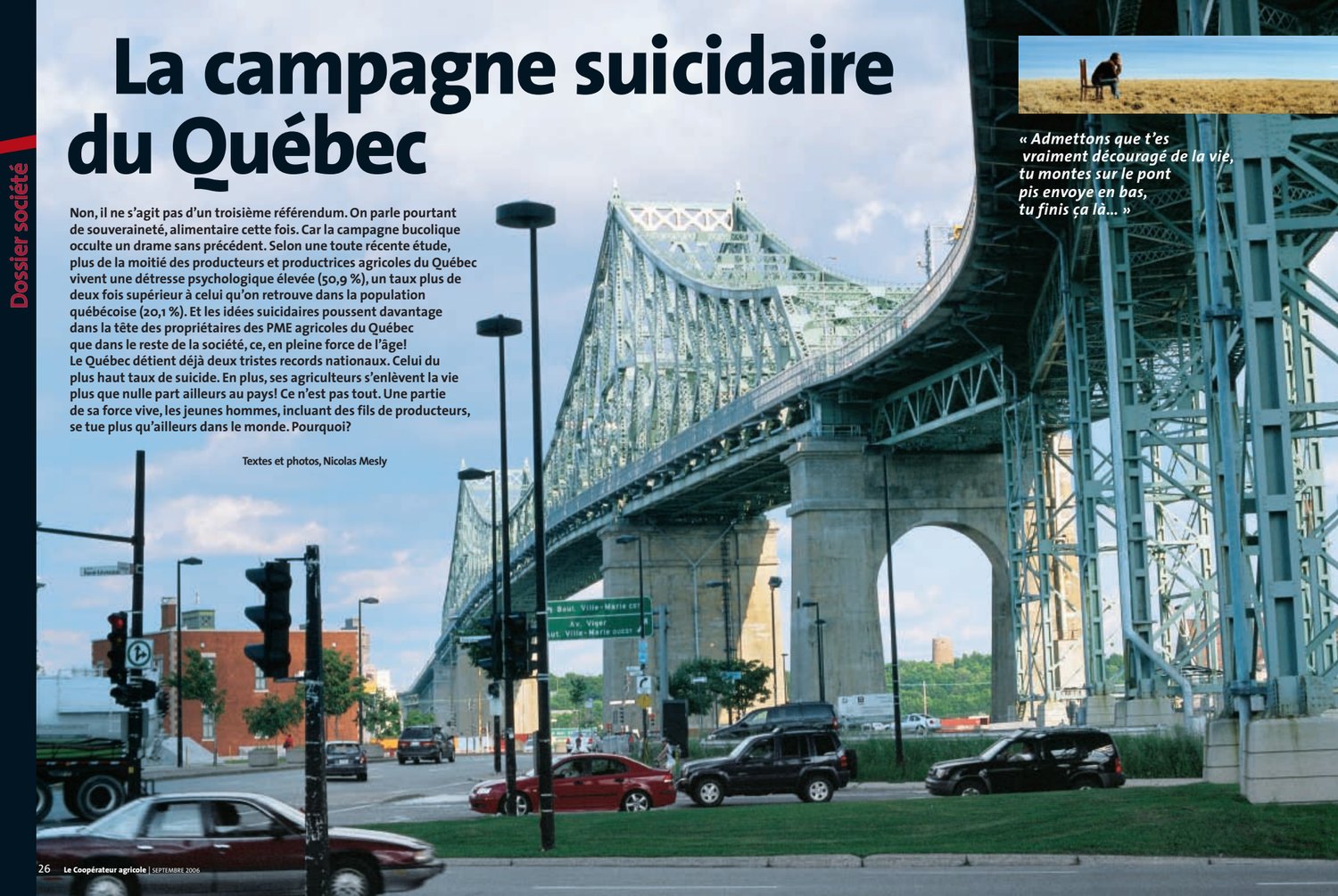
Part of her strength, young men, including sons of producers, are killing herself more than anywhere else in the world. Why? 26 Le Coopérateur agricole , SEPTEMBER 2006 The suicide campaign of Quebec "Let's admit that you are really discouraged from life, you climb on the bridge sent to the bottom, you finish that there..." Texts and photos, Nicolas Mesly Company fileFile 28 Le Coopérateur agricole , SEPTEMBER 2006 A variety of stressors, among the 20 listed by the researcher, also gravitates the health of Quebec producers: environmental obligations, animal diseases, obligation to succeed, etc.
The stress, the study reveals, is less important for young people who start their careers and the older ones who approach retirement. But the stress level is rising for the 35-54 age groups. And more than three-quarters of these producers are regularly stressed half the time to almost always. I've been so tight in the last few years that they've used about 3/8 inch," wrote another producer to the researcher.
Almost 40% of producers surveyed suffer from severe back pain, difficulty finding sleep or very poor digests."The more an individual is affected by a high frequency of stress, the more likely he is to experience physical symptoms," says Lafleur. "The morale on land The high level of distress affects producers at the top of their career, regardless of the Quebec region. However, the distress of producers has not the same source.
The supply management system, which is in place in the 1970s, allows farmers to receive a guaranteed price in return for a supply of quality products year-round, while farmers whose products compete on the world market (pork, beef, field crops) "have already been fighting the battle for the lowest price."
While the liberalization of world agricultural trade, as promoted by the WTO, is a win-win event, it is also a loser. It is pointed out by several agricultural organizations of the 149 countries participating in the exercise as a major responsible for the peasant disarray. Following the last WTO meeting in Hong Kong in December 2005 and the ensuing negotiations in Geneva, the President of the Union des producteurs agricoles du Québec (UPA) and Vice-President of the Canadian Federation of Agriculture (CFA), Laurent Pellerin, even recommends that the Canadian government withdraw the agricultural sector from negotiations to protect the gains.
He also suggested that the country should have a Canadian Farm Bill to compete with the ultra-subsidized American and European commodities that had been sold on the world market. Korean peasant Lee Kyung-hae, for his part, described the WTO process as "waves that destroy our beautiful rural communities," before committing suicide at the 2003 Cancun ministerial meeting, which had failed. According to Lafleur's study, 48.1% of Quebec milk producers are in a state of high distress. In addition to their financial situation, they are then concerned about the weather and then overwork that is ampling their social lives, the insecurity caused by WTO negotiations and the succession and transfer of the farm.
Poultry producers are also concerned about WTO negotiations; 36.4% of them live with high psychological distress. They are no longer farmers, they were dropped before losing their heads!" Ginette Lafleur, PhD in Psychology at the UQAM Centre for Suicide and Euthanasia Research and Intervention (CRISE), did not expect to receive nearly half of the questionnaires from her survey on the psychological health of agricultural producers who had been blackened with comments.
And no question, in this environment, even whispering with help. "Let's admit that you are really discouraged from life, you climb on the bridge and send it down, you finish it there...", let's loose one of them. Crazy cow crisis, avian flu, World Trade Organization (WTO), performance, the farmer modeling no longer takes to subsidise to the needs of his family, his village or the town v ioisine, but to those of the global village. Managing an iron me, moreover, has nothing to do with what the oprio d'a textile company is experiencing.
The man has been working with animals, plants, and he defends a family-owned path omen for four or five generations. An alarm signal had already been given on the number of suicides in the Quebec countryside. In a striking report, La dédimie des producteurs, evoking the suicide of a young beef farmer and television broadcast on the Canadian Broadcasting Corporation in November 2004, all the producers interviewed said they knew someone who had gone to the irremediable act.
It was this report that triggered the CRISE student's survey, La santé psychologique des producteurs agricoles du Québec, published in June 2006 and carried out at the initiative of La Coop fedérée among members of her network. "The path to suicide is through stress and distress. We wanted to scientifically measure these two stages," explains Ginette Lafleur, co-author of the study with Marie-Alexia Allard, who surveyed the spirit of 1338 milk, pork and poultry producers using a questionnaire in December 2005 and January 2006.
The researcher also met with four groups of field crop producers. Once a bond of trust had been established, the taboo subject of suicide was addressed with the lips. In a group of five farmers, three of them had a son, an employee, a neighbour who had gone through the act. Feeding the world: a stressful job Two basic ingredients are Quebec farmers' stress cocktail: the decline in income and the increase in spending.
These two "stressors" directly affect the financial health of the company, and are also the main concern of Canadian producers, according to a 2005 survey by the Canadian Agricultural Security Association (CSA), a single "mad cow", discovered on a Alberta farm in 2003, has caused an unprecedented agricultural income crisis in Canadian history since the "Dust Bowl" in 1929, a cumulative of drought years that sprayed the Prairies of wheat in the field of dust.
The Canadian producers have the highest agricultural debt in history, and in the middle they are the most indebted in the country. Company file N" Ginette Lafleur The phenomenon of high psychological distress is not unique in Quebec and Canada, but global. Is the current model of agricultural production encouraged by globalization partly responsible?
This is the question the researcher intends to explore. SEPTEMBER 2006 file The Agricultural Co-operator 29 On the recommendation of the Quebec Chief Coroner, Jacques Cartier Bridges and Champlain Incorporated, a federal entity, built an anti-suicide fence on the Jacques Cartier Bridge in 2004 at a cost of $2 million. In 2005, authorities report that suicide attempts and suicides have decreased by 80%. Is this the best way to counter the evil of living?
"Stress has taken my spouse away in fact." Source of stress (billions of dollars) Net farm income of Canadian farmers (billions of dollars) 0 10 1980 19 85 1990 1995 2000 2005 ,3 3.7 51.0 4.1 Total debt of Canadian farmers (billions of dollars) Source: Statistics Canada PHOTO: FEDERED COOP SEPTEMBER 2006
"If you were to lower your salary every year, would you be moral?" she said. "Do you think that it would be a good thing to do that?" she asked during her meetings with focus groups. "Because of their precarious financial situation, many grain farmers did not know if they could sow this year, and one of them even had "flying his seeds in his barn." Unlike any other economic sector and even other agricultural production, grain farmers run "an open-air plant" and the influence of weather on yields is a significant stressor," says Lafleur. "The price of corn is the same as it was thirty years ago.
The illegal cultivation of cannabis in corn fields gives a good deal of frustration. The invasion of land by mariculturers is a source of insecurity and loss of quality of life. The general impression, Lafleur reports, is that "these illegal producers are leading a great life course without being worried by the tax authorities." Quebec, the Royal Canadian Mounted Police (RCMP), is the country's leading producer of field-grown pots.
Contrary to what a large segment of public opinion thinks, agricultural producers are not anti-environment, Lafleur says. "They feel that they are being hit more on their heads than other sectors of society, including the ordinary city dweller. Moreover, when you are on the global market and your higher environmental standards translate into costs that your competitors don't have, it makes you sweat!" The "phenomenal" amount of paperwork to fill to comply with environmental regulations is considered "disheartening."
According to Pierre Rhéaume, consultant and coordinator of the psychological distress campaign at UPA, agricultural producers have recently invested $136 million, partly with government support, to meet new green demands. Several producers question their profession, according to Lafleur. "What will be be left to our children, a gift from Greek?" they ask themselves. Some are instead advising their offspring to study in another field and to find a job of five days a week to live "a normal life with holidays."
"I never really explained why Quebec farmers commit suicide more than in all other provinces in Canada. I never explained why this rate is higher than in the rest of the population. The answer is in your communities," says Dr. William Pickett, a native of Ontario, author of the only study on suicide among Canadian farmers conducted on behalf of Health Canada covering the years 1971-1987.
"The suicide rate tends to rise in times of economic crisis. Even if my study dates, it could be expected that this problem will still be very important because of the current context of Canadian agriculture."For its part, the Institut national de santé publique du Québec does not compile data on suicides by occupation. So it is impossible to know how many farmers are taking their lives.
One in four men who died at the age of 45 died because of suicide, which ranked Quebec among the first 15-20 "country" of this sad leading platoon. Pierre Rhéaume, coordinator of the information campaign on psychological distress at the UPA. It was an internal survey of tax and accounting officers of the UPA "who met more than 20,000 farmers and farmers a year" who had listened to the psychological distress of union members.
Pig producers: black sheep in Quebec agriculture However, two thirds of pork farmers (66.6%) are in high psychological distress, "a case of public health," says Lafleur. Declining pork prices and diseases are the primary stressors for these producers, followed by increased spending and environmental constraints. These producers are twice as many as feel no solidarity with their rural community, and more than one third of them feel that their work is not recognized by society.
"We are being paid badly, considered gross people," wrote one of them to the researcher. "A raise in the price of pork would ease the anxiety of this group of producers," says Lafleur, "but is the industry able to meet these expectations?" Olymel, a subsidiary of the federal and largest Canadian pork coop, hit hard by the rise in the Canadian dollar, has lost more than $150 million over the past three years. The company, like the manufacturing sector, has had to close three slaughterhouses and lay off 350 workers in the Belle Province.
The agreement between the Fédération des producteurs de porcines du Québec and the Quebec processor to market an animal that meets the competition and needs of international markets is a life-sustaining development. Several experts predicted that without this agreement, it was the end of beans."I think that the life of a farmer is in danger. Try to give us a fair price for pork..."
Company fileSynthesis Encan on the farm: Quebec loses on average three farms per day . Number of Canadian farms, 1961-2001 (in thousands) Source: Statistics Canada 1961 1966 1971 1976 1981 1986 1991 1996 2001 481 247 "My psychological health has improved much since August 2004, when I sold my cows and quota!" High level of psychological distress by production (%) Production 70% 48.1 66.6 36.4 Milk Milk Milk Milk Milk Source: Survey of the psychological health of Quebec agricultural producers, Ginette Lafleur, Marie-Alexia Allard, June 2006.
N 30 Agricultural Co-operators - SEPTEMBER 2006 PHOTO: GRACIEOUSTY PIERRE HRÉAUME 1976-1978 1977-1979 1978-1980 1979-1981 1980-1982 1981-1983 1982-1984 1983-1985 1984-1986 1985-1987 1986-1988 1987-1989 1988-1990 1989-1991 1990-1992 1991-1993 1992-1994 1993-1995 1994-1996 1995-1997 1996-1998 1997-1999 1998-2000 1999-2001 ,8 30.7 16.1 19.0 Adjusted suicide mortality rates for men 1976-1978 to 1999-2001 Quebec and the rest of Canada Source: MSSS, Quebec Deaths File and Statistics Canada data, calculations at INSPQ, March 2004.
Rates per 100,000 men "The ratios are completely reversed. Fifteen years ago, there were about 1,400 men dying of road accidents, compared to 700 to 800 who committed suicide. Today, it is the opposite!" explains Louis Lemay, general manager of the Association québécoise de prévention du suicide du Québec (AQPS). According to the 2004 data of the Institut de la statistique du Québec, suicide is the leading cause of mortality among men aged 20 to 39 years, before the ravages caused by different types of cancer and infarction.
After 40 years, suicide is the second leading cause of death. In the 15-19 age group, suicide is the second leading cause after motor vehicle accidents. A reflection of society, we find, in this blackboard, sons of farmers. "We have a stratology to fight suicide since 1998, but it is very shy and today inoperative!
The Charest government is planning to update all of this in 2010. One in three people is directly or indirectly affected by this phenomenon. It is hoped that the government will commit itself well before, in 2007, by using the population. We have received about 40 emails.
But we don't have the budgets of the Société de l'assurance automobile du Québec (SAAQ) to advertise our products," added Louis Lemay, whose only awareness budget, which is dedicated to Suicide Prevention Week, is $40,000. "The cost of the SAAQ's planned 2006 alcohol and speed prevention radio and television advertising campaigns is $1.9 million."If you have a cancer tumor, you're removed. If you break a leg, you're fixed up and, before you leave the hospital, you have an appointment with a physio.
But we don't give the money to fix the soul!" says Brigitte Lavoie, former director of the Montreal Suicide Prevention Centre, who left the intervention environment completely disillusioned. "Agriculture, a world apart? There is a suicide prevention emergency line in Quebec, 1 866 277-3553, open 24 hours a day. But, says Maria Labrecque Duchesneau, a pioneer in providing psychological support services to producers, "to tell a farmer that he must be prescribed two weeks of holidays by his doctor during haytime, it's not about the agricultural reality!", says the founder of the organization At the heart of agricultural families, located in Montérégie.
Today, farms are small businesses worth several million dollars, where every operation, especially seed and crops in the fields, is a race against time. "It may not have been a good call, but our people are trained to connect people who commit suicide throughout life," says Louis Lemay. "However, the demand for the profession by the speaker to his interlocutor in distress is not a systematic part of the intervention protocol, "it is primarily a question of establishing a bond of trust."
Two provinces, the M anitoba and the S askatchewan, have a special emergency line for farmers. The most populous of the provinces has just cut off the farmers' lives at the Farmers Help Line Ontario. "The Ontario Agriculture and Science departments are sending the ball back about a $18,000 grant," says Denis St-Pierre, president of the organization, who says they receive two or three distress calls daily. The remaining administrative costs are borne by agricultural associations and the organization is using volunteers.
St-Pierre's needs would be $200,000, and Saskatchewan and Manitoba's Agriculture departments would invest $400,000 and $300,000 annually in such a service. There is no such provincial emergency telephone line for farmers in the east of the country."Our survey found that this type of service would not meet the needs of Quebec producers, who would prefer to have time to have coffee between them in the village or to shove on the fence to chat with the neighbour.
But farms have grown so much that it is more possible. They would also like to benefit from services such as replacing work on the farm to take leave," says Ginette Lafleur. "PHOTO: THE FEDERAL COOP Between the path of stress to distress, social support or the ear of a confidant is extremely important to "stop rubbing black ideas" that can lead to irreparable. Other psychological support organizations start to push in the area to break isolation and loneliness.
"Like street workers, we want to develop the concept of row workers, with people who are very familiar with the environment, like retired producers," says Chantale Doyon, coordinator of Agri-Ressources, located in Plessisville, in the Bois-Francs. "However, before we can prevent the suicide of a farmer, we will have to change the image of weakness associated with the demand for help, because producers do not even consult for physical problems."
The recent study by Ms. Lafleur and Ms. Allard does not directly measure the impact of the stress caused by money issues on the life of couples and families. More than half of the approximately 31,000 Quebec farms are incorporated into companies or companies where the family noun operates 7 days a week, 365 days a year. "The rise in debt and financial difficulties refer to our couple, which is still increasing our stress level. I think it's common in the profession," one of them writes.
In addition to economic and social pressures, the researcher agrees that a difficult personal or family situation is part of a chain reaction that can lead to suicide. Give us oxygen! Ms. Lafleur thinks that farmers, who now represent less than 2% of the population of Quebec, need an oxygen mask. Would society lose a lot if it amputated the hand that feeds it?
"Quebec society may not have suffered enough hunger to ask itself this question. Consumers do not question the origin or how their food is produced. Moreover, our recent governments have evacuated any notion of food sovereignty. They have never assessed the social, psychological and political costs if we were to make a decision to a point of non-relationship in agriculture."
A farmer of the year in 2003, who won the 2004 Agricultural Merit Gold Medal, she underwent a series of personal bursting events, including the death of her spouse and father in 2005. This former social worker had the reflex to jump into her truck to go and get psychological help in a CLSC "before she crashes." "When a producer no longer marvels at his fields, which grow in front of his passionate cows, the good smell of autumn, that everything is black, it's a signal of alarm!"
"The most dangerous candidates for suicide are those who don't speak!" said an anonymous producer whose son committed suicide ten years ago. Maria LabrecqueDuschesneau, founder of the organization At the heart of agricultural families, wants to organize a provincial symposium on psychological distress on February 1, 2007. Company file 32 The Agricultural Co-operators - SEPTEMBER 2006 PHOTO: DOMINIQUE GRAVEL COMUNIMAGE PHOTO: GUYLAINE GAGNO Calqué au image des travailleurs de rues, Chantale Doyon, coordinator of Agri-Ressources, intends to develop a network of workers of ranks composed of retired farmers in the MRC de l'Érable, of which 25% of the employment is linked to agriculture.
Gaston Pellerin, president of the UPA's core union in Plessisville, chairs the Agri-Resources Committee. This multidisciplinary committee of nine people, which includes representatives of the Royal Bank and La Coop des Appalaches, can count on the expertise of Louis B. Plourde, the Réseau de Prévention S uicide des Bois-Francs, and also professionals from the Arthabaska-Érable Health and Social Services Centre. Evil de l'soul is not a matter of territory, and Yves Côté, 2nd executive member, Fédération de l'UPA du Centre-Québec also acts as a resource person.
At 26, Frédéric Dubois, the administrator of the Mégantic-Nord Agricultural Feeding Group, sits on the committee."For a producer, his business is his picture. If he goes bankrupt, he says he has not succeeded. Many live for agriculture, while agriculture should make you live.
This is a means, not an end," says the young entrepreneur. Among the proposals developed by Agr iRessources is a first aid kit for the many stakeholders who are working around the farmers. An inaurative veter in the region has brought back an urgent call to go and treat a cow in a producer. After examining the animal and having found nothing, the farmer would have said to him: "It is not my cow that is sick, it is me!"
The organization also wants to target farmers directly to foster discussion on stress management and work-family reconciliation. The founder of the organization At the heart of farm families in Montérégie, Maria LabrecqueDuschesneau, wants to organize a provincial symposium on psychological distress on February 1, 2007. "An awareness-raising exercise" to which representatives of the UPA, community organizations and stakeholders in the health network will be invited. "Each region must develop its prevention network, because the problem is not automatically the same in Abitibi as in Centre-du-Québec."
Company fileSEPTEMBRE 2006: The Agricultural Co-operator 35 Dr Vandana Shiva, Director of the Foundation for Research on Science, Technology and Ecology, describes suicide as more than 40,000 farmers in India as "genocide." India, the second most populous country on the earth, has more than 600 million peasants, and agriculture is the cornerstone of the Asian tiger economy. According to Dr Shiva, this suicide epidemic is "the real barometer of stress" to which Indian agriculture and its peasants are subjected by globalization.
It is said to be the result of the policies imposed on the Indian government for seven years by the WTO and the World Bank to convert Indian peasant agriculture into an industrialized corporate production system."These suicides are the result of debt, and this debt is being caused by rising costs of the production and collapse of food crops, two factors linked to policies to liberalize the trade in this agricultural sector." In May, Dr. Shiva published the fourth version of her report, "Semicide seeds: the ecological and human cost of globalization in agriculture, which targets, among other things, the suicide of Indian cotton producers.
The privatization of the government's public seed distribution and production network, under the trade liberalization regime, has transformed polyculture fields into monoculture and has prompted farmers to use hybrid seeds instead of their ancestral open-pollinated varieties, says Shiva. In Andhra Pradesh State, the change has been very rapid, from a mixed millet, lentils and oilseeds crop to a monoculture of hybrid cotton. In this part of India, the Bt cotton seed varieties produced by Monsanto, which are promoted by the Ministry of Agriculture, have failed to keep their promise of high yields.
The price is 4.5 times higher than normal seeds and the crop requires less pesticides. Affected by a disease, the harvest of GMO cotton has been thin. Indebted producers owe money to local usurers who compensate for the decrease in subsidies. 34 Agricultural Co-operators - SEPTEMBER 2006 The Director of the Research Foundation for Science, Technology and Ecology, Dr. Vandana Shiva, is the author of many books on agriculture. For more information see www.navdanya.org.
Soon, the ranks of the workers! The genocide of Indian farmers PHOTO: THE CANADIAN PRESS In the direction of the clock needles, Chantale Doyon, Louis B. Plourde, Yves Côté and Frédéric Dubois. PHOTO: THE FEDERAL COOP 36 The Agricultural Co-operators WHERE SEPTEMBER 2006 "These hybrid cotton varieties are environmentally very fragile and their yields are intimately related to the use of certain pesticides.
In addition, monoculture planted on a very large area promotes disease development. The best sustainable strategy for disease control and control is to conserve a great biodiversity, not chemical or technological solutions that reduce this diversity and kill farmers more effectively than insects," says Dr Shiva. Since 2000, more than 2,300 cotton growers have taken their lives to escape debt, some of whom have been drinking pesticides.
The American daily The Herald Tribune reports that "ruined iron grops have put signs on the road, offering their village to the most offerer." Other newspapers report the sale of girls to recur the debts. Peasant suicides are not limited to the state of Andhra Pradesh, but also affect other areas such as Punjab, the Indian attic where wheat and rice are produced and where the green revolution in India originated last year. In a submission to the Indian Prime Minister, Shri Manmohan Singh, representatives of many agricultural organizations are calling for India to withdraw from the WTO and, among other things, demand the restoration of full tariffs to protect itself from dumped subsidized imports.
They also call for the introduction of a "fair" minimum price for Indian farmers. "To stop suicide among farmers, you will have to go beyond the compensation of the families who have been victims," the memoir states. The Indian government has set up a commission to investigate the phenomenon. In France, the number of farmers has fallen from 6 million to 700,000 since the end of the Second World War.
The French farmers now have a suicide rate of 83/100,000, higher than the rest of the population of 52/100 000, reports the programme Supplement d'étude televisée sur France 2 in 2006. Producers are said to be victims of their productivity because, if their number has decreased, farms, on the other hand, have grown more in need of neighbours than hectares.
The United States has over 30,000 suicides per year. But these figures are not counted by prevalence, says Chr istine Bergeron of the American Association of Suicide. Americans are therefore unaware of the extent of this phenomenon among their farmers. Company fileOther countries in the world Adjusted suicide mortality rates for men, 1996-1998 International comparison United Kingdom United States Australia France Quebec Rate per 100,000 men 11.5 19.8 23.0 28.2 30.4 Source: Robert Choinière (2003).
Mortality in Quebec: An International Comparison, Quebec, INSPQ, p. 50.
Complete original publication
The complete facsimile presents the publication in its original editorial design.
Open original PDF ↗