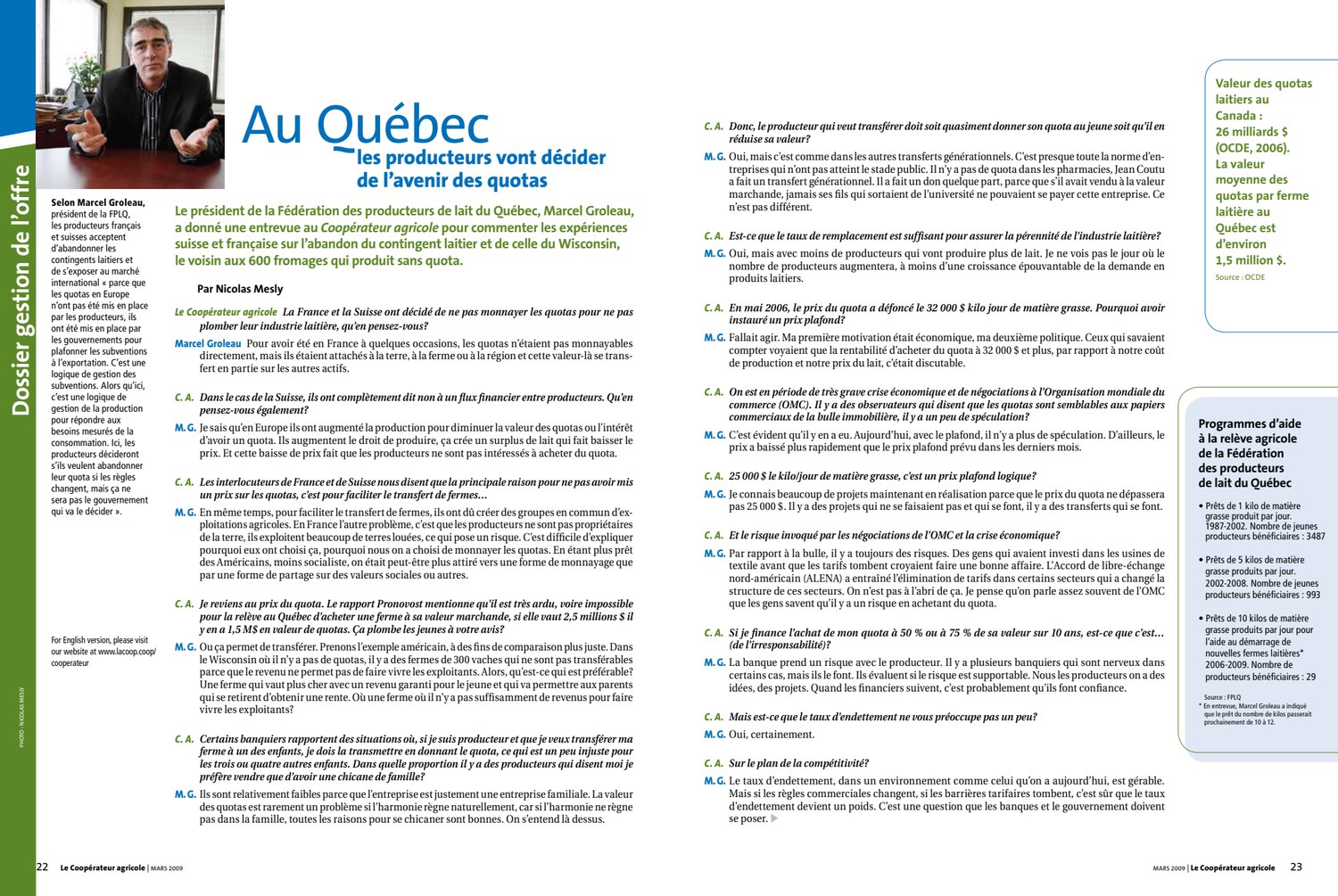
The complete story
22 The Agricultural Co-operator - MARCH 2009 MARCH 2009 - The Agricultural Co-operator 23 Supply Management Record C. So the producer who wants to transfer must either give his quota to the young person or reduce its value? Yes, but it is like in other generational transfers. It is almost the whole standard of companies that have not reached the public stage.
There is no quota in pharmacies, Jean Coutu made a generational transfer. He made a donation somewhere, because if he had sold at market value, never his sons who were out of university could not afford this business. Is the replacement rate enough to ensure the sustainability of the dairy industry? Yes, but with fewer producers who will produce more milk.
I do not see the day when the number of producers will increase unless the demand for dairy products increases dramatically. In May 2006, the quota price went up on $32,000 kilo-day fat. Why did you set a ceiling price? My first motivation was economic, my second policy.
Those who knew how to count saw the profitability of buying a quota at $32,000 or more, relative to our cost of production and milk prices, as questionable. We are in a time of very serious economic crisis and negotiations at the World Trade Organization (WTO). There are observers who say that quotas are similar to the trade papers of the real estate bubble, there is some speculation? It is obvious that there were some.
Today, with the ceiling, there is no more speculation. Besides, the price has fallen faster than the price ceiling expected in the last months. A. $25,000 per kilo/day of fat, is a logical price ceiling? I know a lot of projects now in implementation because the price of the quota will not exceed $25,000.
There are projects that are not being made and that are being made, there are transfers that are being made. And the risk raised by the WTO negotiations and the economic crisis? Compared to the bubble, there are always risks. People who had invested in textile factories before the tariffs fell thought they were doing a good deal.
The North American Free Trade Agreement (NAFTA) has led to the elimination of tariffs in certain sectors that have changed the structure of these sectors. We are not immune to this. I think it is quite often referred to as the WTO that people know that there is a risk when buying quota. If I finance the purchase of my quota at 50% or 75% of its value over 10 years, is it... (irresponsibility)?
The bank takes a risk with the producer. There are several bankers who are nervous in some cases, but they do. They assess whether the risk is bearable. We producers have ideas, projects.
When financiers follow, it's probably that they trust. But don't you have a bit of a concern about the debt rate? In terms of competitiveness? The debt rate, in an environment like the one we have today, is manageable.
But if trade rules change, if tariff barriers fall, it's sure that the debt rate becomes a burden. It's a question banks and the government must ask themselves. u In Quebec The president of the Fédération des producteurs de lait du Québec, Marcel Groleau, gave an interview to the Agricultural Co-operator to comment on the Swiss and French experiences on the abandonment of the dairy quota and that of Wisconsin, the neighbour to the 600 cheeses that produce without quota. the producers will decide on the future of the quotas The Agricultural Co-operator France and Switzerland have decided not to raise quotas to avoid the lead of their dairy industry, what do you think?
Marcel Groleau For having been in France on a few occasions, quotas were not directly transferable, but they were attached to land, farm or region and this value is partly transferred to other assets. In the case of Switzerland, they completely said no to a financial flow between producers. What do you think too? I know that in Europe they increased production to reduce the value of quotas or the interest of having a quota.
They increase the right to produce, it creates a surplus of milk that lowers the price. And this price drop makes producers not interested in buying quota. The interlocutors in France and Switzerland tell us that the main reason for not having put a price on quotas is to facilitate the transfer of farms... Mr. At the same time, to facilitate the transfer of farms, they had to create joint groups of farms.
In France, the other problem is that producers are not owners of the land, they are exploiting a lot of leased land, which poses a risk. It is difficult to explain why they chose this, why we chose to cash the quotas. By being more ready to the Americans, less socialist, we were perhaps more attracted to a form of money rather than to a form of sharing on social or other values. I come back to the price of the quota.
The Pronovost report states that it is very difficult, if not impossible, for the Quebec government to buy a farm at its market value, if it is worth $2.5 million in quota value. That is what makes young people feel? Or it allows us to transfer. Let's take the American example, for a more accurate comparison.
In Wisconsin, where there are no quotas, there are 300 cows farms that are not transferable because income does not allow farmers to live. So, what is better? A farm that is worth more with guaranteed income for the young and that will allow the parents who retire to get an annuity. Where a farm where there is not enough income to support the farmers?
Some bankers report situations where, if I am a producer and want to transfer my farm to one of the children, I have to pass it on by giving the quota, which is a bit unfair for the other three or four children. How much of the producers who say I prefer to sell than have a family chicane? They are relatively weak because the company is just a family business. The value of the quotas is rarely a problem if harmony naturally reigns, because if harmony does not reign in the family, all the reasons for snaging are good.
Photo: NicolaS MeSly According to Marcel Groleau, president of the FPLQ, French and Swiss producers agree to abandon milk quotas and expose themselves to the international market "because quotas in Europe were not set up by producers, they were set up by governments to cap export subsidies. It is a logic of managing subsidies. While here, it is a logic of managing production to meet the measured needs of consumption.
Here, producers will decide whether they want to abandon their quota if the rules change, but it will not be the government that will decide it." By Nicolas Mesly Programs to help the Federation of Quebec Milk Producers to raise their farm • Loans of 1 kilo of fat produced per day. 1987-2002. Number of young producers who are beneficiaries: 3487 • Loans of 5 kilos of fat produced per day. 2002-2008. Number of young producers who are beneficiaries: 993 • Loans of 10 kilos of fat produced per day for aid in the start-up of new dairy farms* 2006-2009.
Number of producers receiving the loan: 29 Source: FPLQ * In interviews, Marcel Groleau indicated that the loan of the number of kilos would soon increase from 10 to 12. Value of dairy quotas in Canada: $26 billion (OECD, 2006). The average value of quotas per dairy farm in Quebec is approximately $1.5 million. Source: ocDe For English version, please visit our website at www.lacoop.coop/cooper 24 Le Coopérateur agricole MARCH 2009 MARCH 2009
The Pronovost report and Caisse Desjardins suggest "be beyond defensive attitude and develop different scenarios for reducing tariff barriers and opening up the internal market." Do you envisage these scenarios? We have studied their impact if that happens. It is certain that we are now able to take a certain percentage of tariff reductions.
We can probably handle this in the short term. In the long term it's going to be difficult. How will it be difficult in the long term? The problem in agriculture is that the weight of the tariff reduction will be carried only on the producers.
Whenever tariffs are lowered, neither the processor nor the scorer reduces their margin. The reduction in margins is always transferred to producers and on the price of the raw material. It is a universal law. If we accept the opening of markets, the Quebec producer will not compete with the least good in the United States, but with the best in the United States.
It is certain, with the size of the companies in the United States, industrialization, the environmental rules - tales that are different here, the climate... Just at home, in my rock land compared to a producer in Saint-Hyacinthe, there is already a difference of 500 thermal units. If we drop the tariff barriers and we are relieving that to the competitiveness of the market, milk production will not increase here, it will decrease. Saputo and others will always be able to obtain dairy ingredients elsewhere at better prices than in Canada because of our production costs.
It makes no sense, since it is less expensive to produce a T-shirt in China, it is less expensive to produce a kilo of skimmed milk powder in Argentina."By capping the quota price at $25,000, the industry has self-regulated because at $30,000-32,000 it was more transferable. Monsters were created when we thought that on an average farm of 51 cows – worth $3 million – half, $1.5 million, is attri - drinkable to the quota," says Yves Mathieu, vice president Agricultural and Agri-Food Markets at Desjardins.
The institution lends to agriculturists up to 50% of the value of the quota over a period of 10 years, a common practice today in the banking community, "but the ideal duration is four to five years," says Le Mouvement des caisses Desjardins is the banker of two farms in three in Quebec. Financing of quotas: i never interest rates rise, it's like houses, there will be bankruptcies!" warns Cyrille Parent, nicknamed the agronomist ban - quier and inducted into the Temple of the Fame of Agriculture in 2007, after a long career at the National Bank, the second largest agricultural lender in the Belle Province.
In retirement for 14 years, Parent sssin - who was a layman of the overbidding of credit in the current context of the most serious economic crisis since the 1929 crisis and the ongoing WTO negotiations."The quota was funded over four years and was worth $2,000 per cow. It rose to $25,000- $30,000 per cow.
"Sometimes farmers say that if quotas fall, I'm out of debt. If your debt value is greater than your collateral value and if I'm in default, I can repatriate my financing because I don't have anything to cover myself," says Raymond Morissette, agronomist and account manager at Royal Bank of Canada (RBC). As a fourth lender in Quebec, RBC extended its loan financing period to 50% of the quota value from 7 to 10 years in 2003-2004, to keep up with competition.
In addition, Vincent Giard, Vice President Operations Québec, Farm Credit Canada (FCC), denies any unfair competition and denies a rumour that the institution lends 100% of the quota value over a period of 20 years. FCC, the third largest financial services player in Quebec, is not a chartered bank, but a crown corporation with a portfolio of services to Canadian farmers and agri-entrepreneurs amounting to $15 billion."There are all kinds of variants in the quota purchase.
If there is only a quota as a guarantee, we will not be able to go beyond 10 years. If it is the big kit, the purchase of cows, quota, equipment, buildings including a manure pit, it may be that the average depreciation exceeds 10 years, but never more than 20 years because it would not be serving the borrower," he adds. "We do not want FCC to give any capital repayment leave on the quota portion. Whether the federal government has a strategy to prepare farmers for a greater opening of the domestic market and a tariff reduction, which could influence the value of the quotas, Jean-Pierre Blackburn replied: "We want to maintain the GO5 and the management of the supply... that is the position of Mr.
Farmers know that they are being defended. Through this, we are around a table, we hope that, at the end, the other countries will actually accept our point of view and respect that principle."The Minister of National Revenue and Minister and State for Agriculture reiterated his unconditional support for the management of the WTO's supply and the principle of "food sovereignty" at a telephone interview on January 29, two days after Liberal leader Michael Ignatieff, endorsing the Conservative bid, allowed Stephen Harper's government to remain in power.
Many dairy producers are investing or tempted to invest at a time when interest rates have been among the lowest in 45 years and the quota price is around $25,000. The word caution is on the lips of all silversmiths."The United States is printing money to boost the economy. When it starts to start again, there will be a recovery in inflation and a sharp rise in interest rates that will hit the agri-cole economy with full force," said Mr.
Giard predicts an increase in interest rates from 3% to 4% in the next 12 to 18 months, and recommends that producers take shelter by setting interest rates over a period of 3 to 10 years and maintain a margin of manoeuvre of at least 3% of their debts to deal with music. No one can predict the future of quotas or the outcome of WTO negotiations by 2009-2019 when the landscape of Quebec dairy companies is polarized. There are large farms and small farms on the one hand and very efficient farms and much less, due to "managerial talent", it is said in the banking community.
For the retired agronomist, Cyrille Parent, sooner or later the economic forces will push Canadian producers to close with those who produce less expensive milk. In this sense, he concludes, "I am not afraid for the survival of agriculture in Quebec." "We finance the quota, but on the day the quota is worth nothing, the agricultural producer is in business the same. It is the same bubble as real estate."
S extreme prudence claims an ex-banker! By Nicolas Mesly According to the retired agronomist banker, Cyrille Parent, in the current context of the worst economic crisis since 1929 and the uncertainty of the outcome of the WTO negotiations, the value of quotas is more speculative than ever as were the commercial papers in the real estate sector. Supply management Number of dairy farms in Quebec (year/number of farms) • 2000: 9193 • 2007: 6822 Source: AGÉCO Group $0 5000 ($) 35,000 $22,433 $25,952 $24,370 $28,339 $28,595 $27,179 $29,094 $30,840 $28,159 $26,521 $24,490 Average milk quota price (kg MG/day) 1999-2008 1999 2000 2001 2002 2003 2004 2005 2006 2007 2008 2009 (January) Photo: KeDl Source: FPLQ
Complete original publication
The complete facsimile presents the publication in its original editorial design.
Open original PDF ↗