The complete story
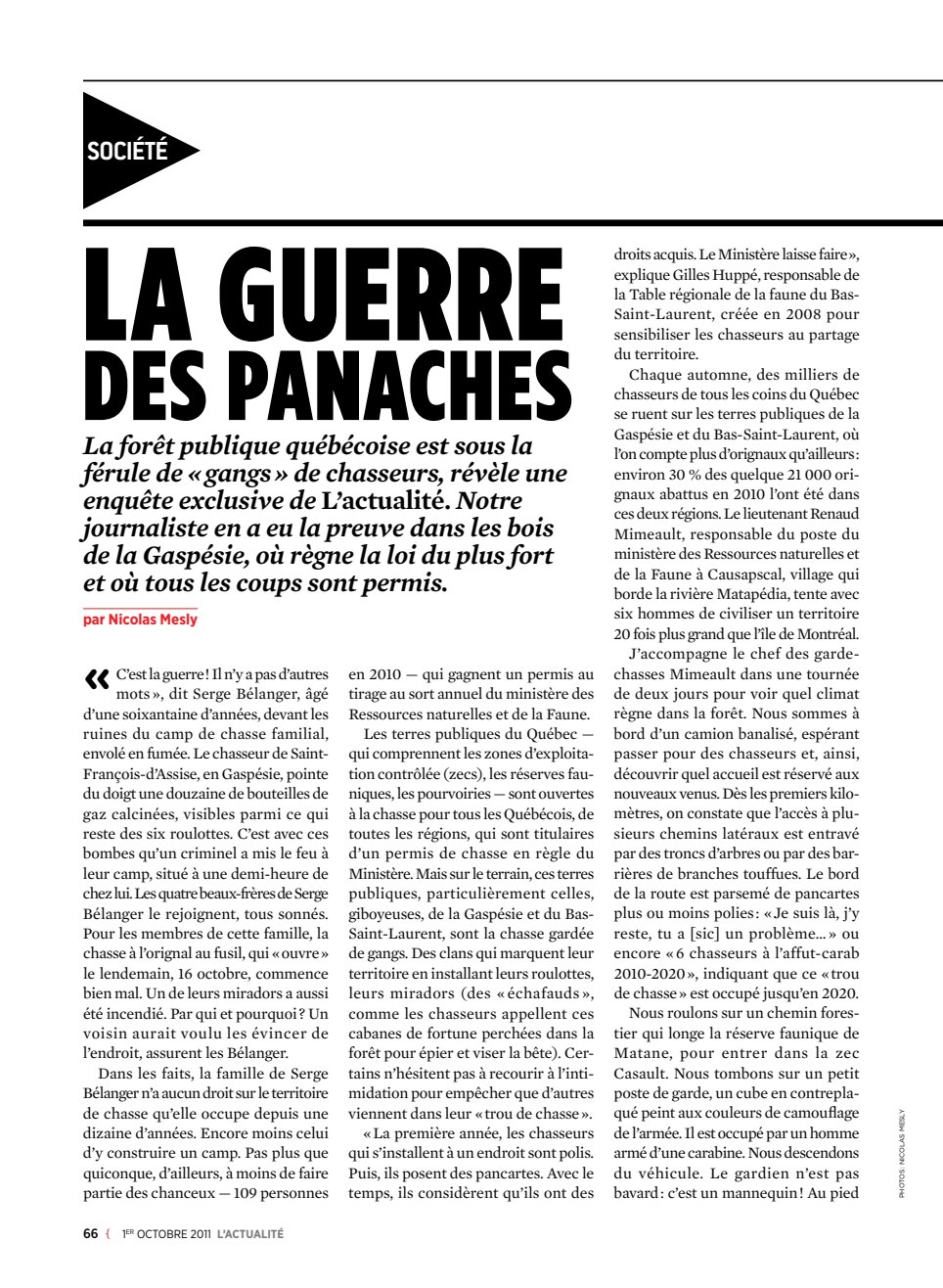
66 { 1st OCTOBER 2011 L-ACTUALITY SOCIETY THE WAR OF THE PANACHES "It's war! There are no other words," says Serge Bélanger, 60 years old, in front of the ruins of the family hunting camp, who is flying in smoke. The hunter of SaintFrançois-d-Assisi, in the Gaspésie, points out a dozen bottles of calcined gas, visible among the remaining six trailers. It is with these bombs that a criminal set fire to their camp, located half an hour from home.
Serge Bélanger's four brothers-in-law joined him, all of them sounded. For the members of this family, the hunting with the rifle, which "opens" the next day, October 16, began badly. One of their miradors was also burned. A neighbour would have wanted to evict them from the place, assured the Bélangers.
In fact, Serge Bélanger's family has no rights in the hunting territory that she has occupied for about ten years. Even less the one to build a camp there. No more than anyone else, unless they are among the lucky — 109 people The Quebec public forest is under the ferrule of hunters' "gangs", reveals an exclusive investigation by Ls. News. Our journalist has had proof of this in the woods of the Gaspésie, where the law of the strongest reigns and where all the blows are allowed. by Nicolas Mesly in 2010 — who won a permit to draw the lot of the Ministry of Natural Resources and Wildlife every year.
The public lands of Quebec — which include the controlled exploitation areas (zecs), wildlife reserves, outfitters — are open to hunting for all Quebecers, from all regions, who hold a hunting permit in good standing by the Ministry. But on the ground, these public lands, especially those, giboyous, from the Gaspésie and Bas-Saint-Laurent, are the guarded gang hunt. Clans that mark their territory by installing their trailers, their miradors (the "scafauds", as hunters call these makeshift huts perched in the forest to spy and target the beast).
Some people are not hesitant about using intimidation to prevent others from coming into their "hunting hole." "In the first year, hunters who settle in one place are polite. Then they put up signs. Over time, they consider that they have acquired rights.
The Department let it happen," explains Gilles Huppé, head of the Regional Wildlife Table of the BasSaint-Laurent, created in 2008 to make hunters bilisating to the sharing of the territory. Every fall, thousands of hunters from all parts of Quebec are on the public lands of the Gaspésie and Lower St. Lawrence, where there are more moose than elsewhere: about 30% of the approximately 21,000 moose slaughtered in 2010 were in these two regions. Lieutenant Renaud Mimeault, head of the Department of Natural Resources and Wildlife in Causapscal, a village bordering the Matapédia River, is attempting with six men to civilize a territory 20 times larger than the island of Montreal.
J--I accompany the head of the Mimeault guardhouses on a two-day tour to see what the weather is in the forest. We are on board a commonized truck, hoping to pass as hunters and thus discover what welcome is reserved for newcomers. From the first kilometers, we find that access to several side roads is hindered by trunks of trees or by barricades of tufted branches. The edge of the road is dotted with more or less polished signs: "I am here, j----------------------------------------------------------------------------------------------------------------------------------------------------------------------------------------------------------------------------------------------------------------------------------------------------------------------------------------------------------------------------------------------------------------
We drive along a forest road along the Matane Wildlife Reserve, to enter the Casault Zec. We fall on a small guard post, a plywood cube painted in the camouflage colors of the army. It is occupied by a man armed with a rifle. We descend from the vehicle.
The goalkeeper is not talkative: he is a model! At foot PHOTOS: NICOLAS MESL Y LHOST 1st OCTOBER 2011 } 67 of the healer runs a red ribbon, which was probably used to block the way. We go up in the truck and continue our road. At about 100 meters in front, a hunter crashes in the middle of the road, forcing us to stop.
The man, a strong man, is not armed, but he shoots us from the look. I lower the ice and he approaches. He quickly made to identify my companion hunting guard. It must be said that Renaud Mimeault, tall, square shoulders, silver hair cut into a brush, does not go unnoticed.
He occupies the entire seat of the driver. And difficult not to notice the shield of the Ministry of Natural Resources and Wildlife sewn on the right shoulder of his jacket: a head of moose woven under the motto "Protect, educate, prevent". The man across the path presents himself as a police officer of the informed of our identity by radio. Then, in the cul-de-sac of a forest road, we are entitled to another ice reception: "What are you doing here?" asks the hunter, rifle in shoulder, in an unequivocal tone.
He too quickly recognizes Lieutenant Mimeault, and the tension is falling again by several crans. This time we learn that we are in the territory of the Pelletiers. Later on the phone, Gilles Lavoie, the former police officer at the head of the group of hunters, refuses to want to appropriate the territory by installing a healer.
"These are warning measures for other hunters to avoid an accident caused by a lost bullet," he says. Gilles Lavoie admits, however, that he would be angry at hunters who land tourists and grab caches already in place. "Find yourself a retired Quebec Security Hole. When we ask him if he would let us pass if we were hunters, he replied, "What do you want me to do?"
Okay, he couldn't have stopped us from passing through, but would hunters have been welcome? His "no" is categorical. Why did you install a model?
"To prevent people from coming here." It's against the law," said the gamekeeper. "I'm just putting on a ribbon." The man tells us that he's part of the clan of Gilles Lavoie, a former SQ policeman too.
He adds that, further on, there is a group of 8, then another of 12, the Lemieux "gang". We leave him by wishing him good hunting. Ten minutes later, we pass in front of amirador. The hunter does not leave his perch, probably Posters and obstacles on the paths discourage hunters from entering "reserved" areas.
Here: An illegal hunting camp. Below: The supreme trophy. PHOTOS: NICOLAS MESL Y 68 { 1st OCTOBER 2011 L-ACTUALITY THE WAR OF THE PANACHES. Eat by the sailors, then tear the skin by the branches, too!"
The conscientious hunters, he says, put their caches in advance months in July. It is necessary to draw paths to get the moose to walk around like in a maze and lay blocks of salt to attract them. Mario Bellemare, owner of the Amqui Hunting and Fishing store, says the operation can easily cost between $1,500 and $2,000. This is why foreigners are not welcome.
"There was someone from Montreal in my scaffold," he says. "I politely told him that he had not pushed there alone. Fortunately, the person had common sense and he left elsewhere." Conflicts are exacerbated in the Gaspésie and Lower St. Lawrence by the fact that these areas are real paradises of l'orignal hunting.
There are 48 animals for 10 km2, while the average is 8 in the other regions. Moreover, the well-maintained forest roads network (by forest companies or wind farms managers) makes hunting accessible to any person with a simple subcompact vehicle. "To come here, you must be invited," says Yves Boucher, hunter of SainteVictoire-de-Sorel, met earlier in the day. Same comment by André Prince and Jocelyne Germain, crossed by their trailers.
For seven years, this couple, about 40 years old, from SaintJean-sur-Richelieu, has been hunting with two friends. Each year, each couple "shoots" its original — the limit is set on one beast for two people. But for them, the hunt is over. Our friend wants to take this place back next year to set up his children.
We don't want a chicane, so we're going," said André Prince, showing, in a mixture of pride and disappointment, their ultimate catch, which lies in the truck's box. They refuse to name their friend. But Lieutenant Renaud Mimeault quickly discovered that it's the Roussel clan. At the Gaz-O-Bar in Causapscal, where hunters record their catch when they leave the forest, three of them explain that they had been knit out of the woods with two congeners from Montreal.
"They parked their trailer near ours, and they told us they'd been fired five times, and they got stuck in the forest, passing under our scaffold. We didn't say anything, because we killed our two allowed animals and we were getting out of the woods.
But it is neither ethical nor safe. At some point, a fine will be paid, suggesting the suspension of the licence of the repeat offenders. In an attempt to calm the game, the organization plans to print leaflets inviting hunters to courtesy and respect among themselves. They will be distributed at the Lower St. Lawrence licence points for this hunting season.
She and her two colleagues witnessed, despite her, the discord in the woods. She studied at Laval University, and conducted a research on the body condition of moose and collected the kidneys of the animals slaughtered by the hunters who participated in her study. At the exit of the Casault Zec, a public territory at a causapscal span, she said that the three women were making an inventory of the plants in the forest when their dog barked. Then, they heard the dry clapping of a shot.
"The gentleman apologized, and he asked us what he was doing on his hunting grounds with a dog. He wanted to scare us," says Janick Gingras. "The latter thinks the hunter missed their dog.
Suddenly, the young woman bites her fingers. She needs the cooperation of the hunters to carry out her mastery project. And she fears to put them on her back... The shot was fired in July, outside the hunting period. Imagine the climate in the middle of the season. drama," says Marc-André Ross, of Saint Tharcisius, near Amqui, about thirty years old.
According to Lieutenant Mimeault, the ten complaints received in the positions of Causapscal and Pointe-au-Père for the past two years do not reflect reality. Intimidated by a group or by a single hunter, people live under the law of l'omerta, according to him. Anyone convicted of having broken the right to hunt others is currently liable to a fine of between $350 and $700. This is little, says Lieutenant Mimeault.
Gilles Huppé, of the Regional Wildlife Table of the Lower St. Lawrence, recommends that this ORIGNAL be increased: PRISMA / ALAMY; PANNEAU ROADER: ISTOCKPHOTO. ARNAQUE IN THE WOODS The illegal sale of "hunting holes" by hunters on public lands is gaining ground in the Lower St. Lawrence and Gaspésie. "People buy wind. There is no charter certificate or notarial sales document," explains Gilles Huppé, head of the Regional Wildlife Table of the Lower St. Lawrence.
Attracted by the near certainty of killing a moose, they pay a lot: between $5,000 and 15,000 dollars. It is impossible to say how many hunters fall into the trap, but the phenomenon is growing."We know that we don't yet have a concrete plan to counter these illegal sales," says Éric Santerre, spokesperson for the Quebec Ministry of Natural Resources and Wildlife.
Complete original publication
The complete facsimile presents the publication in its original editorial design.
Open original PDF ↗