The complete story
The value of the quotas for the five supply-managed products (milk, eggs, poultry) is set at $40 billion. However, several experts agree that if this dam were to jump, the Canadian market would be invaded by a flock of Brazilian or New Zealand dairy products that were no longer expensive.
The support of the G5 industry is therefore more easily explained: there is a fear of a financial crack. In this way, too, the desire to classify these products in the so-called "sensitive" category is also expressed. Canada is trying to house the goat and cabbage. On the one hand, it wants to protect products under supply management (to make this part of agriculture safer would cost it $40 billion, or the price of quotas).
And, politically, it's suicide!) On the other hand, he wants to benefit from the opening of markets to sell his beef, his pork, but more specifically his wheat, because the country is one of the five attices of the world. The Canadian Wheat Board, under the spotlight In the eye of the American eagle for more than a decade, the Canadian Wheat Board (CWB), which is a "state enterprise", is the last collective tool of western grain farmers. It is also suffering the fueled fire of the European Union.
"We are the currency of exchange between the two superpowers," explained Larr y Hill, a producer and director of the CWB, just before he was disbanded for Hong Kong. "Because both WTO experts and NAFTA, and even the American Commission of International Trade, have exempted the CWB from any unfair trade practices, including dumping. C CB expends some 17 million tonnes of wheat per year in 70 countries around the world. Internationally recognized for its quality, Canadian wheat orders a premium.
In the event of the disappearance of the dairy cow from Canadian grain producers, these quality premiums would no longer be in the producers' pockets, but in those of the shareholders of the multinationals Cargill, ADM, ConAgra and Louis Dreyfus. The CWB estimates the amount of these premiums at $200 million per year on an average export volume of 20 million tonnes, including wheat and barley. "Hong Kong's final text means that the existence of the CWB will not be at the WTO negotiating table. This will complicate the US' ambition to eliminate our marketing system," said CWB President Ken Ritter in a recent press release.
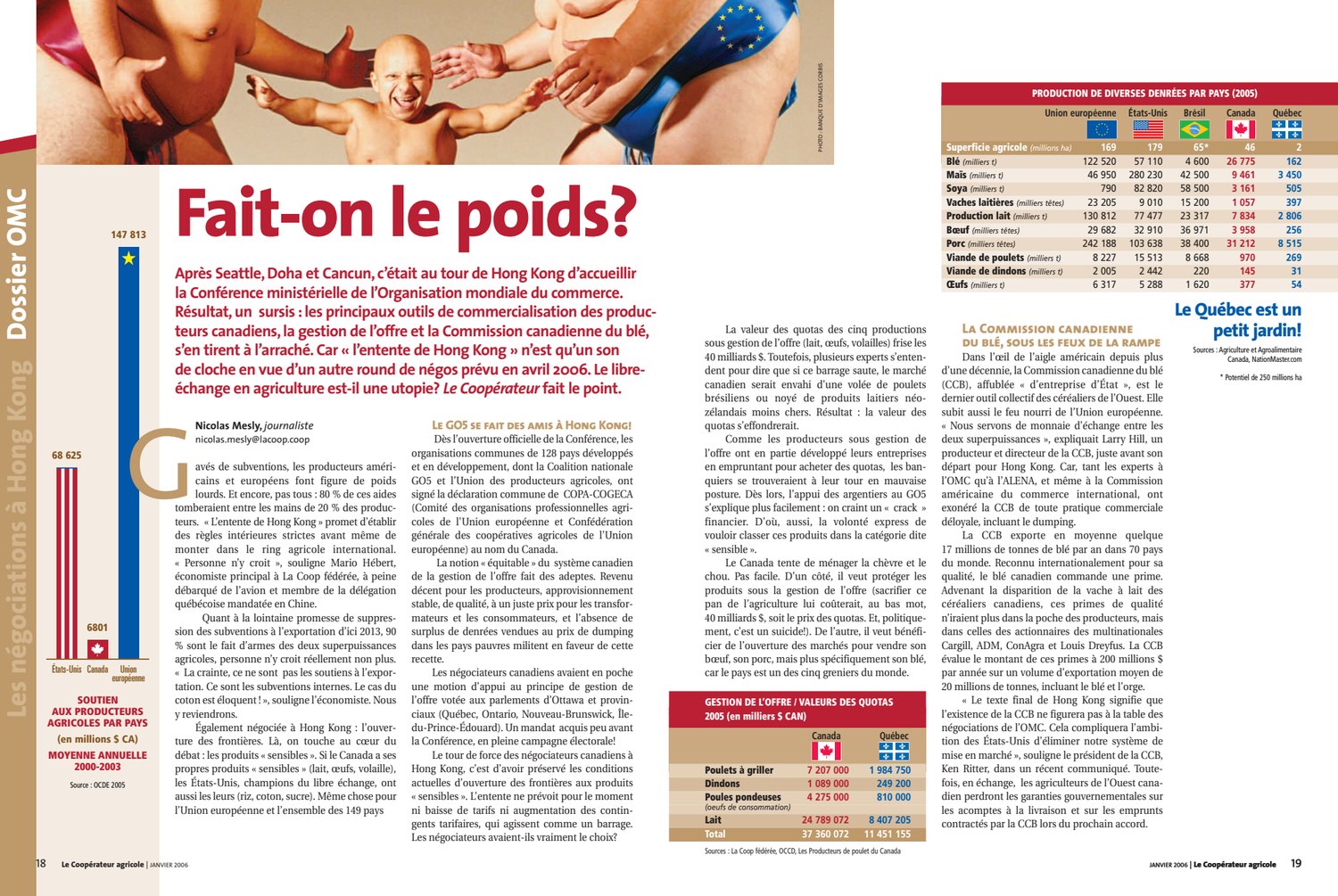
However, in return, farmers in Western Canada will lose government guarantees for the delivery and loan payments made by the CWB in the next agreement. JANUARY 2006: Agricultural Co-operator 19 SUPPORT FOR AGRICULTURAL PRODUCERS BY COUNTRY (in millions of CAD) ANNUAL MEDIUM 2000-2003 After Seattle, Doha and Cancun, Hong Kong was in turn hosting the World Trade Organization Ministerial Conference. The result was a stay of the process: the main marketing tools of Canadian producers, supply management and the Canadian Wheat Board were pulled out.
The Commission has already taken a decision on the proposal for a Council Decision on the conclusion of the Agreement between the European Community and the Republic of Korea on the conclusion of the Agreement on the conclusion of the Agreement on the European Economic Area (ECSC) on the conclusion of the Agreement on the European Economic Area (ECSC) on the conclusion of the Agreement on the conclusion of the Agreement on the European Community (OJ L 347, 30.12.2006, p.
"The Hong Kong Agreement" fails to establish rules of interest even before going up into the international agricultural ring. "No one believes in it," says Mario Hébert, Senior Economist at La Coop fedée, who has barely landed from the plane and is a member of the Québec delegation mandated to China. "As for the distant promise of abolishing export subsidies by 2013, 90% are the weapon of the two agricultural superpowers, no one really believes in it either. "Fear is not export support.
These are internal subsidies. The case of cotton is eloquent!", the economist points out. Also negotiated in Hong Kong: opening up borders. There, we touch at the heart of the debate: "sensitive" products.
The US, which is the champions of free trade, has its own "sensitive" products (milk, eggs, poultry) and its own (rice, cotton, sugar). The same applies to the European Union and all 149 countries. The GO5 is made friends in Hong Kong! As soon as the Conference officially opens, the joint organisations of 128 developed and developing countries, including the GO5 National Organization and the Union of Agricultural Producers, have signed the joint declaration of COPA-COGECA (Committee of Agricultural Professional Organizations of the European Union and the General Confederation of Agricultural Cooperatives of the European Union) on behalf of Canada.
The "fair" notion of the Canadian supply management system is a strong supporter. Decent income for producers, stable supply, quality, at fair prices for processors and consumers, and the lack of surplus goods sold at dumped prices in poor countries are pushing for this recipe. Canadian negotiators had a motion in their hands to support the principle of managing the offer voted at the Ottawa and provincial parliaments (Quebec, Ontario, New Brunswick, Prince Edward Island).
A mandate acquired shortly before the Conference, in the midst of an election campaign! The turn of the Canadian negotiators in Hong Kong is to have preserved the current conditions of opening up borders to "sensitive" products. The agreement does not currently provide for any reduction in tariffs or increase in tariff quotas, which act as a barrier. Did negotiators really have a choice? 18 The Agricultural Co-operatorSUNVIER 2006 JANUARY 2006
The Hong Kong negotiations WTO file G United States Canada European Union PRODUCTION OF MISCELLANEOUS DENIED COUNTRIES (2005) European Union United States Brazil Canada Quebec Agricultural area (million ha) 169 179 65* 46 2 Wheat (thousand t) Maize (thousand t) Soya (thousand t) Dairy cows (thousand t) Milk production (thousand t) Beef (thousand t) Pork (thousand t) Chicken meat (thousand t) Turkey meat (thousand t) Eggs (thousand t) PHOTO : BANK D'IMAGES CORBIS 68 625 147 813 6801 Quebec is a small garden!
OFFER MANAGEMENT / QUOTAS VALUES 2005 (in thousands of CAN$) Canada Quebec Grilled Chickens Turkeys Laying Chickens (consumer eggs) Milk Total Sources: La Coop fedée, OCCD, Chicken Producers of Canada Sources: Agriculture and Agri-Food Canada, NationMaster.com * Potential 250 million ha Source: OECD 2005
Complete original publication
The complete facsimile presents the publication in its original editorial design.
Open original PDF ↗