LONG-FORM REPORT · 2018
The future is more pink in cannabis than tomatoes
2 pages · 2153 words
Open original PDF ↗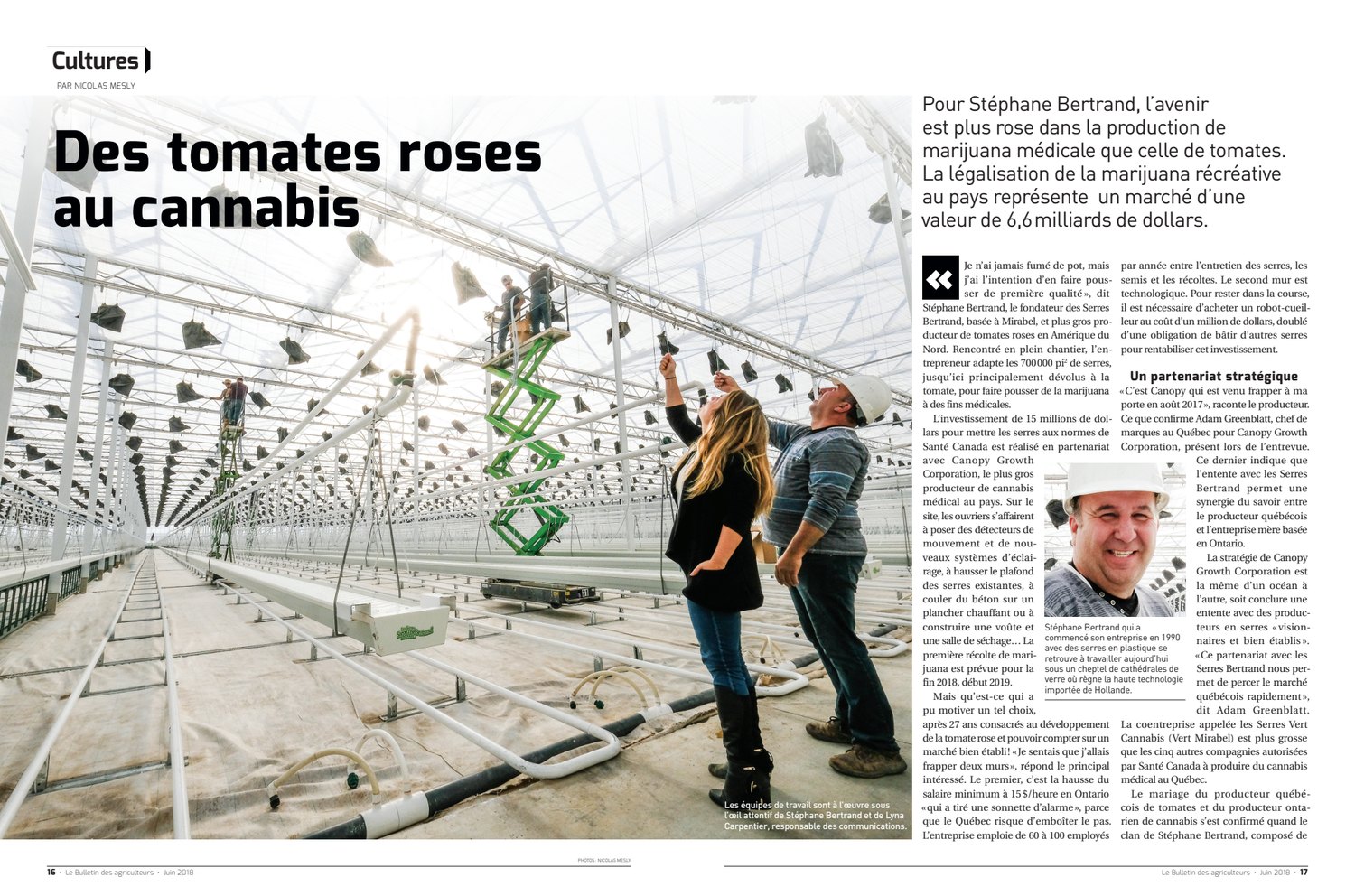
The complete story
16 • Farmers' Bulletin • June 2018 Farmers' Bulletin • June 2018 • 17 Pink tomatoes to cannabis For Stéphane Bertrand, the future is more pink in the production of medical marijuana than that of tomatoes. The legalization of recreational marijuana in the country represents a market worth $6.6 billion. PHOTOS: NICOLAS MESLY I have never smoked pot, but I intend to make it a top quality service," says Stéphane Bertrand, founder of the Serres Bertrand, based in Mirabel, and the largest producer of pink tomatoes in North America.
The company's investment of $15 million to bring greenhouses to Health Canada standards is being undertaken in partnership with Canopy Growth Corporation, the largest medical cannabis producer in the country. On the site, workers are working to set up motion and new calf detectors for the use of rabies, raise the ceiling of existing greenhouses, pour concrete on a heated floor, or build a vault and drying room... The first marijuana harvest is scheduled for late 2018, early 2019.
But what could have motivated such a choice, after 27 years of developing pink tomato and having a well-established market?"I felt I was going to hit two walls," the main interested person replied. The first was the increase in the minimum wage to $15/hour in Ontario "which drew a alarm bell," because Quebec might be in a position to take the lead. The company employs 60 to 100 employees a year between greenhouse maintenance, seedling and harvest.
The second wall is technological. To stay in the race, it is necessary to buy a robot collector at a cost of $1 million, coupled with an obligation to build other greenhouses to make this investment profitable. A strategic partnership "C'est Canopy qui came knocking on my door in August 2017", says the producer. Adam Greenblatt, Quebec brand leader for Canopy Growth Corporation, who was present at the interview, confirms.
The latter indicates that the agreement with the Bertrand Serres allows for a synergy of knowledge between the Quebec producer and the Ontario-based parent company. Canopy Growth Corpo ra tion's strategy is the same from coast to coast, either to enter into an agreement with producers in "visionary and well-established greenhouses."This partnership with the Bertrand Serres allows us to break into the Quebec market quickly," says Adam Greenblatt. The joint venture called the Cannabis Serres Vert (Vert Mirabel) is larger than the five other companies authorized by Health Canada to produce medical cannabis in Quebec.
The marriage of the québé producer - tomato coas and the producer have - nothing cannabis was confirmed when the clan of Stéphane Bertrand, composed of Cultures BY NICOLAS MESLY "The work teams are working under the watchful eye of Stéphane Bertrand and Lyna Carpentier, responsible for communications. Stéphane Bertrand who started his business in 1990 with plastic greenhouses finds himself working today under a flock of glass cathedrals where the high technology imported from Holland reigns. 18 • The Farmers' Bulletin • June 2018 The Farmers' Bulletin • June 2018 • 19 eight members of his family, visited May - his mother located in a former chocolate factory in Smiths Falls, Ontario, in October 2018.
"J'ai been impressed by the company's values and the power of its marketing," says Stéphane Bertrand. "It's the return of this four-day journey that we decide that the future is more pink in the production of medical cannabis than in tomato. As a result, Stéphane Bertrand and his wife, Sylvie Lalande, are no longer worried about the sustainability of their business, in which his son Steve, holder of a DEC in management and accounting, and his daughter, Marilyne, holder of a Bac in agro-economics.
The person who spent almost 30 years getting an annual turnover of $10 million will multiply it by ten, 100 million as of 2019. Produce "organic" cannabis The deal with Canopy Growth Corporation occurs when the Bertrand Serres just obtained a organic certification - Ecocert logic in February 2017 for pink and red cherry tomatoes. What Stéphane Bertrand has succeeded in producing tomato, he intends to succeed in the production of medical cannabis, by putting all his expertise to use to produce in the medium term a organic herb.
To do this, we must master the integrated insect control that consists of a true "art of war." "In the tomato, the enemy was the white fly. In cannabis it is the green spider, but we know it because it was fought in the production of cucumbers," he says. So it will be a matter of detecting and deploying armies of predators at the right time during production.
Of the 170 products authorised for the production of organic tomatoes, the latter will have to limit itself to about 20 100% organic products. It expects to achieve 5% of the organic production of the 60 tons of medical marijuana planned once in production. It is the mother house that will decide the cultivars to grow in the greenhouses of Green Cannabis. The genetic bank of Canopy Growth Coporation has about 100 varieties in production.
There are several types of cannabis, including industrial cannabis Can recreational cannabis be produced as well as sweet corn? At least not at this time. While it is clear that medical cannabis must be produced in greenhouses specific to Health Canada standards, it will be necessary to wait for Bill C-45 on cannabis. Ottawa was to approve this bill on July 1, 2018, but its adoption was delayed in August.
It will be more clear at that time whether producers will be able to produce recreational cannabis in fields. However, the provinces have a say."The Minister of Agriculture, Laurent Lessard, indicated that the production of recreational cannabis intended to supply the future Société québécoise du cannabis (SQC) will be produced in greenhouses," explains André Mousseau, President of the Quebec Greenhouse Producers. According to the organization's calculations, it would take 10 ha of greenhouse to meet Quebec's demand for recreational marijuana.
The SQC will be a subsidiary of the Société des alcools du Québec (SAQ) and will sell recreational marijuana through twenty or so branches. SAQ has also entered into a 58-ton supply agreement with six companies for its first year of operation. Québec also intends to prohibit the possibility of growing a limit of four marijuana plants at home for personal consumption, as proposed by Ottawa."Some of our members would be interested in providing small cannabis plants to consumers," continues André Mousseau.
This demand would result in the potential sale of four million plants, produced by about 50 greenhouse producers located in Quebec, to serve a local clientele. André Mousseau looks forward to the future of recreational and food cannabis production a little like microbreweries."There are more than 1200 varieties of cannabis with different tastes and effects," he says. "To win the market, producers will have to "cuff the mafia" by producing a quality herb, with specifications and traceability, at competitive prices.
The recreational cannabis market in Quebec is estimated at several hundred million dollars. The Canadian cannabis industry is a speculative bubble! Canopy Growth Corporation is the first Canadian medical cannabis company to be listed on the Toronto Stock Exchange in 2014. At its beginning, the monthly average share price was close to $2.50 to be catapulted at more than $30 this year.
In 2017, the company's sales value was $47 million, while its capitalization value in the spring of 2018 was... $5.6 billion, slightly less than that of Air Canada! "Investors have confidence in our company and in the future of this industry," says Adam Greenblatt, Quebec brand leader for Canopy Growth Corporation, explaining the stratospheric value of the company's capitalization. "The businessman says that Constellation Brands, the manufacturer of Corona beer, invested $250 million in Canopy Growth Corporation and even BMO invested $200 million in it, while "the same bank had refused to grant us a loan at one time."
According to Bloomberg, Canadian cannabis companies also attract U.S. investors because Canada will be the first OECD country to legalize marijuana for recreational purposes. The Canadian industry is dominated by four major players that rely on public funding: Canopy Growth Corporation, Aurora Cannabis, Aphria Inc. and MedReleaf Corp. Also according to Bloomberg, some 84 Canadian cannabis companies are listed on the stock exchange for a collective value of more than $46 billion.
Acquisitions and concentration of players are underway and to be expected in the coming months on the scale of the production of medical and recreational cannabis. As we go to press, Aurora has suggested that it wants to buy its rival MedReleaf at a price of $3.2 billion. Several observers fear a future correction of the market. And if this bubble bursts, many investors risk falling clouds.
Medical Cannabis Producers Approved by Health Canada At the time of publication, 104 producers are licensed by Health Canada to produce medical marijuana. Ontario dominates, followed by British Columbia. Quebec and Alberta are nosy for the number of licensed producers. Canada has converted into a large chessboard where players place their pawns for the legalization of recreational cannabis. for the production of hemp, recreational and medical.
The latter includes varieties that will stimulate appetite, reduce pain, act as a stimulant, promote sleepiness, etc. Medical cannabis has a cen - tin of molecules, including tetrahydrocannabinol or THC. It is this molecule that provides the euphoric effect. And there is also cannabidiol or CBD.
"This molecule does not freeze, but it reduces pain and, unlike opiates, it does not create addiction," says Greenblatt. "It sees enormous potential for both human and veterinary medicine for products made from medical cannabis. One of the parent company's subsidiaries, Canopy Health Innovation, holds a dozen patents in this direction. It is certain that medical cannabis producers have the foot in the chain to start producing marijuana for recreational purposes also known as "rigolo tobacco."
Justin Trudeau's government delayed the legalization of cannabis in August 2018. This market is otherwise more lucrative. Anthony Peluso, Assistant Director and author of numerous studies on cannabis - nabi at Statistics Canada, reported that the market for illegal cannabis use in 2017 was $6.6 billion, while the market for medical cannabis was $400 million for roundlet totalling $7 billion."Canadians spend as much money on cannabis as they do on wine and a little less than on beer," says the expert who estimates Canada's cannabis production at this time at 773 tons.
Also Green Mirabel is considering composing part of the demand for "tobacco funny" at the appropriate time. Canopy Growth Corporation has also concluded a 12 tonne supply agreement with the Société des alcools du Québec. The producers may one day have the choice of hovering, by lighting up a small organic joint from Mirabel's terroir. Canopy Growth Corporation's strategy is to enter into an agreement with "visionary and well-established" greenhouse producers, says Adam Greenblatt, Quebec brand leader for the company.
Nicolas Mesly is an agro-economist and freelance journalist specializing in agri-food issues. He covers field crops for Le Bulletin. Col.-Brit. 22 Alberta 6 Sask. 4 Manitoba 2 Ontario 57 Quebec 6 N.B. 3 N.S. 3 I.-P.-É. 1 Source: Canadian pot companies are worth trillions, but is it a bubble ready to burst?
Complete original publication
The complete facsimile presents the publication in its original editorial design.
Open original PDF ↗