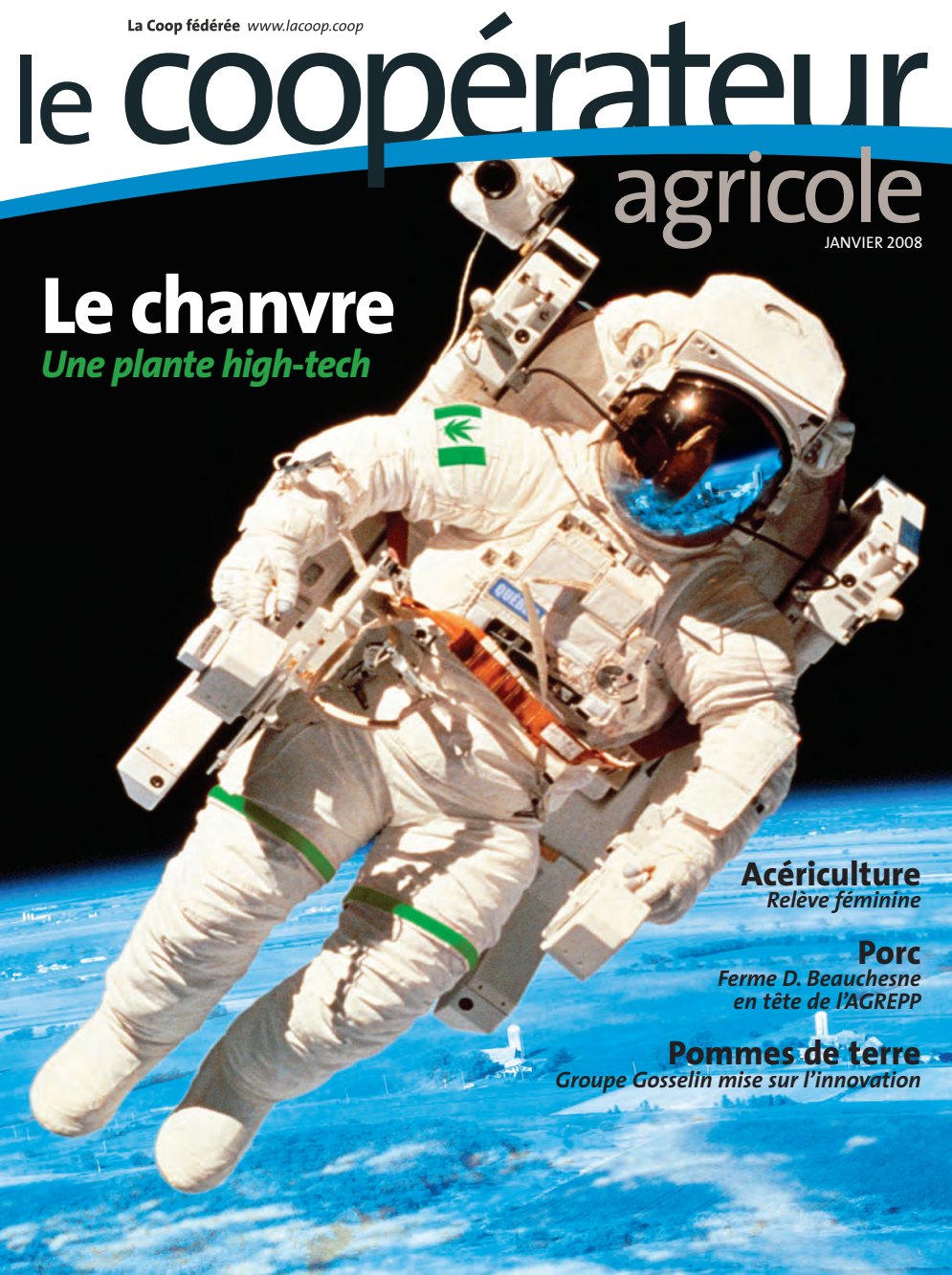
The complete story
JANUARY 2008 Acreculture Female reel Pork Farm D. Beauchesne leading the AGREPP Potatoes Gosselin Group is innovative Hemp A high-tech plant Dossier Hemp n wants to make the whole plant profitable. Hemp is an ecological plant, inexpensive to use and that is part of a sustainable development logic," explains Gille Gagné. Cooked, roasted or ground seeds, also called henvis, are an excellent source of fatty acids essential for re-establishing their health, including the famous omega-3 and omega-6.
While the oil removed from the seeds can be used to raise salads, it can also be used in the composition of beauty products. A first straw transformation separates the fibers from the chènevotte, the heart of the plant. The latter finds its usefulness in a range of products ranging from animal litter to light cement alloy. Furthermore, Naturally Advanced Technology Inc., a Vancouver "green" clothing manufacturer, plans to dress Canadian athletes with a uniform designed with hemp fibers for the 2010 Olympic Games!
But these natural fibres can also replace the fibreglass used by the automotive, aeronautics, leisure and construction industry."Our goal is to develop composites that will support our agriculture and manufacturing sector. Making lighter, more resistant parts in the design of aircraft, boats or locomotives from natural fibres will allow us to be more competitive on the international market. We will do two rounds of stone.
These vehicles will consume less oil, so we will reduce our greenhouse gases and better meet our Kyoto commitments, and we must know that three companies are making fiberglass in the world, and they are a monopoly.
With the oil price booming, petrochemical materials will cost the eyes of the head," says Johanne Denault of the Institute of Maté - Industrials of the National Research Council of Canada (NRC), based in Boucherville. According to the chemist, half of the plastic materials will be produced from biological sources next day. The cultivation of hemp is windy in the sails T exte and photos by Nicolas Mesly The successive kings of France and England encouraged the settlers of New France to cultivate a plot of hemp to allow their ships to return to the motherland.
And Christopher Columbus would not have discovered America without the veils and ropes made of hemp fiber. It is the eye poached on a promising horizon that the president and CEO of Lanaupole Fibres, Gilles Gagné, wants to convert 2,800 hectares of tobacco plantation into cannabis land. Because governments, by crushing the cigarette butt, put on straw 58 producers of yellow tobacco cigarettes from the Joliette region. An economic activity of $150 million flew forever in smoke.
"O Gilles Gagné, President and CEO of Lanaupole Fibres (left) and André Bérard.This visionary producer did his first hemp cultivation trials on his farm in 1998. This led to a visit after a report by police officers who thought they were dealing with a mariculteur. JANUARY 2008
This same hectare can generate six tons of straw from which 1.5 tons of fibre can be extracted. (Source: Agriculture and Agri-Food Canada) "On the day the carbon exchange starts, industrial hemp is likely to bring us a new income, because it is a big CO2 pump! It is also a big heavy metal pump to de-mine polluted land," says Christian Boisjoli, president of the newly-created co-operative. According to the former tobacco producer, hemp is a very good crop rotation program.
In addition, while husked in a biorefinery, industrial hemp offers as many possibilities for producing products as a refinery does with oil: enzymes, solvents, acids... The market seems unlimited, as humanity begins a slow turn from the petroeconomy pollutant to a new bioeconomy based on green and recyclable materials. However, there is still a long way from lip cutting before making the materials of tomorrow. The first field trials A handful of ex-tabaculteurs from the Joliette region have tripled the area seeded from 10 hectares in 2006 to 32 hectares in 2007 to become familiar with this promising plant.
"Mitigate" is the conclusion of the harvest of hemp varieties grown last summer by seven of the thirteen farmers in the Lanaufibres Production Cooperative, founded in February 2007. Late planting is one of the causes of low yields."Setning is more difficult to obtain than a restricted weapon permit. It would have been necessary to sow at least three weeks earlier in the spring to establish plant cover and prevent weed competition.
In addition, the rainy spring did not help," explains Christian Boisjoly, president of the cooperative, on an open day organized last summer by the agrocentre Les Ferrais Lanaudière Inc. For the 2008 season, producers plan to undertake the administrative procedures for obtaining permits earlier. The acquisition of certified seeds, as well as production, processing and marketing permits, are strictly controlled by Health Canada's Office of Controlled Substances (OCS).
The lack of a criminal record and the provision of a GPS-identified cadastre for seeded fields is one of the myriad criteria required by the BSC to be able to start production. Industrial hemp belongs to the species Cannabis sativa L., the same plant as the "pot", but the THC level, the euphoric substance, is 0.3% while marijuana contains more than 5%. With the exception of three cultivars, producers are required to have seed samples collected in accredited laboratories tested for THC content, adding to the cost of production.
"Even if you smoke two balls, you'd have nothing but a good headache!" says François Roch, who is doing a lot of beating in the coop's producers, who had to coat his combine harvester during the seed harvest to protect certain mechanisms from the potential damage caused by the winding of ultra-resistant fiber. The chenevis tends to fall easily to the ground; it must be harvested at 12-15 % moisture and when 75-80% of the grains are brown.
As for straw, the coop producers were able to harvest it this year with a special used double knife mower, sharp as "accuros", obtained through a grant of $5,000 from the Berthierville Development Centre. With the experience of two seasons, the Lanaufibres producers retain in their future production protocol a higher seeding rate 45 kilos per hectare (40 pounds per acre), a fertilisation program including a good dose of nitrogen – hemp in raffole – and the detection of insects (legionaries and defoliators).
Another finding to increase yields is the use of certified seeds with a germination rate above 90%. While producers are appreciating the agronomic needs of industrial hemp, Luc Boivin, Managing Director of the Agrocentre Les Ferrais Lanaudière Inc., intends to "emphasize the development of a suitable genetic in Quebec." In 2007, the BSC approved the commercial production of 27 varieties of hemp, either for seed and fibre cultivation.
The varieties planted in Quebec last summer were from Western Canada. Manitoba and Saskatchewan are the two major industrial hemp producers in the country. The varieties used in the Canadian prairies come mainly from Eastern Europe and are entirely destined for the production of chénvis and d'oile. So we look at Poland, but also France, for the development of certified seeds in Quebec.
In addition, Lanaupôle Fibres has developed close ties with, among others, the Central Cooperative of the Producers of Chanvre Seed (CCPSC), which supplies 80 to 95 % of European markets. In contrast, Canada, which, under puritan pressure and that of nylon manufacturers, endorsed an American law criminalizing this production (the Marijuana Act in 1937), France never stopped growing industrial hemp. Canada lifted this ban 60 years later, in 1998, in front of the industrial promises of the plant.
In Europe, industrial hemp is mainly intended for the production of fine paper because of the lack of forests."We will choose varieties according to the markets, but these are to be developed. The land is virgin in Quebec," says Christian Boisjoli. The seeds harvested this year have found themselves in the Trigone Foods, a small food processing company that specializes in products derived from hemp.
One member of the cooperative also sold his straw to a chicken producer, who, under the supervision of MAPAQ, tests the use of chopped hemp straw to replace the litter of wood chips, which, as a forest crisis, is becoming increasingly rare on this side of the Atlantic. The chènevotte makes an excellent litter for animals, because it has a phenomenal absorbing capacity in addition to enjoying, as well as fiber, antimicrobial property. In the medium term, the members of the cooperative aim at the more lucrative market of litter for horses.
"Our industry is facing two major challenges, a small market for seed and an almost non-existent market for fibre. The reason is simple: an oil press costs a lot less than a defibrage plant," says Arthur Hanks, President of the Canadian Hemp Trade Alliance (CCCA), who estimates the retail value of current hemp products at $40 million. "After sowing a record of nearly 20,000 hectares in 2006, Canadian grain farmers planted four times less hemp in the country in 2007.
"Many producers speculated about the market's ability to sell seed and decided to produce without a contract with a trader or processor," says Yvan Beaulieu, a market specialist at Agriculture and Agri-Food Canada. "There is more supply than demand, as long as North American food manufacturers do not use more hemp seeds or flour in their products. Unlike wheat, which can be stored for five years, hemp seeds are sipped oil like nuts; they are rancid after two years and must be sold quickly," says Chris Dzisiak, vice-president of Parkland Industrial Hemp Growers Co-op Limited, one of the leading players in this embryonic industry.
Members of the Manitoba co-operative, established in 1999, have had a hard lesson after Chanvre USO14 39% USO31 2% Anka 1% Alyssa 0%Crag 10%Esta-1 0% Felina 2% Finola 46% 18 Agricultural Co-operators
Hemp Production in Canada 1998-2007 Area authorized by cultivar for commercial production in 2007 (Source: Health Canada) (Source: Health Canada) PHOTO: GRACIOUSTÉ D-ARTHUR HANKS 101782_JANV08_Pages16-21_Layout 1 2015-05-08 18:30 Page18 Luc Boivin, General Manager, Les Ferrais Lanaudière. His challenge: to develop industrial hemp varieties adapted to Quebec's climatic conditions. to use hemp products in the composition of various car parts. We need similar legislation here," he explains, very proud of having passed a motion to support the development of the industrial hemp industry at the 25th Congress of Young Liberals held in Quebec last summer.
In addition to the political field, administrative changes will have to be made to ensure that industrial hemp cropping is out of the marginality and gaining ground in Quebec. By including this new crop, for example, in a crop insurance program, as it exists in Manitoba, Saskatchewan and Ontario. Ramper faster than the Americans! To the environmental emergency to rehabilitate the health of the planet from transplanting another to establish an industrial hemp industry in Quebec.
"We must take advantage of the American situation that prevents our producers from growing industrial hemp. There are 17 tobacco-producing states, including Caroline, that are working to lift this ban. The day the Americans are going to start, we are cooked!" says André Bérard, one of the founders of the Lanofibre Production Cooperative. The United States is the only country in the world to maintain the ban on the cultivation of industrial hemp.
But in February 2007, two North Dakota producers sued the Drug Enforcement Agency (DEA) to compel the powerful federal agency to issue permits to produce this crop that some consider as promising as soybeans.2 And Republican Senator John Roulac, a 2008 U.S. presidential candidate, campaigned to claim the merits of industrial hemp as a substitute for corn to produce ethanol, who submitted a bill to Congress to legalize this production, while noting in a video, Hemp for Victory!, posted on the You Tube website, that Canada does not snag into carpet flowers to promote this crop.
How long will the Canadian monopoly on the continent last? However, for Captain Lanaupole Fibres, Gilles Gagné, it is important to distance the powerful American Armada as far as possible. Hence, a certain urgency to plan the construction of a factory for industrial hemp defibrage on Quebec soil. Its cost: between $8 million and $15 million.
A project, he hopes, funded in part by the flairs of the high-tech industry flying the fleur de lis flag."Without the funding of the Spanish kings, Columbus would never have discovered America!" he likes to say. And without this factory, Quebec is likely to miss the boat. 1 There are currently two companies that are transforming hemp fiber in Canada, Stemergy (www.stemergy.com) located in Ontario and Avanti Polymers (www.avantypolymers.com) in Manitoba. A third company, Naturally Advanced Techno - ologies Inc. (www.naturallyadvanced.com), based in Vancouver, is planning to build a defibrage plant in Saskatchewan in spring 2008.
The company already holds three transformation patents, and its shares are listed under the name NADVF on the OTCBB New York Stock Exchange. 2 "Hemp, On a High", The Economist, July 23, 2007. Their main buyer, a Californian company, has left them bankrupt with 4,850 hectares of seeds and fibres for which there is still almost no market. The producers have been trying since 2002 to finance the construction of a defibrage plant. Its cost, initially estimated at between $12 and $15 million, is now $24.4 million, mainly due to the increase in the Canadian dollar.
To be profitable, the factory would require an area of between 8,000 and 10,000 hectares to process 14 000 tonnes of industrial hemp annually. Dzisiak believes that the factory will be on its feet within two years."There is no abundant and inexpensive labour like in China or Mexico to defuse, so we must necessarily opt for mechanization. The problem is raising capital!
I doubt that this kind of factory is growing like mushrooms in the country," notes the ACCC president, Arthur Hanks. Québec: the strategy of small steps... to take off better! Before even considering building a defibrage plant in Quebec, the helmsman of Lanaupole Fibres, Gilles Gagné, proposes to start with the acquisition of a school factory, at a more modest cost of $1.5 million, to receive and defuse cultivated hemp in the region in order to become familiar with the dust removal of the material, the calibration of the fibres and the production of hemp.
Some 100 round balls from the 2006-2007 harvest are in the hold and could be used as a test balloon. There is already a demand in the Belle Province."Import 100 tons of chènevotte from an Ontario 1 supplier to make a mortar that replaces gypsum board," says Gabriel Gauthier, president of ArtCan, a green house manufacturer. "ITA Gradué, Saint-Hyacinthe campus, M.
Gauthier estimates that demand for this type of home has grown from 50% to 100% per year since the company was founded in 2003. As its name suggests, Lanaupôle Fibres intends to become a real research centre in genetics, production, and processing; a Quebec-based plant fibre industry modelled on industrial poles as it exists in France. This does not exclude the use of plants other than industrial hemp."Canada is one of the largest flax producers in the world.
For the moment, all this fiber is burned in the field!" stresses Mr. The ultimate goal: to patent fibre manufacturing technologies for the high-end market. Big names are circulating: Bell Helicopter Textron, Boeing, Airbus, Bom - Bardier, Via Rail... "European technology is mainly aimed at the low end of the range. We are aiming for high performance.
"I already have a contract with a large company, but I can't disclose the name at the moment," says Johanne Denault of NRC, who works closely with Lanaupôle Fibres. "The researcher says she has a budget of $5 million over three years to develop bioproducts. However, to allow this industry to emerge and to encourage private funding to build a real defibrage plant in the Belle Province, Gilles Gagné believes that the federal and provincial governments must quickly prepare the soil.
"In 2015 in Germany, materials used for example in the construction of a BMW will have to be 85% recyclable. This forced suppliers in the United States Ireland United Kingdom $500,000 2004 2005 2006 August 2007 $1,000,000 $1,500,000 $2,000,000 $2,500,000 Japan South Korea Other Hemp Hover 20 Agricultural Co-operator
Presentations from the various speakers are available at: www.infochanvre.ca - Health Canada: List of Approved Crops, Licences and Authorizations for Industrial Hemp at: www.hc-sc.gc.ca - Industrial Hemp Regulations: http://laws.justice.gc.ca/en PhotomoNtAgE: lA cooP fÉDÉÉÉÉÉÉE 101782_JANV08_Pages16-21_Layout 1 2015-05-08 18:30 Page20
Complete original publication
The complete facsimile presents the publication in its original editorial design.
Open original PDF ↗