The complete story
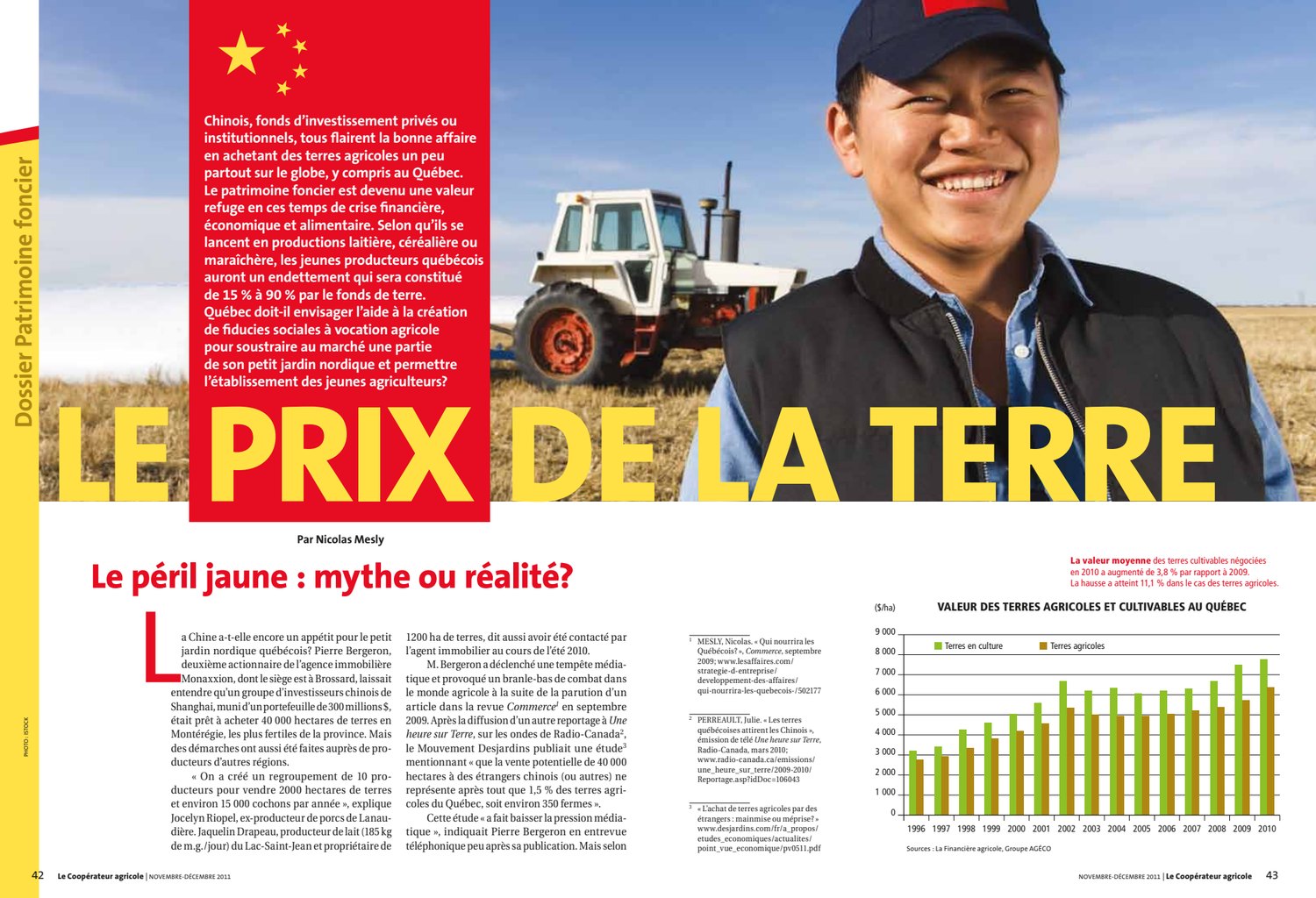
PHOTO: ISTOCK L in China still has an appetite for the small northern garden in Quebec? Pierre Bergeron, second shareholder of the real estate agency Monaxxion, headquartered in Brossard, suggested that a group of Chinese investors in Shanghai, with a portfolio of $300 million, was ready to buy 40,000 hectares of land in the province's most fertile Montérégie. But steps were also taken with producers from other regions."A group of 10 producers were created to sell 2,000 hectares of land and about 15,000 pigs a year," says Jocelyn Riopel, former pig producer in Lanaudière.
Jaquelin Flag, a milk producer (185 kg of m.g./day) in Lac-Saint-Jean and owner of 1200 ha of land, also said that he had been contacted by the real estate agent during the summer of 2010. Bergeron triggered a media storm and caused a fight-down in the agricultural world following the publication of an article in Commerce1 in September 2009. After another report was broadcast on Radio-Canada 2 at 1:00 on Earth, Desjardins Group published a study 3 mentioning that "the potential sale of 40,000 hectares to Chinese (or other) foreigners after all represents only 1.5% of the agricultural land in Quebec, or about 350 farms."
This study "reduced the pressure on the media," Pierre Bergeron said in a telephone interview shortly after its publication. But according to THE LAND PRICE The yellow peril: myth or reality? By Nicolas Mesly Chinese, private or institutional investment funds, all flaunt the good deal by buying agricultural land all over the world, including in Quebec. Land heritage has become a safe haven in times of financial, economic and food crisis.
Depending on whether they are starting dairy, grain or market garden production, young Quebec producers will have a debt of 15% to 90% from the land. Should Quebec consider helping to create farm-based trusts to remove part of its small northern garden and allow the establishment of young farmers? 1 MESLY, Nicolas. "Who will feed Quebecers?", Commerce, September 2009; www.lesaffaires.com/strategie-d-entreprise/ de développement-des-affaires/ qui-nourrir-les-quebecois-/502177 2 PERREAULT, Julie.
"Quebec lands attract Chinese people", TV program One Hour on Earth, Radio-Canada, March 2010; www.radio-canada.ca/emissions/ un_heur_sur_terre/2009-2010/ Reportage.asp?idDoc=106043 3 "L'achat de terres agricoles par des étrangers : masterage ou séquête?" www.desjardins.com/en/a_propos/ etudes_économique/actualites/ point_vue_économique/pv0511.pdf ($/ha) VALUE OF AGRICULTURAL AND CULTIVABLE TERRES IN QUEBEC Lands in cultivation 1996 1997 1998 1999 2000 2001 2002 2003 2004 2005 2006 2007 2008 2009 2010 Agricultural lands Sources: La Financière agricole, Groupe AGÉ CO The average value of agricultural land negotiated in 2010 has increased by 3.8% compared to 2009.
The increase was 11.1% for agricultural land. 42 The Agricultural Co-operator, NOVEMBER-DÉ CEMBER 2011 NOVEMBER-DÉ CEMBER 2011: The Agricultural Co-operator 43 Land Heritage file PHOTO: NICOLAS MESLY INSTITUTIONAL INVESTIGATORS RELUCING AGRICULTURAL TERRES "Never would I have been able to transfer my business to my son because of its value," explains Luc Decubber. This businessman and agronomist founded Canneberges Bécancour in the 1980s. During the summer of 2009, his business was sold to the American First Manulife Investment Corporation, with the agreement of the CPTAQ.
Without revealing the price of the sale, Mr. Decubber explained that "the deal provides that I will remain at the helm of my company for as long as I wish." For this producer, the capital injection allowed his company to survive, including strong support for the development of the small red fruit market. First Manulife Investment Corporation, based in Toronto, is the owner of Hancock Agricultural Investment Group (HAIG), the largest institutional investor in agriculture in the United States.
The company owns 66,800 hectares of the best land in California, the Midwest and along Mississippi, as well as 2400 hectares in Australia. It invests in, among other things, the production of corn, cotton, wheat, almonds and pistachios, as well as in vineyards. HAIG's return on its investment was 11.5 per cent from 1991 to 2008, according to a statement from the company. HAIG was one of the first institutional investors to start up in agriculture, but today it has to count with competition from pension funds and sovereign wealth funds.
Not to mention the voracity of real estate agencies, particularly active in some U.S. states and in western Canada (Saskatchewan, Alberta), where land is not protected by any law against urban sprawl, unlike Quebec. This broker, the process of acquiring agricultural land by Chinese interests is irreversible. Bergeron has shunned our numerous interview requests to take stock of the "1000 records" of producers in Quebec (plus a hundred of Ontario) driven by his agency.
The value of agricultural land in Quebec increased by 12.3% in 2009, and it is better than playing on the stock exchange and more profitable than Canada's savings bonds.
In addition, you don't have to pay any tax."His Chinese customers, he explained, planned their investments over a period of 20 to 30 years. Monaxxion's website publishes the sale of two farms in Saint-Césaire, in Montérégie, one of which is porcine. Head of the sales records of this municipality, Louise AllaireOstiguy states that "two agricultural enterprises have been sold, but to number companies owned by local residents."
The Commission de la protection du terre agricole (CPTAQ) states that it received 108 applications from foreign buyers in 2009 and 2010 and authorized the sale of 6346 hectares of the 6778 hectares that were the subject of an application. "We do not compile the nationality of the buyers," says Marlene Thiboutot, spokesperson for the Commission. "The organization administers the Non-Residents Agricultural Land Acquisition Act (LTNAR).
The Act, adopted in the late 1970s, was intended to stop foreign investors, especially European investors, who speculated on the increase in the value of land in anticipation of the urbanization of agricultural land. "Under this Act, a foreign company cannot buy the shares of an agricultural enterprise. And if an investigation reveals that the company is actually a "prion-name" for foreign interests, it is liable to fines and to the annual - l'ontation of the transaction," says Mario Masse, notary specialized in the field. (Any purchase of land of more than four hectares must be approved by the CPTAQ.
The last record of agricultural enterprises (2009) indicates that of the 29,500 farms in Quebec, "approximately 9000 or 30% are incorporated into shareholder corporations." Moreover, Marc-André Bertrand, an agronomist with the Department of Business Development and Land Use Planning, at MAPAQ, 45% are independent owner companies, 10% are formed from various entities, including cooperatives, and 17% are general partnership companies.
Companies that are formed in this last legal form are more difficult to sell or transfer. According to agronomist Claire Bolduc, president of Rural Solidarity, agricultural producers are left to themselves in the decision to sell their land to foreign interests. "The producer has no form of state aid to ensure that the land remains a collective good. As a society, Quebec does not think in the long term," she says.
"The sale of agricultural land to Chinese or other foreigners is a non-adamant one! Quebec's succession must be prioritized," says Jean-François Ménard, who represents the Saint-Hyacinthe region at the Fédération de la relève agricole du Québec (FRAQ). Since March, the Quebec succession has been able to benefit from the Fund d'investissement pour la relève agricole (FIRA) 4, launched by the late Minister of Agriculture, Claude Béchard. With an envelope of $75 million, this fund includes a portion reserved for the purchase of land, up to a maximum of $500,000.
"It is a capital leave, but we have to buy the land five years later at market price!" raises Jean-François Ménard. And the land is not given. In Montérégie, it was trading last year on average at $11,000/ha, according to data from La Financière agricole du Québec and the Groupe AGÉCO. Such a price would certainly not hold back China, which has a portfolio of nearly $3000 billion - lion US (40% of the foreign currency of the pla - nete) and which seeks to "make its capital grow".
The Middle Empire must feed 20% of the world's inhabitants, while only 7% of its territory is culturally specific, says Loïc Tassé, China's expert and professor at the University of Montreal. "The Chinese are working in a closed circuit, buying land in Africa, for example, importing their labour and exploding the produce to their home country. This model would have important economic and social consequences if it were to reoccur in Quebec," he said.
For the moment, it is difficult to know whether Chinese investors have bought land in Quebec and what their real intentions are. 4 According to Paul Lecomte, Managing Director of the FIRA, two cases of land purchase by young farmers will be studied this fall. Pierre Desourdy, a pig breeder from Montérégie, was contacted by real estate agent Pierre Bergeron of Monaxxion and by a group of Chinese investors in 2009. According to the producer, they wanted to take advantage of the expertise of Quebec swine to found a school and train Chinese peasants.
The transaction never took place with Mr. Desourdy, whose eldest son took over. Jean-François Ménard and his companion, Martine Rainville, took over from the family farm by buying shares of Gérard Rainville et fils. For the young farmer, who chairs the Association de la rendition agricole de Saint-Hyacinthe, Québec could do better to promote the transfer of farms to the Quebec redevelopment.
He said that the debt of the land was a crucial issue. PHOTO: NICOLAS MESLY PHOTO: PIERRE CADORET THE GRAND RECENT ACHATES OF AGRICULTURAL TERRES IN THE WORLD (HA) VENDERS TOTAL BUILDERSJapan South Korea China United Arab Emirates Russia 90 400 90 400 Kazakstan 7 000 7,000 Mexico 1,050 1,050 Cuba 5,000 5,000 Brazil 100,000 100,000 Argentina 21 000 21 000 Madagascar Laos 700,000 Pakistan 900 000 900 000 Indonesia Philipines Australia 43 000 43 000 N Zealand 5 700 5 700 Mongolia 270 000 270 000 Sudan Uganda 4 046 4,046 Tanzania 300 300 Algeria 1,500 1,500 Egypt 1 600 1 600 TOTAL 2006-2009 Sources: BOUSSARD, Jean-Marc.
"La dernier bataille pour les terres prissées ou le retour du colonialisme", Revue politique et parlementaire , NO 1051, april-june 2009, pp. 112-120, and Organisation non-governmental GRAIN. NOVEMBER-DÉ CEMBER 2011
"This kind of trust is a way to remove land from speculators' claws and to make it easier - to read the intergenerational transfer," explains Hubert Lavallée, President of Protec-Terre, an organization created in 1999 to defend Quebec's agricultural land heritage. "The present value of land and agricultural exploitation is too high. Young people in the succession must receive important donations from their parents to establish themselves.
Thanks to the mechanism of such a trust, a young producer does not have to be in debt to pay for a land that can represent 15 to 90% of his loan, depending on whether he is going to go into quality production. And since I come from the city, it gives me access to the land," said the retired teacher who works on the farm voluntarily. "A hundred social units were sold so that the trust could buy Jean Roussel's land for a cost of $200,000."The land was worth more than $300,000.
It was important to transfer a land with a biological vocation of gene - rations in generation," explains Hubert Lavallée. "The trust is a non-profit organization (NOS). Very easy and can be costly to administer, it ensures that this desire is respected "in perpetuity", unless there is a case of force majeure, such as expropriation. The formula would allow a fund-raising to be made to buy neighbouring land "if the opportunity arises".
"For some farmers and farmers of my generation, it is important to own the land. It is not said that I will remain a farmer all my life," says Anne Roussel, former teacher and mother of three young children. "If she ever decided to pass the flame - beautiful to another farmer, she would get out of it without debt, since she did not have to buy the dairy or vegetable fund. Instead, he can invest in technology, buildings, machinery or the development of his market, while building a retirement capital.
"I have the full decision-making power over the vegetables I want to grow, on the investments in buildings and machinery, or on the recruitment of employees. It's like a condo: I'm dealing with the operations on the surface, but the land belongs to the trust," explains Anne Roussel, current operator of the Farm Cadet-Roussel. "It's her father, Jean Roussel, who had the idea of converting her land into a trust of social utility for farming," explains the 31-year-old woman. "My father was growing about 60 hectares in organic production, half of which was rented.
One day, this land was sold and sown in "conventional" corn. My father saw 30 years of work pass away in a wink."French origin, Jean Roussel and Madeleine Heurtebise bought land in Mont-Saint-Grégoire in 1971 and became pioneers of the production of endives in Quebec. But a serious illness caused enormous losses in this production and forced diversification (pierel, celery-rave, French shallots...).
"It is community-supported agriculture that saved the business in 1995," explains their daughter, "this concept, known as the CSA, allows consumers to become partners on the farm, in exchange for the purchase in advance of part of the harvest in the form of baskets of seasonal vegetables. Launched in Montreal by Equi - Terre, the formula is very successful. Louise Casavant, a first-hour customer of the organic basket, now has a $2,000 social share in the brand new trust.
"I see it as an investment in my health, because it allows me to eat ground food. Instead, it plans to build a retirement fund (REER) here, and, icing on the cake, it intends to leave to its successor the benefits of the ASC business formula. According to Hubert Lavallée, the MRCs, the municipalities, the citizens' groups, the companies and society in general would benefit from creating such entities, among others around Montreal, "a case of public health," he says.
On the one hand, such trusts would allow more young farmers to be installed in organic production, while the majority of organic products are imported from the United States. On the other hand, the introduction of a "green belt" around a metropolis promotes a healthier living environment, reducing GHGs and the incidence of respiratory diseases. However, the nerve of the agricultural social trust model is based on its financing. "In France, Terre de liens, a public mutual fund, has capitalized €9 million ($13 million) to collectively buy agricultural land and rent it to young farmers," says Mr.
In Quebec, the idea of such a fund germinates. The land of the Farm Cadet-Roussel protected for life. Here, Anne Roussel and Arnaud Mayet are the first farmers in Quebec to operate within a "social utility trust for farming." Under this scheme, the young couple will never have to go into debt to acquire the land. They produce 150 baskets a week from 60 varieties of organic vegetables in summer and 100 baskets in winter.
These are distributed in the Community-Supported Agriculture (CSA) network, founded by Équiterre. L Area of agricultural land lost in the United States Over 9.3 million hectares of agricultural land disappeared in this country from 1982 to 2007. It is almost five times the land in cultivation in Quebec! The five states that have accumulated the most losses are Texas, California, Florida, Arizona and North Carolina.
Source: National Resources Inventory (USDA) U.S. Foreign-owned land Foreign landowners own nine million hectares of U.S. farmland, i.e. 1.9 per cent of private land and less than 1 per cent of all arable land in the country. Forest land accounts for 59 per cent of this land, grain production land for 14 per cent, and pasture and other land for 27 per cent. From 2008 to 2009, foreign investors acquired 526,000 hectares, the majority of which are Canadian (mainly forest companies), followed by Dutch, English and German.
Source: FSA Annual Report of Foreign Holdings of US Agricultural Land (USDA), 2010 Trusts to Protect U.S. Agricultural Heritage U.S. farmers, communities, municipalities and states use a tool called "preservation easement for tax benefits" to protect agricultural land from the appetite of developers. In addition to tax benefits, landowners may benefit from conservation programs. The duration of such easement may range from 10 to 30 years to life, depending on the case.
Area of agricultural land lost in Quebec (1978-2010) 225 340 hectares Source: CPTAQ. Note: since the revision of the Agricultural Land Protection Act in the late 1980s, the number of dezonated hectares [16 599] is almost equal to the number of hectares added to the green zone [15 947].) Acquisition of land by non-residents, 2000-2010 (Source: CPTAQ) Area Area Year Applications Requested (ha) Authorized (ha) 2000 2001 2002 2003 2004 2005 2006 2007 2008 2009 2010 Note: The years 2002 and 2003 and 2005 and 2006 present abnormally high data, because during this period many transactions were recorded between Canadian forest companies whose head office was not located in Quebec.
Marie-Paule Robichaud , of the Conseil québécois de la coopération et de la mutualité, launched in 2011 a reflection on trusts of social utility with an agricultural vocation. She plans to push forward the discussions in 2012, declared the International Year of Cooperatives by the United Nations. Located just 10 minutes from the Farm Cadet-Roussel, the vineyard Clos de la Montagne, which was the second largest in Quebec, has experienced a very different fate. Located in a white zone, it was split into nine plots for the construction of luxury houses.
His former owner, Aristide Pigeon, deplores this fact, but none of his five children were ready to take over. Free as air, the 72-year-old man rolls his "mechanics" – a Harley-Davidson – on the roads of Quebec and the United States. PHOTO: NICOLAS MESLY PHOTO: NICOLAS MESLY PHOTO: SIMON CAREIL 46 The Agricultural Co-operator: NOVEMBER-DÉ CEMBER 2011 NOVEMBER-DÉ CEMBER 2011
John Scholl: According to the inventory of national resources, we lost 9.3 million hectares of land from 1982 to 2007. That is the size of the state of Indiana! These are mostly fertile grasslands, easier to convert into residences. The remaining lands are more difficult to cultivate.
As a result, they increase our ecological footprint. CA This is not good news? According to these data, the conversion rate has decreased over the last five years. I attribute it in part to our efforts and message, which says, "Let's try to be smarter in managing our agricultural land assets."
CA Did the 2008 financial crisis help to reduce the amount? JS We don't have the data for 2008. But, of course, the crisis has had to slow down the process. CA Do you think that the US's loss of agricultural land is a matter of national security?
JS We are convinced that in the United States, as elsewhere in the world, people are asking about the origin of their food, how it is produced and how it is produced, and how it is safe, and that these concerns are reflected in a greater desire to buy locally.
And I believe that the events in Africa and the Middle East, as well as the arrests on television, are also linked to the price of food. John Scholl, the son of an Illinois agricultural producer, is president of the American Farmland Trust. This organization is dedicated to defending the fertile land of the world's first agricultural and military power. Also, among our neighbours, the best lands disappear at an alarming rate under urban sprawl; the transmission of land from one generation to the next is difficult; and these nourishing lands, in the midst of economic crisis, have become a refuge value for investors.
John Scholl THE AGRICULTURAL TERRE: A challenge that is opening up in the United States 48 The Agricultural Co-operator: NOVEMBER-DECEMBER 2011 Land Heritage CA Congress and President Obama consider land issues? But Washington is the scene of an unprecedented struggle to determine which priority programs and who will receive funding. In the last Farm Bill (2008), we managed to get a program called "Rands and Farms Land Protection Program". JS Our country is very large and has a wide range of situations.
But it must be noted that 27 of the 50 states have programs to protect agricultural land. Now, are these efforts combined with those of Washington sufficient? CA Is the American farmer drawn between the desire to transfer his land to his children and the desire to sell it at a high price to a commercial developer? JS C is a crucial issue.
We have determined that one of the very important people responsible for converting agricultural land is the taxation system of our states. It is based on "the highest value and best use." The value of a plot of land devoted to building can be as high as $62,000/ha, while that of a nearby farm plot is between $7,000 and $12,000/ha. When a farmer dies or wants to transfer the land to his heirs, they have to pay taxes on the highest value.
Can CA Washington regulate land transactions, especially foreign interests, in the name of national security? JS When I grew up on the family farm in the 1970s in Illinois, the Department of Agriculture (USDA) encouraged us to sow from one fence to another. The export market was booming.
And this boom attracted new investors in agriculture, which fed into the issue of foreign ownership of land. The federal government then passed a law in 1978 and an audit system for these purchases. CA This debate is re-emerging today?
The value of land has increased since the lows of 1980 and 1990-2000. The current global instability, coupled with food crises, means that investors see agricultural land as a stable and long-term investment, which could rekindle the political debate. I have just learned that my own county of McLean, Illinois, is one of the most land-rich in the United States.
CA Investor countries, such as China, South Korea or Saudi Arabia, buy land all over the globe. JS If vast tracts of agricultural land in the United States were sold to foreigners, it would certainly create an outcry! But we are a country of immigrants. My ancestors came from Germany, through Canada, five generations ago.
I see no difference between them and a Chinese farmer who would become my neighbour. However, if his production were siphoned by whole barges along the Illinois River to go to China via the Panamá Canal, and if this would decrease our national production, the debate would risk heating. 1970 0 1000 2000 3000 4000 5000 $6000/ha AGRICULTURAL LAND PRICES IN THE UNITED STATES CONTINUED OF CROISTER (1970-2011) $1,7000 1975 current $ 2005 1980 1985 1990 1995 2000 2005 2010 1 Average price of farmland and pastures, including buildings Sources: United States Department of Agriculture (USDA); Agri-US-Analysis, No. 175, April-May 2011 50 Agricultural Operators - NOVEMBER-DÉ CEMBER 2011 Land Heritage
Complete original publication
The complete facsimile presents the publication in its original editorial design.
Open original PDF ↗