LONG-FORM REPORT · 2016
Farmers, big ignored in the fight against GHGs
5 pages · 2426 words
Open original PDF ↗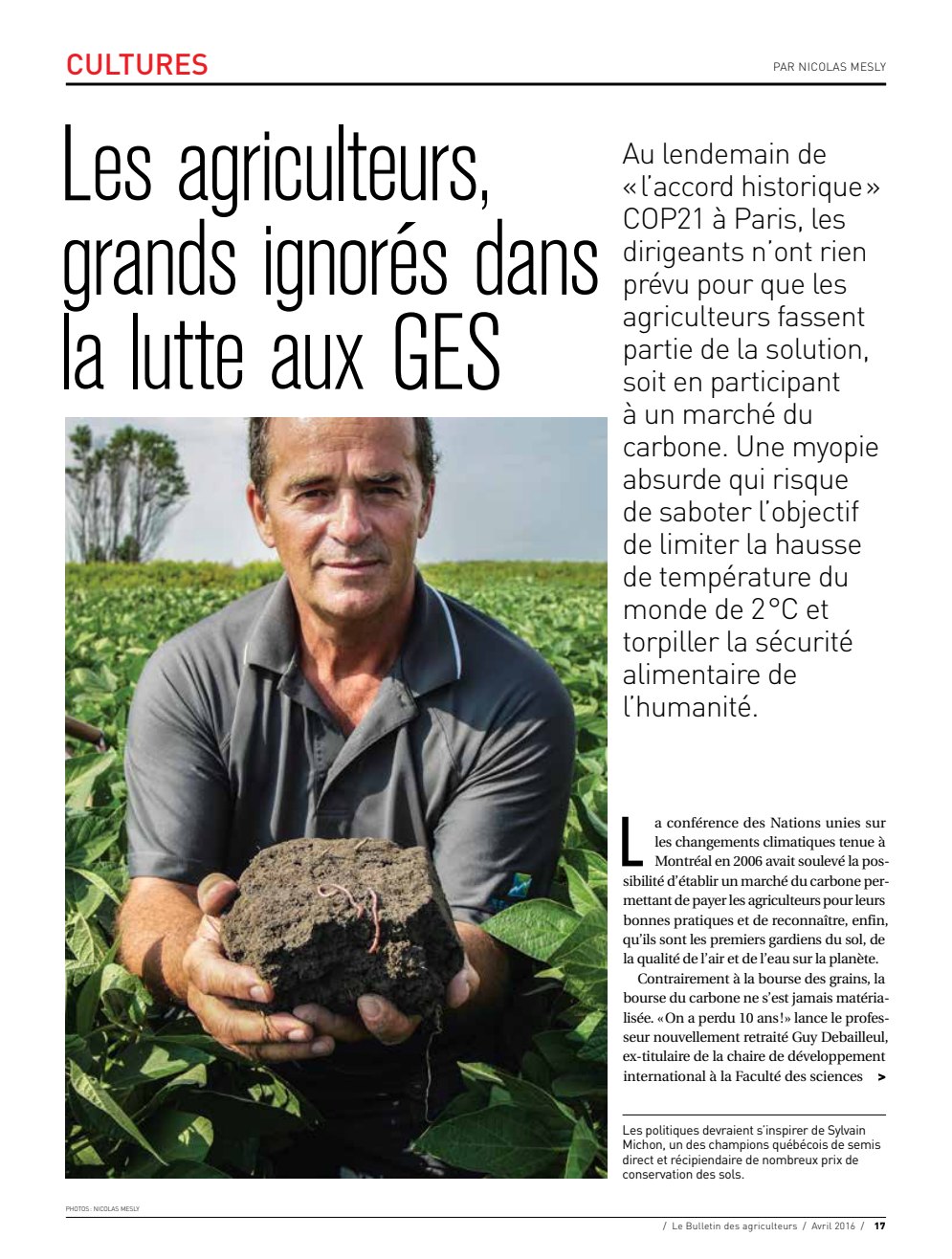
The complete story
/ The Farmers' Bulletin / April 2016 / 17 BY NICOLAS MESLY Farmers, big ignored in the fight against GHG CULTURES The day after the COP21 "historical agreement" in Paris, leaders have not planned anything for farmers to be part of the solution, either by participating in a carbon market. An absurd myopia that risks sabotage the goal of limiting the world's temperature rise by 2°C and torpedoing the food security of humanity. L PHOTOS: NICOLAS MESLY Policies should be inspired by Sylvain Michon, one of Quebec's direct seeding champions and recipient of numerous soil conservation prizes. at the UN Climate Change Conference held in Montreal in 2006 had raised the possibility of establishing a carbon market that would allow farmers to pay for their good practices and finally recognize that they are the first custodians of the soil, air quality and water on the planet.
Unlike the grain exchange, the carbon exchange has never materialized. "We have lost 10 years!" launches newly retired professor Guy Debailleul, former holder of the chair of international development at the Faculty of Science CULTURES 18 / April 2016 / The Farmers/Agriculture and Food Bulletin of Laval University. The latter travelled the long way from Montreal to Paris where COP21 was held last November, bringing 195 countries together and whose goal is to limit the global temperature rise to 2oC by injecting $100 billion of public funds by 2020.
Several decisions explain the failure of global leaders to recognize farmers as a central pillar of the "decarbonization" of industrial countries. First, Stephen Harper's conservative government "who denied the Kyoto agreement," says Guy Debailleul. The newly elected US President Barack Obama also quickly disappointed the possibility of establishing a carbon market in the face of a conservative US Congress, which blocked any attempt to regulate the pollution market because of fear of making the US economy less competitive against the Chinese dragon.
Without an agreement on establishing a carbon market between the two largest economies in the world, the United States and China, which are at the same time the world's two largest polluters, a global pollution exchange died on the show. Chinese people choke under a smog cover. And Americans, faced with repeated droughts, recognize that climate change is caused by man. Today there is a glimmer of hope," continues Guy Debailleul.
SOIL, A FORMIABLE CARBON POWER! In Paris, the role of agriculture has unfortunately been ousted, says Guy Debailleul, with the exception of a parallel French initiative called "4/1000: soils for food security and climate." The 4/1000 ratio, however small, represents the annual growth rate of organic matter, crucial to soil fertility to feed 9.5 billion people by 2050, and the potential to prevent the planet from cooking. According to some experts, the soil of our blue planet would indeed be a carbon sink as great as the oceans, but the soil is much more within the reach of human management.
This through cropping practices aimed at increasing GHG emissions Over-receiving the CARBON MARKET ACTUAL GHG Emissions Actual GHG Emissions Reduced GHG Emissions Allocations Offset Units Offset Credits Auction and Over-the-counter Credits SALED CARBON TRADES EMETTOR B organic matter, a CO2 capture tool par excellence."The 4/1000 initiative is to be developed, but does not include the establishment of a carbon exchange that would allow producers to be paid," explains Christophe Malvezin, agricultural advisor at the French Embassy in Washington, D.C., and met last January during his visit to Montreal.
The European Union (EU) was the first region in the world to establish a binding carbon market to combat GHGs. Unfortunately, "the agricultural sector is excluded from the European carbon exchange because it is not known what the potential for soil mitigation is. This requires a lot of scientific research to quantify and then certify this potential," adds Malzevin. The same problem arises with the 4/1000 initiative.
According to the French attaché, about 100 countries are committed to this new initiative, including Canada. But how will the country engage under Justin Trudeau's government? Mystery and gumball. The maple trees, the lung of Quebec?
Quebec maple trees have sequestered 1.2% of Quebec's greenhouse gases (GHGs), i.e., the capture of 290,000 cars or 9% of Quebec's fleet. By including undeveloped maple maple trees, the maple carbon capture account amounts to 3.3% of the GHG emissions in Quebec, equivalent to 770,000 cars or 25% of the fleet, reveals a study by the AGECO group published in February 2016 (Evaluation of ecological goods and services associated with the maple trees in Quebec). According to François CharronDoucet, Scientific Director at AGECO, the maple trees store more carbon than they emit.
Forests are the subject of a major scientific debate about their carbon balance. According to the World Resource Institute (WRI), forest (forest degradation and change of vocation) contributes to almost 6% of the GHGs emitted by humans on Earth. Ammonitrates, such as YaraBela CAN 27 from Yara, are more reliable because of their composition. Here is why: • Ammonitrates contain a higher proportion of nitrogen in the form of nitrate than nitrogen or l ́urea solutions. • Nitrate is more easily absorbed by the roots of crops. • Nitrate availability for crops is immediate since it does not need to be previously transformed into soil. • Ammonitrate absorption depends less on weather conditions than other nitrogen inputs. • Their loss by ammonia volatilization is much less than with nitrogen or lÂurea solutions.
Yara's YaraBela CAN 27 is one of the most efficient and reliable sources of nitrogen, with an environmental impact that is lower than other nitrogen products. You knew: all nitrogen fertilizers are not equally effective. Optimizing yield, preserving the environment n Earth ploughing n Prairie Ammonitrate UreaSolution 3% 25% 20% 15% 10% 5% 0% 2% 27% 22% 14% Loss by volatization as % of nitrogen contributed Source: UK Ministry of Agriculture Study (DEFRA-2003-2005) www.yara.com CULTURAL 20 / April 2016 / Farmers' Bulletin / Seeding advice & services at harvest Making soy a crop Our team of agriculturalists and technicians are here on the ground to advise you throughout the season.
You can only call them! 311-02/2016 Montérégie Region Adriana Puscasu 514 770-2627 Montérégie and Estrie Region Hicham Fram 514 771-3831 Laurentides Region Valentin Baciu 514 208-6639 Central Quebec Region Guillaume Vincent 819 818-7853 Eastern Ontario Region Andrew Hodges 819 208-0787 Élise Vincent 613 894-5338 Choose the higher yielding Ceresco seeds 1 888 427-7692 www.sgceresco.com WHERE IS L ENT
Our wheat exports capture more carbon than we emit," says John Bennett, president of the Saskatchewan Soil Conservation Association (SSCA), who has just released the Capturing Value Carbon Sequestration study, a 20-year research project conducted by soil science experts at Agriculture and Agri-Food Canada's Swift Current-based plant. Half of the 18 million hectares grown in Canada's attic are in direct seeding. According to the SSCA, the province represents a 22 million tonnes CO2 carbon sink.
And the potential payment to grain farmers for this service - ecological vice would range from $262 million to $427 million, based on a price ranging from $30 to $50 per tonne of pollution."We still haven't seen the color of this money," says John Bennet. In the fight against GHGs, the Belle Province has been a Canadian champion by joining with the strong man and former California governor, Arnold Schwarzenegger, to generate a California-Quebec carbon exchange. The Terminator inspired several other governors of U.S. states and premiers of Canadian provinces to form the first binding carbon market in North America, the Western Climate Initiative (WCI).
In addition, Ontario and Manitoba have announced their intention to join. Officially in operation since 2013, the WCI aims to harmonize the sale and purchase of carbon credits between 11 jurisdictions. But the Quebec agricultural sector is virtually excluded from the deal."An integration of the agricultural sector into the carbon market by the Quebec government could prove more profitable in terms of GHG control, regional development and economic benefits than the subsidized development of the wind energy sector," says Guy Debailleul.
Just 5% to 8% of Quebec's agricultural land is grown in direct seeding, as on the rest of the planet, according to Odette Ménard, a soil health specialist at MAPAQ. "Producers who are committed to this technique should be credited, because they employ three times less fuel per hectare and 40% less fertilizers. Direct seeding emits much less GHGs," she explains. "Producers can generate credits by trapping carbon in the soil, but also by reducing GHGs produced by their company.
However, WCI does not recognize this type of project. Because of its vocation in animal production, research on carbon capture had been undertaken in the Humanity region, thanks to a thin epidermis of fertile soil that covers a part of the planet and takes millions of years to form. / The Farmers' Bulletin / April 2016 / 21 Belle Province, the country's leading milk and pig producer. "We had begun to measure the emissions and capture of GHG emissions on two dairy farms in Quebec, but our research budgets have been cut," explains Daniel Masse, a researcher at the Sherbrooke-based Agriculture and Agri-Food Canada station.
At the time, a cow produced between 450 litres and 660 litres of methane per day was discovered to be "the equivalent of a regular car driving 14,600 km a year." And that there was a way to reduce these emissions by 10% to 20% by trading in food to produce less methane per litre of milk. However, the official announcement of a proposed measure to mitigate GHGs in the dairy sector is not long overdue, according to Jean Nolet, president of Coop Carbone. Coop Carbone is a group of the federal coop, Desjardins Group, the FondAction CSN, the Centre for Energy Efficiency Excellence (C3E) and the Quebec Energy Management Association (AQME).
"A central question is how to pool offsetting credits. Quebec farms are smaller than they are in the United States and they cannot enter the carbon market alone," explains Jean Nolet. "The certification protocol for agricultural projects between Quebec and California remains to be established," says Debbie Reed, Executive Director of the Coalition on Agriculture Greenhouses Gases (CAGG), a Washington-based coalition of more than 80 North American organizations, including Coop Carbone.
On the California-Quebec Stock Exchange, the tonne of pollution is at about $13/t CO2e. As with their colleagues in Saskatchewan, Quebec producers do not seem ready to see the color of this money. "Open your eyes!" to paraphrase the famous French agronomist, René Dumont, who has now passed away and devoted his life to defending the essential role of farmers in our societies. Indeed, the 21st century seems to be badly off.
At a time when all governments are being cut, the world's major polluters, through a global carbon market, could pay farmers for their environmental services. First, they can pay for their soil preservation. Global food security is based on an epidermis of organic matter a few centimetres around the globe. This life matrix not only guarantees air quality, but also water, preventing erosion.
The global challenge is to find mechanisms to pay producers for whatever size of their business, less than one hectare in India, China, Africa or Mexico, or 300 to 30,000 ha, or even 300,000 ha in the Americas or Europe. Is it necessary to recall that the 800 million starved in the world are agri-food producers? And that the majority is stuck in the first trenches of climate disruption. By integrating Canadian farmers into this urgent fight, Ottawa, the world's 11th largest GHG emitter, and Quebec could show themselves as true leaders.
But to do this, Guy Debailleul points out, "we will have to change current policies." The bet of the Terminator Arnold Schwarzenegger has not hesitated to set up a quota system to limit greenhouse gases (GHGs) from major polluters (cement plants, coal-fired power plants, etc.) in the Golden State and to force them to buy their skies, through the introduction of severe fines and through the exchange of pollution rights. A fertile soil to encourage research into the development of innovative solutions to the fight against GHGs.
Its bet: turning Silicon Valley's digital start-ups into state-of-the-art environmental service companies, to be the first to gain the benefits of the global pollution market. Haiti's peeled mountains no longer have organic material that serves as a sponge to absorb water. Result: rains of tropical storms and hurricanes deplete their flanks by taking over everything from their villages, including villages. Nicolas Mesly is an agro-economist and freelance journalist specializing in agri-food issues.
It covers field crops for The Bulletin.
Complete original publication
The complete facsimile presents the publication in its original editorial design.
Open original PDF ↗