LONG-FORM REPORT · 2016
The agricultural stakes of the Indian tiger
4 pages · 2260 words
Open original PDF ↗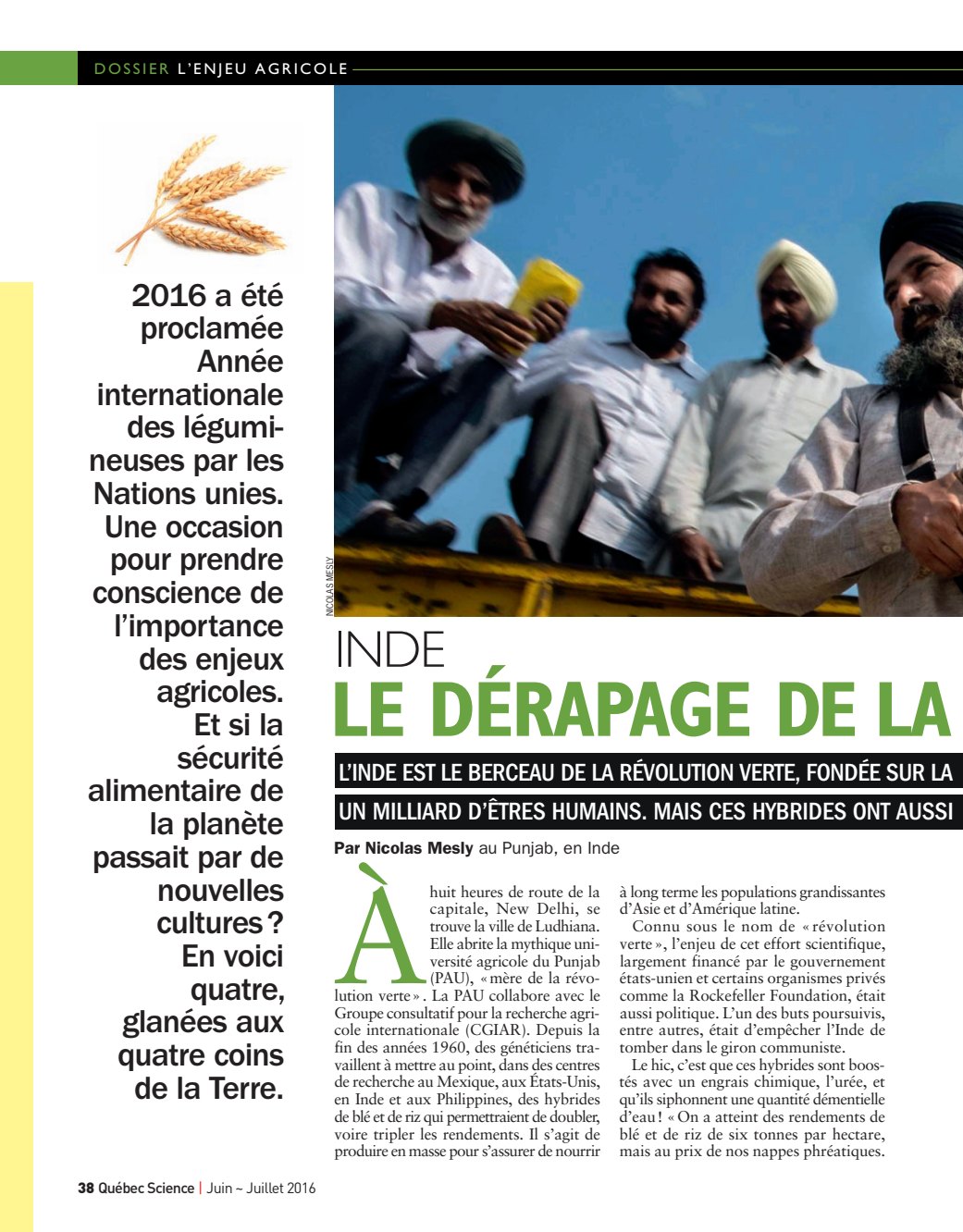
The complete story
The city of Ludhiana is located in New Delhi, where the city is home to the mythical Punjab Agricultural University (PAU), the "mother of the green revolution." The AAP has been working with the International Agricultural Research Advisory Group (IARC). Since the late 1960s, geneticists have been working to develop wheat and rice hybrids in research centres in Mexico, the United States, India and the Philippines that would double or triple yields.
The aim is to produce a massive amount of food to ensure that the growing populations of Asia and Latin America are fed in the long term. Known as the "green revolution", the stakes of this scientific effort, which was largely financed by the US government and some private organizations such as the Rockefeller Foundation, were also political. One of the aims pursued, among other things, was to prevent India from falling into the communist giron. The problem is that these hybrids are boosted with chemical fertilizer, lukewarmed, and that they sphon a demented quantity of water!
"We have achieved yields of wheat and rice of six tons per hectare, but at the price of our groundwater. D O S S I E RL
What if the planet's food security was going through new crops? Here are four, gleaned from the four corners of the Earth. 38 Québec Science & Science & Science ~ July 2016 INDIA THE DERAPAGE OF R NICOLAS MESLY AgricultureQS June-July 2016_Layout 1 16-05-05 3:47 PM Page 38 ON THE DISCOVERY OF BLE AND RIZE HYBRIDS WHO, IT IS SAID, HAD AUSSI FAIM WELCOMED TO AN ECOLOGICAL AND FOOD CATASTROPHY. The next green revolution must preserve our natural resources," says Rajan Aggarwal, a soil and water specialist at the PAU.
To cultivate the paddy – the complete rice – we are digging the soil with a multitude of wells. More than 12 million pumps are sphoning the water table! Irrigation is such that Punjab has become the largest artificial freshwater lake on the planet. The figures declined by the specialist are amazing.
To give only one: since 1991, the level of groundwater has fallen between 10 m and 30 m! It took only one generation to empty the Punjab basement. Scientists at the UAP are therefore looking for solutions for a more sustainable agriculture. First, they are planting on varieties of early basmati rice.
Ready to be harvested at 100 days rather than 130 or 140, they require less water. Then, they encourage farmers to use a laser machine (which costs more than $25,000) to level their fields. The device saves 15% to 25% water. They add that, for 10 years, a third of the cultivated area of the state has been levelled thanks to this miracle device "made in Punjab".Finally, they opt for drip irrigation systems, which more and more farmers already use.
The ultimate goal of the UAP is to reduce water consumption and allow monsoons to recharge aquifers. As in the rest of India, 60% of Punjab's cultivated land is rain-fed and 40% is irrigated. However, according to the ex-dean of the UAP, the agro-economist S.S. Johl, it is the green revolution that has transformed Punjab into a rice producer.
The region was first wheat producer. The farmer is formal: Punjab, already in water deficit, should not produce such quantities of rice. At the same time, he denounces the over-grazing subsidies of New Delhi which, according to him, are the veJunin ~ July 2016
AgricultureQS June-July 2016_Layout 1 16-05-03 10:17 AM Page 39 D O S S I E RL 的 E N J E U A G R I C O L E P , K... Azote, phosphorus and potassium are the major elements that plants need in large quantities to grow. Besides, it is the percentage of each of these elements present in the preparation that are referred to by the three figures on the fertilizer packaging (e.g. 20-10-20). Mixed with soil, these elements penetrate into the plants by their roots. If nitrogen and potassium compounds are found or are manufactured relatively easily – and anywhere – phosphorus is more localized.
Usually, it comes from a few deposits of phosphate sedimentary rocks whose strata have accumulated for millions of years at the bottom of ancient seas now extinct. The main deposits are in Morocco, China, the United States and Syria. The ore from these deposits is a variety of calcium phosphate called apatite. As it is, apatite is not very soluble; it must be treated with sulphuric acid to be assimilated by plants.
It is called superphosphate. Like all minerals, apatite is a non-renewable raw material and one will eventually have exploited all the deposits. Hard to know this moment, however: 50 years for the most pessimistic; a few centuries for the most optimistic. Whatever the case, without apatite, agriculture as it is today will only be perishable.
But this is without counting on mycorrhizae. These underground mushrooms, in the form of fine filaments, associate intimately with roots and increase the volume of soil from which the plant can draw resources. "In addition, mycorrhizae are capable, thanks to the responsible for the plundering of groundwater. Producers do not pay for water or electricity, they receive subsidies for urea and diesel, in addition to obtaining guaranteed prices for rice and wheat cultivation.
This encourages a wasteful waste of resources and a "pump-up" attitude between producers. e along the road leading from Ludhiana to Bathinda to Chandigarh, the capital of Punjab, the wheat fields are going from green to gold. We are in early March and, in three weeks, thousands of harvesters will beat the grain there. J'ao regularly see huge, lying round ears, as if elephants s'y were ploughed. This pouring is not due to wind or hail, but too much use of the dried, is explained.
The wheat hybrids of the green revolution were designed to have short straws that allow them to resist the weather. Too dairy makes the plants grow proud, weakening the stems, which bend under the weight of the ears. Result: the grains are eaten on the ground by rats and birds. That the green revolution has derailed, this is the proof.
It must be said that the urea, heavily subsidized by New Delhi, costs less than salt, which encourages its overuse. The government of the current Prime Minister of India, Narendra Modi, is considering directly transferring to producers the subsidies – estimated at nearly $13 billion a year – currently granted to fertilizer manufacturers. But this would increase the price of fertilizer on the farm, a not very popular measure. I prefer that the subsidies for urea remain in the hands of manufacturers.
Because I don't want to wait a month until I get reimbursed by the government," says Haridenyat Gill, a cereal producer who was met on his farm near Lidhuana. In addition to weakening the plants, this overdose of the spread throughout the country burned the soil. India has a cereal yield per hectare per amount of fertilizer applied lower than China and twice as much as the US. That's why Narendra Modi launched a large-scale program last February called "National Soil Map".
The aim of this operation is to provide soil analysis laboratories with more than 2,000 outlets for fertilizer companies over the next 3 years. According to this plan, each producer will have his soil map. He will thus know the nitrogen, phosphorus, potash and microelements needs of his soil lopin, as well as his organic matter rate. "It is a win-win situation since producers will use less dry water.
The government will save 40 Québec Science!June ~ July 2016 N L QUEBEC APATITE, BACTERIES, MYCORHIZ ON NYAUT THE FARTER THEM WE HAVE AVAILED! By Joël Leblanc EYE OF SCIENCE/SPL An electronic microscope mycorrhizal AgricultureQS June-July 2016_Layout 1 16-05-03 10:17 AM Page 40 d的 huge subsidies and soil health will improve," said P.K. Joshi, Director of South Asia of the International Food Policy Research Institute (IFPRI), based in New Delhi. Some 140 million soil health maps have already been issued by the Indian Ministry of Agriculture.
"These soil tests are not enough! We need to increase their fertility by reducing our dependence on chemical fertilizers, by promoting crop diversity and rotation," says Vibha Varshney, editor of the Down to Earth magazine, published by the Center for Science and Technology, also based in New Delhi. "To break down monocultures of wheat and rice, she suggests the adoption of agricultural policies that would, for example, promote the cultivation of lentils, champions of all categories of ecological matters.
The country is not very rich in water, but would be able to regenerate the soil with natural nitrogen and reduce the intake of water. Moreover, the country is very poor (Canada provides 40% of the lentils imported by India). This crop would have beneficial effects not only on agronomics but also on nutrition, as the lens is rich in iron. "This second green revolution must also take into account the food deficiencies of the Indian population.
Almost 90% of pregnant women in the country are anemic!" adds A. Kishore, responsible for sustainable agriculture and climate change at IFPRI. It remains to be seen whether the government will give the necessary impetus to realize this new green revolution.IQS June ~ July 2016
Superphosphates are so soluble that they are quickly leached by rainwater. Ordinary phosphates stay longer in the soil, and they can be used as a source of phosphorus to a plant if it is helped by mycorrhizae." But there are also igneous deposits of apatite, i.e. from the cooling of the magma. They usually contain less d-apatite than sedimentary deposits and it is harder to separate from the rock, because it is harder.
This source of phosphorus is of less good quality for fertilizers, and has been neglected for a long time. With the announced shortage, however, it becomes interesting. Especially thanks to the broadening of knowledge on mycorrhizae. Where farmers once applied superphosphates, they can now inoculate the soil with mycorrhizae to favor symbiosis with the roots of plants, then fertilize the soil with ordinary phosphates.
"Through the mycorrhizaes, J. André Fortin continues, these phosphates provide as much phosphorus as superphosphates, and since they are not likely to be washed by rains, we don't need to put so much." These mycorrhizae have been offered in the form of powder for some years and the farmers are increasingly adopting the formula. L-apatite igneous, it, waits in the soil.
In Quebec, two companies are planning to start mining in the near future: Mine Arnaud in Sept-Îles and Arianne Phosphate in Saguenay. A slightly greener agriculture that the mining industry could support here... The situation has been even more interesting since a team from Laval University demonstrated a year ago that the plant-mycorrhiza association could be further improved by the arrival of a third player: bacteria present in the soil, capable of secreting organic acids and dissolving the disease.
These bacteria make phosphorus even more available to mycorrhizae who in turn transmit it to the plant.1 There are also interesting initiatives in different parts of the world to recover the huge amounts of phosphorus in our excreta and in farmed animals. In Vancouver, for example, a company has developed promising technology that allows up to 90% of the phosphorus in the wastewater to be recovered by a biological process. It turns it into an economic fertilizer that is directly used by farmers.
The process already produces 2,000 tons of fertilizer per year at the sewage treatment plant in Edmonton, Alberta. 1 The discovery has earned researchers a place in our list of 10 discoveries of 2015 and was the favourite of our readers. See Quebec Science, January-February 2016, p. 25-27. Water is a critical issue in Punjab and Uttar Pradesh, among the poorest states in India. This peasant draws vital liquid from an underground table with a diesel pump.
RHIZES AND USES NICOLAS MESLY AgricultureQS June-July 2016_Layout 1 16-05-03 10:17 AM Page 41
Complete original publication
The complete facsimile presents the publication in its original editorial design.
Open original PDF ↗