The complete story
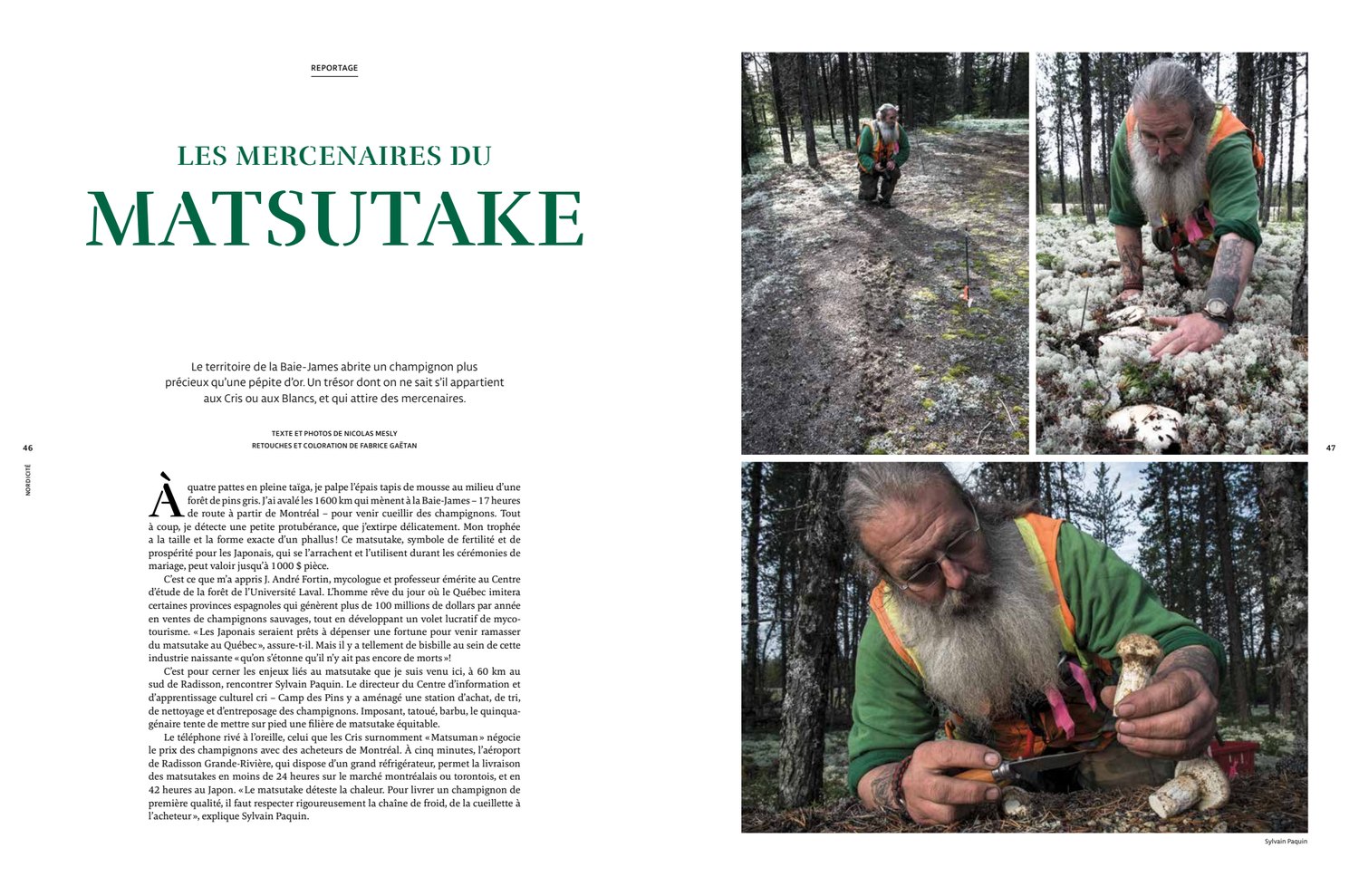
On four legs in the middle of taiga, I climbed the thick foam mat in the middle of a forest of grey pines. I swallowed the 1,600 km that leads to James Bay – 17 hours of driving from Montreal – to pick mushrooms. Suddenly, I detect a small protuberance, which I gently extirpate. My trophy has the exact size and shape of a phallus!
This matsutake, symbol of fertility and prosperity for Japanese people, who are tearing off and using it during wedding ceremonies, can be worth up to $1,000 apiece. This is what J. André Fortin, mycologist and professor emeritus at the Centre d'étude de la forêt de l'Université Laval, learned. The man dreams of the day when Quebec will imitate some Spanish provinces that generate more than $100 million a year in wild mushrooms sales, while developing a lucrative component of myco - tourism.
"The Japanese would be willing to spend a fortune to pick up matsutake in Quebec," he says. "But there is so much bisbille in this emerging industry "that it is surprising that there are no dead yet!" I came here 60 km south of Radisson to identify the issues related to matsutake. Sylvain Paquin, the director of the Cree Cultural Learning and Information Centre – Camp des Pins, has set up a station for the purchase, sorting, cleaning and storage of mushrooms.
The Quintagénaire, an impossible, tattooed, bearded man, tries to set up a fair matsutake line. The ear-ridden phone, the one that the Cree nicknamed "Matsuman" negotiates the price of mushrooms with Montreal buyers. Five minutes away, the Radisson Grande-Rivière airport, which has a large refrigerator, allows the delivery of matsutakes in less than 24 hours on the Montreal or Toronto market, and in 42 hours in Japan. "Matsutake hates heat.
To deliver a first-class mushroom, you must strictly respect the cold chain, from picking to buying," explains Sylvain Paquin. MATSUTAKE MERcenAIRES The territory of James Bay is home to a mushroom more precious than a gold nugget. A treasure that is unknown to the Cree or whites and attracts mercenaries. NICOLAS TEXT AND PHOTOS MESLY RETOCHES AND COLORATION OF FABRICE GAËTAN Sylvain Paquin 4746 NORTHICITY REPORTING We are in September, at the beginning of the harvest season, which lasts about a month.
A good harvester can harvest 20-25 kilograms a day. The value varies depending on the quality of the fungus, which, the open collar, can reach the size of a plate. In 2015, the price offered to harvesters was $15 per kilogram; while at the Jean-Talon market and in the specialty shops of Montreal, the king of mushrooms retailed up to $80 per kilogram. A GISEMENT THAT MADE JAPANAIS LENVIE Between 2005 and 2008, the Camp des Pins served as the basis for a research consortium led by J.
André Fortin and Professor Jean-Marc Moncalvo, Senior Mycology Curator at the Department of Natural History at the Royal Museum of Ontario in Toronto. Their work, funded by the Natural Sciences and Engineering Research Council of Canada, has identified 350 species of fungi, including the matsutake, along the James Bay Road and around the Cree communities of Chisasibi and Wemindji. It was still to assess the value of this formidable matsutake deposit. It is what Biopterre, a Quebec company specializing in the development of bio-products, did.
In 2009, after adapting a technology for remote sensing and the use of spatial data, it succeeded, in collaboration with Crees, in locating the slabs of these mushrooms (also called "witch circles") in the Jamasian territory, which is large as Germany. The company cost the deposit at the time to a million dollars. Today, Sylvain Paquin estimates the potential harvest to be 75 to 100 tons, along the James Bay road only. An 8 million dollar manna!
A LAND CONFLICT "The people of the south [of the province] come here to pick mushrooms or hunt without permission. If they did this on land in Montérégie, they would be shot at!" said Eric House, Director General of the Chisasibi Business Development Centre. The Cree territory, he explains, is composed of 300 traplines, controlled by tallymen, or trapmasters, who manage the animals and plants while protecting the sacred places. In 2010, the Cree Trappers Association demanded that the harvesters of non-wood forest products (NPFPNL) obtain permission from the trapmaster before making commercial crops.
The matsutake is just one of the many species of PFNL listed on a territory that is full of blueberries, Labrador tea, and sand pepper... The request has remained a dead letter. To preserve the resource, Sylvain Paquin advocates the formation of recreational or professional harvesters and a supervised harvest. He would also like a permit, such as for hunting and fishing, and even a harvester's passport to be issued, and he would like to see GPS identify the volumes and parcels harvested, in order to ensure the traceability of a food that could be fatal, for example if the matsutake was confused with a toxic fungus or was rendered inedible as a result of contamination.
The precious mushroom is not inspected by the Ministère de l'Agriculture, des Pêcheries et de l'Alimentation du Québec. The man oversees the production of the matsutakes on the hatch line of the Cox family, to which the Camp des Pins belongs. He documents the dates of hatching, the yield of the plots, and, armed with his camera, the invasion of those whom he calls "mercenaries", whose excesses he denounces on his Facebook page. In one of the plots he shows me to visit, the mushrooms were harvested by kicks; in another, the passage of 4 x 4 and motorcycles, whose traces are still visible, has forever destroyed the fragile circles of witches.
But the idea of a supervised harvest is far from being achieved. In Radisson, the brothers Kevin and François Charest, two harvesters who grew up in the village, oppose it: "It's as if one could pick piasters on land. It's the gold rush!" Their harvest brings them about $2,000 a year, enough to finance their moose hunting.
They are not defending themselves as "mercenaries." Both claim to have the consent of a tallyman, feel they do not need training and refuse to reveal to anyone the GPS coordinates of their tiles. Since 2006, a dozen entrepreneurs have been interested in the Jamaican deposit, including Pascal L
However, his relationship with Sylvain Paquin quickly turned vinegar, among other things, about the payment of a royalty to the Cox family. The price of the matsutake is determined by the Japanese. "We cannot pay a fee of one dollar a pound [2.2 dollars per kilogram] to the owner or master of the trap line, because the market for mushrooms is good a year and sea - says the following year. It would not be profitable!" explains Pascal L
"If a charge applies to the camels, will one be imposed on the blueberry or atoca harvest, or on moose hunting?" added Normand Lacour, president of Radisson's Economic Development Corporation. "If he is not an expert in law, he indicates that the harvests along the James Bay Road are on lands classified as public lands under the James Bay Agreement. However, according to James O的Reilly, an Aboriginal law specialist, "the Cree should be able to charge a royalty on the commercial exploitation of the matsutake, as well as on the exploitation of a mine."
L'AVENIR In 2015, the Charest brothers were unable to finance their moose hunting by selling matsutakes. At the price Forestia offered them for a 2000 kg order, they failed to hire the eight Cree harvesters needed to gather. Pascal L
While lamenting the conflict that drove West Coast Wildlife away, he said: "Our goal is to create jobs for our young people, businesses run by Crees, and to provide the resource for future generations." J'ai left Matsuman, his bunker and his dog horde after spending seven days at Camp des Pins. Mad for one, genius for the other, he managed to sell only a hundred kilos of mushrooms in the Montreal market in 2015. The matsukes deposit in Baie-James arouses the confidence and passions.
And successful exploitation has its share of challenges. The golden mushroom may sleep in witch circles for a long time. The mycelium that produces the matsutakes feeds on the sap of the roots of grey pines, hence their nickname "pin mushrooms". These hatch in circles or semi-circles and can reach the size of a house.
In fact, matsutakes grow in symbiosis wherever there are jack pines on the planet – in China, Japan, the United States, Europe... They are also found in Quebec, both in the north and in the south. Michael Gervais, professional picker 48 49 NORDICITY
Complete original publication
The complete facsimile presents the publication in its original editorial design.
Open original PDF ↗