The complete story
Somewhere in the Gulf of St. Lawrence, on the border with Quebec and Newfoundland, would hide a beautiful little pactole; Old Harry, a deposit of 5 billion barrels of oil. Ever seen in eastern Canada! Will Quebec finally see its old dream of the 1970s come true: to see oil spring out of its basement?
Old Harry, which is so much discussed, is far from unique. It has long been known that the Gulf contains oil geological formations. It has been identified in Anticosti Island and in Gaspésie. Petrolia company already extracted nearly 40 barrels a day near Gaspé, and it is only at the exploratory stage.
In February, during its annual meeting, oil also announced its intention to drill two new wells in the "Bourque" area near Murdochville. According to the company's management, it would be a large geological structure with a potential of 100 million barrels. These hydrocarbon deposits, whether underground or underwater, all formed in the same way, before the animals were released from the water. The Gulf region was then located in Ecuador.
The water was hot and life was spreading there. A layer of organic matter, mainly seaweed, was deposited at the bottom. Then, gradually, it was covered by other sediments which gradually plunged it into the basement. The combined action of the pressure and the heat of the earth "cooked" this organic material, transforming it into oil or gas.
The hydrocarbons then tended to rise to the surface and migrated to a porous rock – called "reservoir rock" – which, in some places, is covered with an impermeable layer that traps oil. Two large geological basins are identified. The first, the Anticosti, covers the island of the same name and extends into the middle of the river, to Newfoundland. It looks like a huge, floor cake.
The age range of the species is 410 to 490 million years. The organic matter is trapped in the macasty shale rock, the macasty shale. A second basin, Madeleine, extends to the coasts of Nova Scotia, New Brunswick and also Newfoundland. It includes the Magdalen Islands archipelago.
This large basin dates from the Bo nary Cari n, is 280 to 350 million years old and looks like a deformed cake. There are faults, folds, peaks caused by the birth of the Appalachian mountain range. Its mother rocks also contain fossil remains. One of the d'elles contains even coal from the decomposition of plants and trees.
The presence of organic matter in the two main Gulf basins makes it potential oil and gas reservoirs. This has not escaped oil companies. Since the 1970s, a dozen exploratory wells have been drilled in the Gulf of St. Lawrence by various companies. La 32 Québec Science
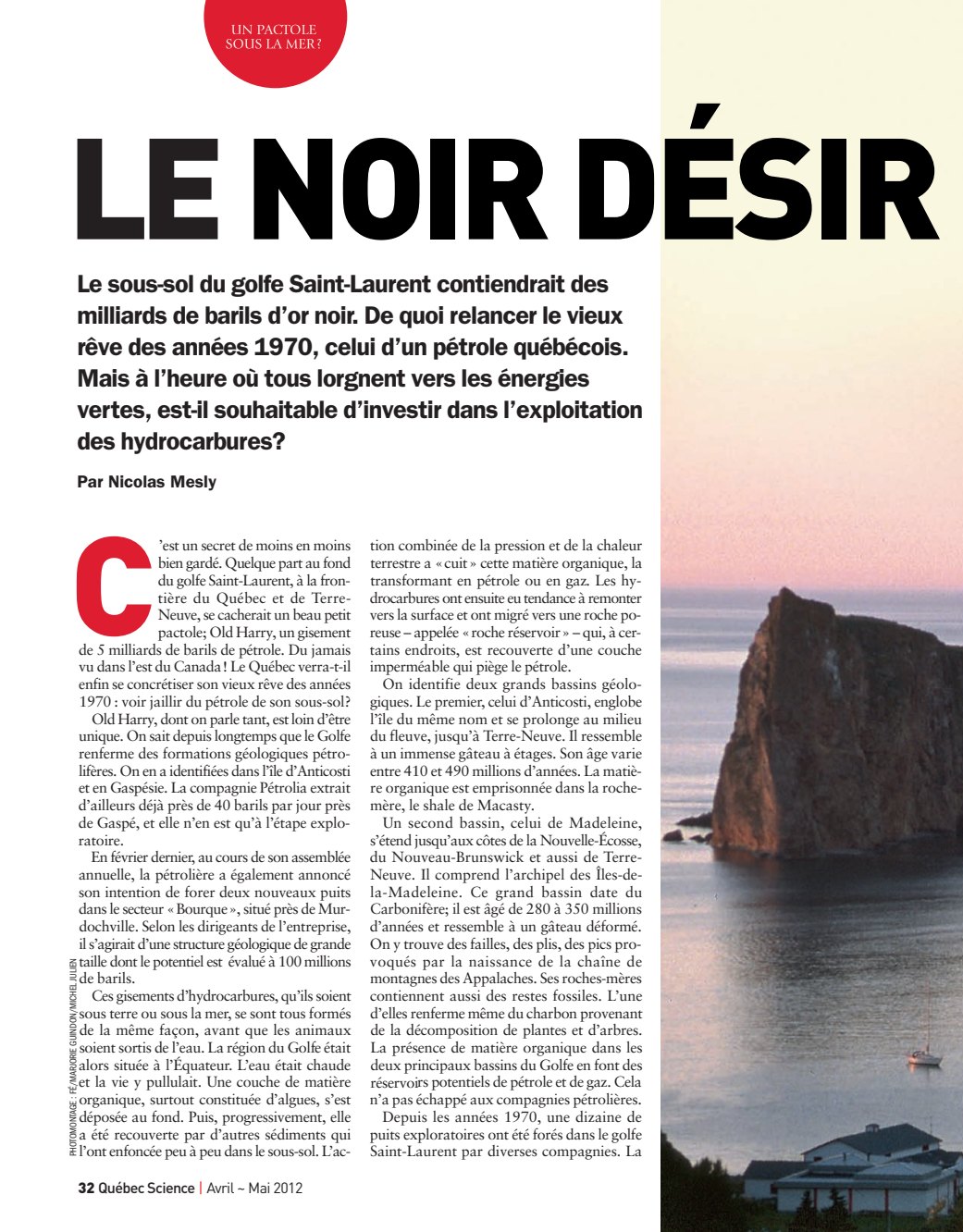
What is the idea of reviving the old dream of the 1970s, that of a Quebec oil? But at a time when everyone is looking for green energies, is it desirable to invest in hydrocarbon exploitation? By Nicolas Mesly LE NOIR DESIR D CPHOTOMONTAGE : FÉ/MARJORIE GUINDON/MICHEL JULIEN Pétrole QS April-May 2012_Layout 1 12-03-15 5:36 PM Page 32 April ~ May 2012
Four of these wells have revealed tiny traces of hydrocarbons, and only one of them seemed promising. Five other wells have also been drilled on the mainland, notably in Prince Edward Island and Nova Scotia. Corridor's chief geophysicist, Paul Durling, had to do a real detective job to get an idea of the potential of the Madeleine Basin. He was particularly interested in the Brion Island well, located in a steeple of the Magdalen Islands Archipelago, and dug in 1970 by HydroQuébec, in partnership with a subsidiary of Texaco.
Geochemical analyses of the mother rock samples collected in this well revealed the existence of a type of organic material that would indicate the presence of oil or an oil and gas "combo". And using software to visualize the geological formation of Old Harry, the Corridor team found that the potential was much greater than expected! But the computer has its limits. Corridor Resources announced that it would conduct exploratory drilling by 2015.
"We cannot yet be sure of the quantity and nature of oil: light, heavy or sulphurous," said Philip Knoll, president of Corridor Resources. "To know that, we need to dig a well." There is, however, something to be confident about.
The salt rock is known to be the most impermeable in the world, capable of keeping any hydrocarbon deposit waterproof. Old Harry is the most studied geological structure in the Gulf of St. Lawrence. But most of the data date back to the 1960s and 1970s. "To know exactly what it contains, seismic surveys should be repeated with more modern appliances," says Michel Malo, professor of structural geology at the National Institute for Scientific Research (INRS).
The devices used at the time could be compared to a black and white television, whereas those used today are like a plasma-coloured television." In short, they would make it much clearer. Except that in 2004, Quebec imposed a moratorium on seismic surveys, particularly to protect marine mammals and fish, sensitive to powerful sound waves caused by explosions. According to the professor, the most interesting hydrocarbon traps would be distributed between the island of Anticosti and the Gaspé Peninsula, but there would be plenty of little Old Harry elsewhere.
In any case, if there is oil in Quebec, it is only interesting if we succeed in extracting it. This is not done as easily as in the Texas desert. The equipment chosen depends mainly on the geophysical and climatic environment. For the Hibernia deposit, located in the Atlantic 315 km northeast of Newfoundland, it was necessary to design a platform capable of resisting the iceberg assault.
But the weather conditions are not as difficult in the Gulf and the depth of the area does not exceed 500 m. We are far from the abyss of more than 3 km from the Gulf of Mexico. Orridor plans to drill a well in the Old Harry deposit at about 470 m depth, 80 km northeast of the Magdalen Islands. To do this, the company intends to retain the expertise of a company specialized in exploratory drilling that operates both in the oil fields of the North Sea, Norway, and off the Brazilian coast.
The cost of digging this well is expected to take 20 to 50 days. Estimated cost: $55 million. It was necessary to dig 42 dry wells before discovering the Hibernia deposit that made Newfoundland's energy fortune. The initiative is not without concern Joël Arseneau, the mayor of the Magdalen Islands, whose economy depends on tourism, fisheries and mariculture, as well as the designation of aquaculture in marine waters.
"We are not against oil development. But we are the first on the fire line," he says. Everyone remembers the explosion of the Deepwater Horizon platform, which occurred in the Gulf of Mexico in April 2010. Eleven people died and nearly 5 million barrels escaped from the well before it was sealed.
"Deepwater Horizon was in a reservoir in ultra-deep waters, and the pressure was phenomenal! It's not comparable to Old Harry's situation," says Knoll. "It doesn't stop the Gulf of St. Lawrence, an inland sea."THE SAINT-LAUR GOLFE ENT, A SEVEN INTERNAL SEA SEVEN WIND MORE THAN THE MEXICO GO LFE, AND MORE RICHLE IN BIODIVERSITY, SUPPORT IS VERY MAL A ACCIDEN T" – Émilien Pelletier, oceanographer.
The oil spill caused by the explosion of an oil rig in the Gulf of Mexico in April 2010: 11 dead, 5 million barrels spilled into the ocean! 34 Québec Science的April ~ May 2012 C JIM EDDS/SPL (cont'd on page 36) Oil QS April-May 2012_Layout 1 12-03-20 1:35 PM Page 34 New Zealanders are proud of their country, composed of two paradise islands planted in the Pacific Ocean. And they quickly mobilize after an ecological incident. Just like the reservists of the Swiss army, they are "always ready."
On 5 October, when the Renas-cargo was ventilated on a reef 20 km off the coast, causing the worst marine ecological disaster in the country, the population soon reacted. A few hours after the shipwreck, Docteur Brett Gartrell, a veterinarian at Massey University, began to launch his plan for the rescue of marine animals, which is based on a hard core of about 20 professionals throughout the country who are able to quickly mobilize volunteers.
"The question is not whether an accident will happen, it's always when," he explained during my visit to the rescue centre, three weeks after the disaster. Over the last 20 years, this device has been tested on a few occasions during small spills. But this time, the disaster has proved to be major: the Rena had 1,712 tons of oil on board, 350 tons of which escaped in the first hours of the disaster. At the height of the crisis, about 100 volunteers were engaged in cleaning seabirds in this "refugee camp" for animals, consisting of white tents and swimming pools with small blue penguins.
Some 400 birds were rescued, including some 60 red plovers, an endangered native species, and more than 2,000 were frozen in a container pending autopsy. Nine more were known to have died in a spill, and an estimated 20,000 birds died in the fall.
Dr. Chris Battershill, a beach-based expert in coastal marine ecology, collected small, nausea-like oil pellets for analysis. Dr. Chris Battershill is responsible for assessing environmental damage by comparing the state of the sea and the reefs before – and after – the shipwreck. Around him, about fifty volunteers dressed in white buckwheat were searching the sand of their gloved hands. The beach looked like a huge cat litter.
About 20 kilometres off the turquoise sea, the pathetic carcass of the Renaet was visible with its 1,712 containers. "We're cleaning up the mistake of an idiot!" was raging Mary Molphy, one of the volunteers kneeling in the sand. An investigation is under way to understand how the Captain of the Rena – suspected of having been drunk at the time of the accident – was able to get away from her road and hit the Astrolabe reef, which is known to all sailors. The famous James Cook had identified it on a maritime map in 1769!
"If a country decides to embark on the offshore development of the oil industry, it is its responsibility to establish a protective mechanism at the same time, so as to mobilize volunteers in the event of an accident in order to collect the oil as quickly as possible," recommends Professor Battershill. According to the scientist, the Rena accident was a lesser harm because the fuel was spread on the banks, and thus easier to recover. If the oil had drifted on rocky cliffs, it would have been another story.
The approximately 8,000 volunteers trained to clean up the damage have collected over 1,000 tons of heavy oil and waste from the ship, as well as damaged containers at sea.This system of intervention, which relies on trained volunteers, is an integral part of the New Zealand government's oil spill emergency plan.
By Nicolas Mesly Chris Battershill, University of Wakaito, New Zealand: "If a country decides to embark on the offshore development of the oil industry, it is its responsibility to establish a protective mechanism at the same time."NICOLAS MESLY MARITIME NEW ZEALAND April ~ May 2012
The region is home to dozens of rare or threatened species such as the leatherback turtle, beluga or fin whale. One of the greatest dangers in the event of a spill is the formation of a glaze-like mixture, he explains. A very serious risk since ice is present six months a year. "Under these conditions, the mixture is irrecoverable.
We could do nothing," says Émilien Pelletier. "Ice can act as a summer break to protect the banks, but in reality it is more likely to drift with winds and currents by taking its polluting load. However, recent research has shown that the seas and oceans are recovering better than what we thought of such disasters. "Oil-sweet" bacteria.
In a recent study by the American Society of Microbiology (ASM), it is learned that, thanks to its bacterial colonies, the Gulf of Mexico has recovered its health after the tragedy that it has been taking place. It has long been known that families of bacteria adapted to their environment are able to digest oil in tropical waters. But for the ice waters, there was serious doubt. The director of the Centre for Petroleum, Gas and Other Offshore Energy Research (CRPGEE), Dr. Kenneth Lee of Fisheries and Oceans Canada (DFO), who participated in the study of the ASM and conducted his own experiments in the Gulf of St. Lawrence, claims that he has "an irrefutable proof that low temperatures do not delay as much as thought the degradation of oil in the marine environment."
Émilien Pelletier is far from believing it. "The link between the rate of oil biodegradation and temperature is obvious. That's why we put our food in the fridge, because it slows down the work of bacteria," says the UQAR researcher. At best, we can accelerate or decrease the rate of oil degradation by adding nutrients to increase the work of bacteria.
This is why we must think twice before we go ahead. According to the government's estimates, with less than half of the reserves in this deposit, Quebec would cover, for more than 25 years, the equivalent of all its natural gas needs (yes, natural gas, because even if it is oil, DFO does not give any estimates of oil; by a strange detour, it prefers to opt for natural gas equivalence, probably because it looks cleaner!). In any case, these figures are far from unanimous.
"This is a matter of pure speculation," says Michel Malo, INRS. "We may know more soon. Québec commissioned a strategic environmental study from GENIVAR to assess the potential for oil exploitation in the d'Anticosti basin, Madeleine and Chaleur Bay. The report is expected to be tabled in the fall of 2012.
But whatever the conclusions, much discussion and exploration may be needed before Quebec oil can be offered at service stations. In 2011, Quebec passed legislation to prevent the development and exploitation of hydrocarbons in the estuary and northwestern part of the Gulf of St. Lawrence. Will it be judged that the risks are less in the southern Gulf than in its estuary? IQS DORLING KINDERSLEY/ISTOCKPHOTO STUDY BEFORE DEXPLOITER The St. Lawrence Coalition deplores the lack of scientific knowledge on Gulf ecosystems.
Coalition Saint-Laurent was created a year and a half ago to convince decision makers to impose a moratorium on oil and gas development in the Gulf. It brings together 65 associations representing thousands of citizens, from fishermen in the Magdalen Islands or Nova Scotia to the David Suzuki Foundation. "We are not against oil exploitation in the Gulf of St. Lawrence, but we ask that the consequences of this exploitation be better documented," says spokesman Danielle Giroux.
She said the five provinces bordering the Gulf were competing in unhealthy ways to extract the black gold that lies in the seabed. Faced with the concerns of the Coalition, T erre-Neuve was updating its strategic environmental assessment to include the impacts of the Old Harry deposit. This was to be completed in 2012 and should give the Corridor company the green light to be able to drill a first well there. "Fiscals and oil spills have no borders.
Is each province going to exploit its deposits in its own way? It needs a comprehensive vision because the Gulf is a single ecosystem," says Danielle Giroux. "At the moment, Ottawa is deaf ears. Quebec has commissioned its own environmental study from GENIVAR for its portion of the Gulf.
It is expected to be ready in the fall of 2012, but may be very limited. Its funding is only $750,000, compared to over $7 million for a similar study on shale gas. A preliminary report by GENIVAR tabled last year gives an overview of what the Quebec conclusions could be. It says that there are "non-sensitive areas" in the Quebec Gulf.
"How can we say that if there has been no study?" asks Danielle Giroux. "There is a clear lack of scientific knowledge about all the Gulf ecosystems." CORRIDOR Old Harry Newfoundland Madeleine Islands Cape Breton Island Oil QS April-May 2012_Layout 1 12-03-15 4:23 PM Page 36
Complete original publication
The complete facsimile presents the publication in its original editorial design.
Open original PDF ↗