The complete story
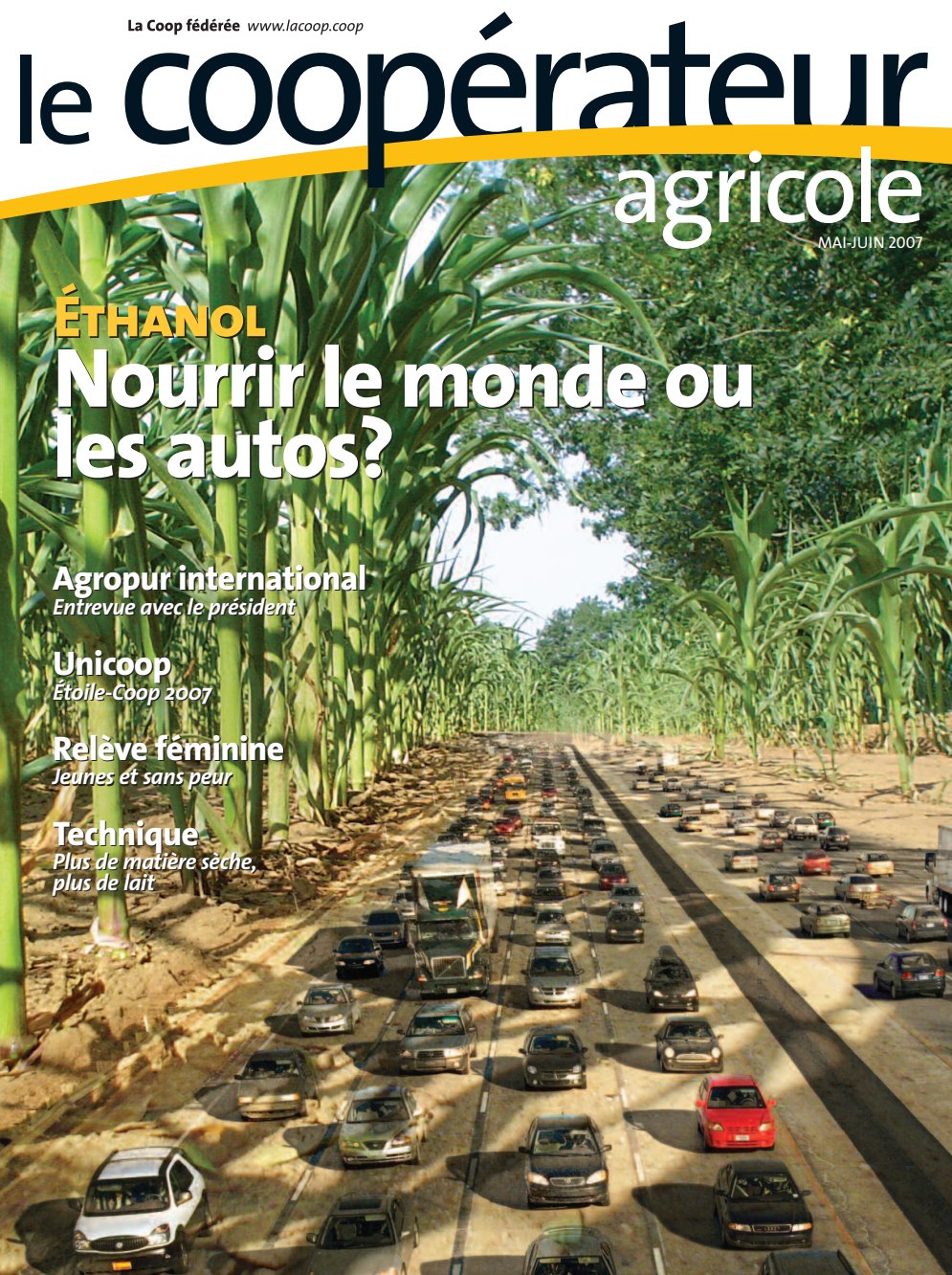
MAY-JUNE 2007 Ethanol Feeding the World or Autos? Ethanol Feeding the World or Autos? Agropur International Interview with President Unicoop Star-Coop 2007 Women's Relevancy Young and Fearless Technique More Dry Matter, More Milk Agropur International Interview with President Unicoop Star-Coop 2007 Women's Relevation Young and Fearless Technique More Dry Matter, More Milk MAY-JUNE 2007
By replacing 133 billion litres of ethanol production with oil consumption by 2017, or 15% of the gasoline consumed, and by reducing fuel consumption by 5% through improved vehicle efficiency. The United States is producing 20.9 billion litres of ethanol when writing these lines. The Bush Plan therefore plans to cut production of "green" gasoline by sex.
The country already has 114 plants and 78 are currently under construction to produce an additional 25.1 billion litres. This fulgurant demand has boosted the price of corn which, in less than a year, has doubled from US$2.00 to US$4.00 per bushel, a record unsurpassed for ten years. This is a welcome development for Agriculture Secretary Mike Johanns, who estimates that the next Farm Bill will cost US$10 billion less to the US Treasury in financial aid to farmers. The Farm Bill 2007, which is heading for American agriculture over the next five years, is to be approved by Congress next fall.
L-Ethanol, an "eco-friendly" essence? "Destroyal!" said President B-ush's ethanol plan, Ralph Rossi. The president of the American Farmland Trust, a leading producer group, called for a profound reform of the 2007 Farm Bill, including the inclusion of the principle of eco-conditionality. The prices of US$4.00 per bushel of corn and US$7.00 per bushel of soybeans will cause "the abandonment of rotations and unprecedented leaching of fertilizer in the watercourses."
Page, President and CEO of Cargill, relies on the development of transgenic corn varieties capable of fixing nitrogen (such as alfalfa) to reduce the application of this fertilizer. Monsanto and Pioneer seeders are working on this and their research is also aimed at improving the yields of corn grains in ethanol from 2% to 4%. As for ADM President Patricia Woertz, the latter said that her company could improve 15% ethanol extraction from corn grain through improved fracturing process.
The green debate on ethanol corn is stormy south of the Canadian border. Dr. Pimentel, professor of agricultural ecology in Ashington, says. US President G. Bush is putting gas into the development of ethanol, a simple alcohol made from corn grains, sugar cane or plant residues, which can replace some of the gasoline in car tanks and reduce CO2 emissions.
The main reason given is to secure the United States' energy supply against two new "enemies", Iran and Venezuela. Iran has not supplied a drop of oil to the United States since 1980, while Venezuela is the fourth supplier. The American energy giant siphons 20 million barrels a day, three times as much as the Chinese, and two thirds of the fossil fuel consumed is used to drive cars, trucks and fly the aircraft of the world's first power.
"We don't want Americans to change their way of life. We don't want you to stop driving big pickups. But we want you to drive bigger, more efficient vehicles," said Allan Hubbard, director of the National Economic Council at the White House, at the annual conference on American Agricultural Prospects 2007 which brings together the world's agri-food gratin for two days in Washington. "Why you put gas on ethanol when, according to the leading economic advisor at the White House, Allan Hubbard, the United States is "Saudi Arabia" of coal, a product that can be technologically liquefied into oil.
The country has coal reserves that can feed the current US oil consumption over the next 250 years. Politically, "biofuels sell better than coal." Then, the ethanol corn lobby cultivates its relationships in the highest spheres of Washington. W The deliriumThe delirium of G.W.
Bush By Nicolas Mesly Dossier Ethanol PHOTO: USDA Mr. Allan Hubbard United States 20.7 China 6.9 Japan 5.4 Russia 2.8 Germany 2.6 India 2.6 Canada 2.3 South Korea 2.2 Brazil 2.2 Mexico 2.1 France 2.0 MAIN PETROLEUM CONSUMER COUNTRIES Americans, who make up only 5% of the world's population, consume more than 20 million barrels of oil every day. This is three times the consumption of Chinese, whose country is the most populous on the planet. Millions of barrels per day United States B resil C anada 250 Americans own the largest car fleet in the world: 38% of vehicles are SUVs, vans and 4x4.
NUMBER OF IMMATRICULATED VEHICLES (millions) Sources: US Bureau of Transit Statistics, 2004 Brazil Departamento Nacional de Trânsito, 2006 Statistics Canada, 2005 Source: Energy Information Administration, 2005 l'Université de Cornell, the energy balance of corn, the sum of fossil energy required to produce a litre of ethanol, is 1.3 liter of black gold per litre of ethanol. This ratio includes byproducts that can make the process profitable, such as feed-fed dredge. In other words, far from weaning oil, the United States must import even more black gold to produce corn ethanol.
In addition, the gasoline-ethanol mixture would have a mixed effect on reducing greenhouse gases (GHGs): "When you add 10% ethanol to gasoline, you reduce the emissions of CO2. However, you increase the releases of nitrous oxide and ozone," explains the interview professor. Rather than reducing GHGs, Dr. Pimentel believes that corn ethanol contributes to global warming, on the one hand because American ethanol plants carbide with natural gas and on the other because it releases harmful gases into the atmosphere.
As for water, a commodity that is essential for life and whose costs are not accounted for, ethanol corn drinks more than a sponge: it has 14 liters of water to produce 1 liter of ethanol by firing corn. The Crificant of the Bush administration, Mr. Pimentel doubts the profitability of the US ethanol corn industry that would not exist without a federal subsidy, the last in force being US$0.13 per liter (US$0.51 per gallon) until 2010. If the Bush plan is implemented with this prolonged aid, (133 billion liters x US$0.13) it is said that a US$17.5 billion injection of public funds by 2017 is being made to support the development of green gasoline.
According to Professor Pimentel, the real winners of the American ethanol project are not the agricultural producers, but the refiners and industrial producers such as ADM and Cargill who share this pactole. The recent ethanol rush has created more than 160,000 jobs that bring billions of dollars of spin-off into the rural Midwest, says the president of the American Renewable Fuels Association, Robert Dinneen. Half of the existing plants are co-operatives that produce 38% of the current volume of ethanol.
Recognized as the most job-creating business formula, because "cooperatives contribute 40% more to the local economy than a corporate entity," says John M. Urbanchuk, director of the LECG consulting firm. The average production of a factory is 190 million litres per year, with returns on investments at times reaching 35%.
According to Tom Houser, CoBank's Vice President, a cooperative bank that finances more than half of the American ethanol plants, the projects were profitable when the price of corn was US$2.00 per bushel and the price of oil barrel at more than $60.00. But the explosion of the price of corn paired to the creek threshold of the prix of the bar it makes that only the factories with an annual capacity of more than 760 million litres, capable of achieving economies of scale, will be retable. The investments required to build such plants, more than US$200 million, "now eliminate the coops from the race."
C argill, for its part, announced investments of US$1 billion around the globe, including the construction of factories in the United States and Europe, including a biodiesel joint venture with the soybean producers in Missouri and another for ethanol production in Brazil. While ADM is investing US$2.5 billion in the construction of two new ethanol plants, as well as two other biodiesel plants in the US soil and one in biodiesel in Brazil, in addition to improving its transportation system, one of the largest in the country.
The rapid pace of ethanol development, which is based on the extreme volatility of the prices of the two oil corn commodities, is a matter of concern to the CHS and Mid-Missoury Energy co-operatives at the USDA conference. But it is the faster than expected arrival on the market of cellulosic ethanol manufactured with straw, built-up panic or plant waste, which is "extremely worrying", as it risks putting these plants off the grid. The Bush plan predicts that half of the 133 billion litres of ethanol will be produced by cellulosic ethanol, as there is a limit to the land that can be grown in corn in the United States.
Agriculture Secretary Mike Johanns has announced US$1.6 billion in fresh research and development money for renewable energy to support a US$2.1 billion guaranteed loan program targeting cellulosic projects. Six cellulosic ethanol plants with an oscillation capacity of 38 and 152 million litres per year have already grown in the United States. One of them, Iogen Bioraffinery Partners, is a Canadian-born company that uses a technology - a technology capable of transforming wheat straw into ethanol.
C argill is working on the full use of the maize plant including the stem and leaves. Dupont, the petrochemical giant, has a small bacterium in his labs that normally lives on the agave plant known to produce the famous tequila*. The lack of the most efficient process to convert the least expensive biomass into ethanol is likely to shake the staff of the American corn industry. At this game, Brazilians, turning the sugar cane into ethanol from the first oil shock of the 1970s, are one step ahead.
Bush-Lula Ethanol Deal Eight of the ten new Brazilian cars are flex or hybrid vehicles, which can carbide either gasoline or ethanol. L'ool derived from sugar cane replaces 40% of the consumption of gasoline. Brazilians, the world's leading exporter of ethanol, are so competitive that their ethanol exports to the United States have sextubled in 2006 despite a price of US$0.14 per litre (US$0.54 per gallon). However, President Bush is not asking for this tariff to be abolished until 2009, when the embryonic American ethanol industry is given the opportunity to take its first steps.
On a flash visit to the country of the samba last March, this last one concluded a bioethanol agreement av ec Brazilian President Lula. The two agricultural superpowers are giving 70% of the world's ethanol and are planning to jointly develop this market around the globe. Bush in Brazil during his tour in Latin America was looking for a nose to Venezuelan President Hugo Chavez who is financing his Bolivarian revolution and anti-American sentiment in the region thanks to his oil. Brazilian environmental groups fear that the Bush-Lula deal will bring the Amazonian forest back to sugar cane plantations.
The newspaper Enviro Health reports a rapid concentration of 72,000 sugar cane producers in Brazil, similar to that in soybeans, in the hands of a few multinational companies attracted to Brazil by low production costs. President Lula said the risk of this agreement is large. Boom ethanol is likely to exacerbate the virulent agrarian conflict between the Movement of the Landless (more than 12 million people) and the landowners. In Brazil, 1% of landowners own 54% of the land.
Ethanol USINES CELLULOSIC D-ETHANOL IN THE UNITED STATES Abengoa BioEnergy , Kansas: annual capacity of 43.3 million litres from wheat straw, built-up panic, sorghum stubble and other livestock feed. Alico, Inc., Florida: annual capacity of 49.4 million litres. Uses gasification technology to process sawmill waste, wood and other plant waste. Bluefire Ethanol , California: annual capacity of 72.2 million litres.
Transforms plant and forest waste with acid. Broin Companies, Iowa: expected annual capacity of 475 million litres. Transforms all the corn plant. Iogen Bior efinery P artner s, Idaho: annual capacity of 68.4 million litres.
Use enzymatic conversion technology to transform wheat straw* Range Fuels, Georgia: Annual capacity of 152 million litres. Use thermal conversion technology to process waste from sawmills or harvested wood for energy purposes. Source: US Renewable Fuels Association *Note: Iogen Corp is a Canadian company.
Its pilot plant, located near Ottawa, has an annual capacity of 1 million litres. American geneticists are working on panic built to make ethanol. This plant covers thousands of hectares dedicated to conservation and where waterfowl reproduces. The Pheasants Forever association fears that the panic harvest built for ethanol production will destroy the hunting of pheasants, partridges and other volatiles, a sport practiced by thousands of Americans who inject a billion US dollars each year into the rural economy.
PHOTO: WOLFGANG HOFFMANN MAY-JUIN 2007: Agricultural Co-operator 57 Mike Johanns , Secretary of Agriculture of the United States MAI: HIGH SAMPLE SUPERFICIES PLANNED IN 2007 USA*: 15% Canada: 20% Quebec: 8% to 10% *The U.S. government expects the most abundant crops since World War II. In 2006, 18.3% of corn harvest was converted into ethanol. *"Big Players Join Race to Put Farm Waste into your Gas Tank", John J. Fialka, Scott Kilman, The Wall Street Journal, June 29, 2006 PHOTO: USDA finally left!
On February 4, a grain corn truck crossed the barrier of the first ethanol fuel plant in Quebec, located in Varennes, and whose plans remained 14 years in the cartons! Its total cost: $130 million. It is owned by two shareholders, one minority Pro-Éthanol Inc., a group of 500 producers who invested $2.5 million in it, and the other majority Ethanol GreenField Inc., an Ontario company that also operates under the name Alcohols de Commerce Inc., the largest producer of ethanol and industrial alcohol in Canada.
The new distillery already produces 350,000 litres per day for an annual capacity of 120 million litres. The Varennes plant is one of nine Canadian plants, built or under construction across the country with $100 million from the federal government, to meet the objectives set by Stephen Harper's Conservative government, namely that ethanol replace 5% of the gasoline consumed in Canada by 2010. Therefore, it is more than threefold the current volume of production to reach 2 billion litres of ethanol, a drop in water compared to the ocean produced by the Americans, which, with three of their new plants, would meet all of Canada's demand.
The Canadian ethanol plan is not intended to deplete from the black gold of the Middle East, as Canada is an oil exporter and the largest supplier to the United States. It aims to purify air by reducing greenhouse gases (GHGs) by 2.7 megatonnes of CO2 per year, equivalent to 675,000 vehicles. L-ethanol, a simple alcohol that enters the composition of gasoline at the pump, is used by refiners as an additive that substitutes, among other things, MTBE, a carcinogen known to have contaminated groundwater.
All oil companies in the country will have to INSTRUCTIONS D-ETHANOLCARBURANT INDUSTRY (February 2007) UNITED STATES CANADA MAY-JUN 2007
"For the past ten years, the consumer price index has been stable at 2.5%. At the time of the first oil shock in 1970, this index had risen to more than 15%. We are looking at the situation with a magnifying glass," explains Ephraim Leitbag, economist at USDA. "For the brand new agriculture-energy marriage, a first in the history of humanity, is worrying.
The idyllic scenario presented at the conference does not include the possibility of drought in the Midwest. "The market would be able to absorb an isolated event, but perhaps not a series of weather-related events caused by climate change," admits the researcher. In the event that the price of maize is catapulted, no "Katrina alimentaire" is envisaged.
President Bush also tripped the budget of the American middle-class housewife, not to mention that the political risk, even minimal, must be considered if the good lady links her fridge to her car. Americans (as well as Canadians) are not used to paying their very expensive grocery basket. The brand new energy-agricultural marriage promoted by the US president is likely to lead to an increase in food prices in Third World countries.
"As a developed society, we will have the opportunity to produce both: food and biofuels. But what price are we willing to charge the poor for their food?" asks Gregory R. Page President and Chief Executive Officer of the Cargill Food Goliath, who is on five continents."As a responsible society, we must seriously think and plan on unknown terrain while supplying food to a growing global population."
The United Nations estimates that food production will have to double by 2050 to feed an estimated 9 billion people worldwide, who feed 80 per cent of five cereals. Will the world, as envisaged by Mr. Bush, whose country accounts for 5 per cent of the world's population, love safer by trunforming corn, wheat, sugar cane, or by growing on the available half-land of plants that are likely to be converted into ethanol to feed American cars?
Éthanol Jean Roberge King of Quebec Ethanol PHOTOS: NICOLAS MESLY Annual production capacity in 2006 18.6 billion litres 565 million litres Number of plants 114 plants in 19 states with capacity 9 plants in 5 provinces of 20.9 billion litres (including Quebec) Number of plants 78 plants, including eight expansions, 4 plants under construction or expansion. under construction in 2007 will increase production Estimated capacity at the end of 2007: 870 million litres of 22.8 billion litres (including Quebec) Number of plants Dozens of additional plants 4 plants under construction planned in 2008 and more are at various stages of development Estimated capacity at the end of 2008: 1.6 billion litres OBJECTIVE 133 billion litres in 2017 Approximately 2 billion litres in 2010 C的 The Varennes plant has just started production of ethanol corn that Jean Roberge is already thinking about at another plant in Quebec, this time Celulosic.
The Government of Quebec is also considering this. The creation of a pilot plant and a research chair are in the 2007-2008 plans, but no budget has yet been decided in this direction. 1 plant (Varennes) in operation since February 2007 120 million litres 2 plants? Approximately 400 million litres in 2012 QUEBEC Source: US Renewable Fuels Association and Department of Natural Resources of Canada. The King of Quebec Ethanol 60 The Agricultural Co-operator MAY-JUIN 2007 offers an E5 mixture (gasoline containing 5% ethanol).
The Ontario requirement for this mixture has been in place since January 2007 and Quebec plans to follow suit in 2012. However, as ethanol costs more than gasoline, it must be subsidized because, unless it is a convinced ecolo, Mr. All-the-World will be filling up his car with cheaper, unleaded, ordinary gasoline than with more expensive green gasoline. It will have taken 15 years to put in place the winning conditions and launch the Quebec ethanol fuel after the first feasibility study.
The promoters subsequently refused $25 million of SGF funding announced in 2000, when Bernard Landry was Deputy Prime Minister and Member of Parliament for Verchères. However, in December 2006, the Fonds de solidarité de la Fédération des travailleurs du Québec finalized a $50 million loan to Éthanol GreenField Inc., "to complete the factory," says Josée Lagacée, FTQ's spokesperson. Also in 2006, the Caisse de dépôt et de placement du Québec became one of three shareholders of Ethanol Greenfield Inc.
However, it will take a few days to complete the investment in the National Assembly until the institution's annual report is tabled in early May. Meanwhile, a cheque of $18 million, from Natural Resources Canada's ethanol expansion program, has just been mailed to complete the plant. It is a loan that must be repaid," explains Jean Roberge, General Manager of the Varennes plant, speaking of federal aid. "Although in 2004 Alcohols de Commerce Inc. was awarded the title of one of the 50 best-run companies in Canada, the ethanol portion of the company remains risky.
According to Ed Sweney, spokesperson for the New York agency Standard & Poor, the average credit coast attributed to ethanol plants is B. "We cannot compare ethanol refineries with the Republic of Cameroon or Burkina Faso that have the same rating, but let's say to a company like General Motors, a speculative investment where companies are very vulnerable to paying off their debts."With the tax credits granted by the Liberal government of Quebec during its last budget, the Varennes factory receives subsidies as soon as the price of the barrel falls below the US$65 mark up to CAN$182 million for the next ten years.
"It's not a subsidy, it's a safety net to protect our financial ratios. It's not fair to us! It's applicable to any company that makes ethanol from grain in Quebec," Roberge adds, adding that to get that full amount, "it's got to have a barrel price of $35 for ten years."
This is considered unfair by the Canadian Institute for Petroleum Products' Vice President Carol Montreuil, as it allows Petro-Canada, which has an exclusive ethanol supply agreement with the Varennes plant, to offer an E5 gasoline at a more competitive price than its competitors."Why are refiners in other provinces and even foreigners not benefiting from this reaise? If it is really a desire to reduce pollution, why not have the same rules for all players?
This is like an agricultural subsidy."The Varennes plant meets just under one third of the ethanol requirements of the Quebec government in its E5 plan. Refiners who want to offer green gasoline to the pump must import ethanol. Norcan, a consortium of independent oil tankers of which Sonic is a member, must pay the tariffs imposed on Brazilian ethanol.
Brazil's ethanol producer champion produces cheaper ethanol from sugar cane. The Canadian government is not considering removing this tariff at this time, in order to allow its embryonic ethanol industry to grow. But what if Canada and Quebec fail to meet their production targets and are forced to import ethanol to meet their own laws? The Varennes plant requires 300,000 tonnes of grain corn per year, of which 200,000 tonnes must come from Pro-Ethanol.
Its president, Germain Chabot, said he was pleased with the development of the ethanol fuel industry in Quebec, which will absorb between 8% and 10% of the province's corn production."Ethanol corn offers a new outlet at a time when pig production is declining in Quebec."Pro-Ethanol also had the option of supplying the other 100,000 tonnes needed for the full plant regime, a volume filled by local grain merchants. Chabot did not want to detail the agreement with the Varennes factory, if not to say that the prices paid to producers are advantageous.
The majority of Quebec corn is intended for animal feed. Chabot doubts that the volume required by the Varennes plant influences the price of yellow grain from the province's farmers, as this price is determined on the Chicago Stock Exchange."We missed our shot with a soybean plant in Quebec and we are forced to buy the meal elsewhere. There we have drêche to compensate," he says.
The Varennes plant produces nearly 100 000 tonnes of distilling dreche on a dry basis of 27% pr oteines. Feeding, milling and dairy farmers are already ready. The plant also produces 80,000 tonnes of CO2 which are used to make gas drinks, to make dry ice or to cool the pig or chicken rendering plants. The fulgurating rise in the price of corn caused by the demand for ethanol in the United States will also allow "to repay our debts to ASAR and to put our businesses back on foot," says Mr.
The corn-grain account for the insurance of Quebec's income, paid to one third by producers and two thirds by taxpayers, has a deficit of nearly $200 million, according to the latest figures available to La Financière agricole. Pro-Éthanol's president does not appreciate the condition "of sustainable maize cultivation" imposed on the Varennes plant by the Quebec Ministry of the Environment, judged double standards for the producer group. "We have considerably reduced our chemical fertilizer intakes to use more organic fertilizers thanks to the work of environmental clubs.
"We are already using our PEFs, we are growing direct seed, we are growing on a hill. None of us will be targeted individually!" Chabot, Quebec producers can grow corn in the province with the genetic improvement of corn that has allowed an average increase of 1.5 to 2 tonnes l-hectare over the last ten years. Nevertheless, to water Quebec's fleet of gasoline E5, we would have to build at least two other plants like Varennes and devote almost one third of the current production of corn from Quebec to ethanol!
In its new energy policy 2006-2015, the Quebec Liberal government excluded the construction of any other ethanol-maize plant. The Varennes corn ethanol plant has just entered into operation that six cellulosic ethanol plants have already grown in the United States. Cellulosic ethanol is derived from agricultural waste, plants such as the built-up panic, industrial hemp or wood chips."The world must stop thinking that there is someone who is going to discover a kind of miracle product that will throw everyone to death.
This is a bit of a bull hit!" explains J ean Roberge. The director at the Varennes plant says he is confident that he can compete with the food giants Cargill and ADM, and petrochemical Dupont, in the search for a cellulosic ethanol manufacturing process. The company employs 12 dear scientists and injects CAD $750,000 into research and development over ten years. Roberge says he has entered into an agreement with Sun Opta for flooring on the enzyme that can digest cellulose most efficiently.
The businessman intends to be the first candidate for the project of a cellulosic plant envisaged by both levels of government. Both Quebec and Ottawa hope to help create a cellulosic ethanol plant before E5 gasoline is mandatory across the country. And we focus on forest waste. By creating the brand new Eco-Fiducie, with a budget of $1.5 billion CAD, including $350 million allocated to Quebec, and by spending $2 billion on renewable fuel production at the M budget.
Prime Minister Stephen Harper, Flaherty, is trying to reverse the steam. Iogen, an Ontario company that manufactures ethanol from wheat straw, has moved to Idaho in the United States, attracted by more generous US subsidies. Éthanol MAY-JUIN 2007
The reason given was the poor quality of the product supplied. The threat raised by this threat forced the Ministry of Agriculture to intervene. Thus, he sent his head of the beekeeping and maple sugar industry, Cyrille Vaillancourt, to put this story in order: the cooperative was founded by bringing together a dozen producers, quickly joined by nearly a hundred others located mainly in the vicinity of LacMégantic, in Estrie, and in small villages of Beauce on both sides of the Etchemin River.
Vaillancourt inherited the leadership of the cooperative and made it one of the many causes of his life. His dynamism on the cooperative scene, particularly in the Desjardins movement, favoured his appointment as a senator in 1944, which did not prevent him from directing until 1969, which is now known as Citadelle, a cooperative of maple syrup producers. The history of Citadelle is intimately linked to the marketing of maple syrup in export markets. In fact, this reason is at the very heart of the advent of the new cooperative, Les producteurs de sucres d'érable de Québec, in 1925.
Cyrille Vaillancourt PHOTOS : ARCHIVES CITADELLE PHOTO : PIERRE CADORET ACÉRICULTURE MAY-JUN 2007
This is partly the reason Suncore and Husky Oil oil magnates are building their own ethanol refineries in Ontario and Manitoba. To date, only one agricultural cooperative has embarked on the risky ethanol adventure in Canada, Integrated Grain Processors Inc., Ontario, which uses corn. Roberge, the future Quebec ethanol industry will be composed of three technologies: 1) the conventional corn industry; 2) the homogeneous cellulosic industry treated with super enzymes; and 3) the heterogeneous cellulosic industry, composed of all kinds of waste treated with gasifiers including even railway wood ties.
Roberge says he signed an agreement on a gasification process with the University of Sherbrooke. If one day the economic sky becomes less clemish, Roberge could easily convert the new Varennes distillery from the production of ethanol-fuel to the much more profitable one of vodka. "The debate about the negative energy balance of Mr.
Pimentel is biased," says R oberge, who admits that the researcher at Cornell University was right at the beginning of the ethanol adventure produced in the United States with "old distilleries." But, according to this engineer who graduated from École Polytechnique de Montréal, technologies have evolved and this balance is now positive. Roberge the energy process of the new Varennes plant allows to generate 3 litres of ethanol with 1 litre of fossil energy, including corn production in the field, fertilizer costs, tractor fuel, in short the life cycle of ethanol up to the consumer's reservoir and counting derived products such as drêche and CO2.
Claude Robert, responsible for the ethanol expansion program at Natural Resources Canada, has a positive energy balance of ethanol corn, but to a lesser extent, because it would take 1 litre of fossil energy to generate 1.4 litres of ethanol. It depends on the size of the land that is being collected and, above all, on which these calculations are made. Furthermore, thanks to technological advances and recycling, the Varenne distillery needs less than half of the water "that it took a similar plant ten years ago," says Mr. Robert.
The gas is destroyed by heating it at 1500 °C. Heat is recovered from the ethanol fibrosis process and the huge factory chimney spits out a simple water vapour "like a gr osse kettle." "I am not a contrôle, I am a very busy man!" says Mr. R oberge, who obtained his certificate of approval from the Quebec Ministry of the Environment on condition that 25,000 hectares of corn are produced in a sustainable manner, including an annual rotation of 6,000 hectares in this area.
The annual production of the Varennes plant, 120 million litres of ethanol, is equivalent to removing 200,000 tonnes of CO2 from the atmosphere, equivalent to 40,000 cars emissions. These figures are derived from a U.S. and Canadianized computer model by Natural Resources Canada. According to Eric Darier, a Greenpeace spokesperson, the issue of ethanol is a distraction that hides colossal energy issues."Although cellulosic ethanol seems more promising, both levels of government would benefit from investing in energy savings, introducing stricter rules for car manufacturers and offering credible alternatives to public transit."
Ethanol "I am not against the environment, I am a springboard!"
Complete original publication
The complete facsimile presents the publication in its original editorial design.
Open original PDF ↗