The complete story
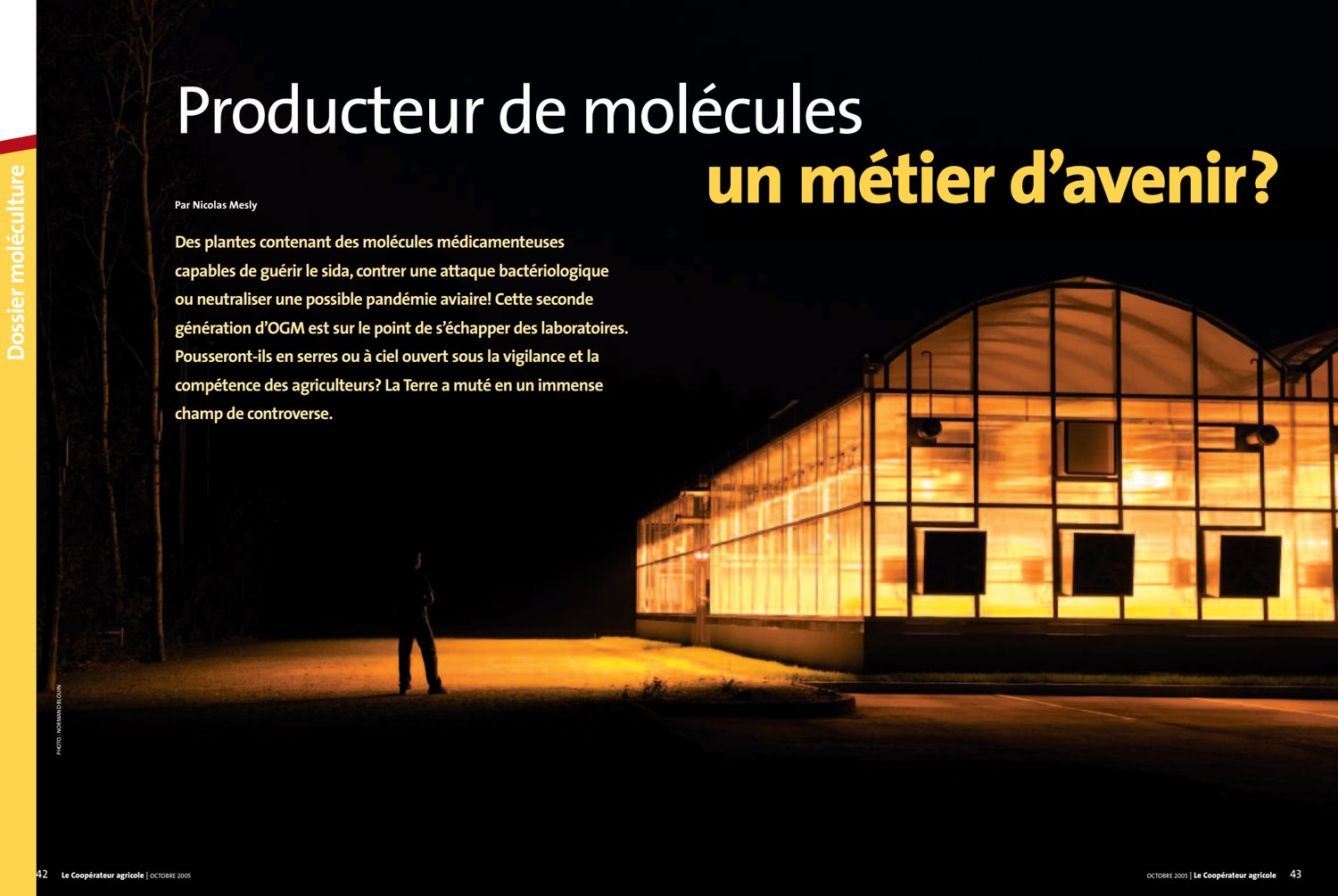
By Nicolas Mesly Plants containing drug molecules capable of curing AIDS, countering a bacteriological attack or neutralizing a possible avian pandemic! This second generation of GMOs is about to escape from laboratories. Will they be pushed in greenhouses or open air under the vigilance and competence of farmers? The Earth has transferred into an immense field of controversy.
PHOTO : NORMAND BLOUIN Moleculture file 42 The Agricultural Co-operators - OCTOBER 2005 Molecular producer a future occupation? OCTOBER 2005
But, even more surprising, they cultivated their pharmaplant in the heart of the American Corn Belt! This, for some, is a nightmare scenario of potential genetic pollution and an incalculable risk to human health. We would prefer to see these new GMOs confined in sealed greenhouses or in the center of the Earth, bloated within old abandoned mines. Far from José Bové The Horan brothers pushed their first harvest of pharmamas in the middle of the American M idwest for the account of a French laboratory, Meristem, a subsidiary of the agricultural cooperative fr ançaise Limagr ain, "far from the League of Voluntary Faucheurs of J osé B ové", explains Dr Guy de Martynoff, responsible for business development.
GMOs are not listed among the European public opinion, whose Parliament, on behalf of the precautionary principle, leaves imports and cropping on its terrtory only to the dropper. On some 3 million hectares of maize grown in France, for example, transgenic maize occupies only 20 d'hectares on an experimental basis, and these are regularly the target of vandalism. By choosing to conduct trials in the heart of the United States, Meristem also lays the foot in the world's most lucrative drug market.
The American junkie consumes 40% of all medicines produced on the planet! Another reason, not the least of the French lab's presence at Uncle Sam, "85 % of biotechnology investments are made in the states," says Dr. de Martynoff. Horan brothers and Dr. Guy de Martynoff were invited to the 2005 Conference of Moleculture Pharmaceuticals at the Queen Elizabeth Hotel in Montreal last February. Not even 10 years ago, about 50 biotech companies, often founded by university researchers, are now competing in the quest for capital to fund research on pharmaplants.
These researchers are using tobacco, corn, soybean, barley, potatoes and other plants to convert them into mini-mills for drugs, antibodies or vaccines, and are being watched by four multinationals dedicated to the "life sciences" and the main sponsors of the Montreal Conference. They are: Bayer CropScience, N exGen (C orée), S yngenta and Do w AgroSciences. Where does the interest in the cultivation of phharmplants come from?
The main handicap of these production modes is their small volume. Moreover, they require massive investments in stainless steel reactors where only one dose of product can be produced at a time.
"It would take $1 billion to produce our molecule-drug using traditional methods. It's too expensive for such a small market. Corn is much more efficient and economical!" continues Dr. de Martynoff. Meristem has conducted trials in the fields of his pharmamais also in Chile and France (with special permission from the French Minister of Agriculture and today under high police supervision).
Neither the amount of sun nor the type of soil affected the quality of merispase, "The drug molecule contained in transgenic corn is the same on both continents." And the first clinical trials have already taken place on about 20 patients in Europe. Moleculture is a science that aims to genetically modify plants and animals to produce vaccines, pharmaceutical proteins, industrial enzymes and a host of other useful products.
These new GMOs, called plants with novel traits (VCNs), are not used to produce food intended for human or animal consumption or textile fibre. These VCNs can produce three types of molecules: therapeutic products for human use: antibodies, blood proteins, enzymes, vaccines, hormones, nutraceuticals, cosmetics; therapeutic products for animal use: vaccines, nutrients, growth factors; industrial products: food enzymes, plastics... Sources: CFIA, Bureau of Plant Biosafety and "Biotechnologies 2003"
There are still no medicines, vaccines or antibodies available on the market from pharmaplants around the world. Meristem will be one of the first to put its small bottles of pills on the pharmacy tablets. The company intends to file its dossier for the commercial approval of its medicine with the European and American authorities, the European Agency for the Evaluation of Medicinal Products (EMEA) and the Food and Drug Administration (FDA), in 2008-2009. "We will need hundreds of kilos of merispase to keep up with the approximately 100,000 patients with cystic fibrosis on both sides of the Atlantic," says Dr. Guy de Martynoff.
This is where the skills and fields of farmers can become interesting. 44 Agricultural Co-operator: OCTOBER 2005 Dr Guy de Martynoff of Meristem Therapeutics has contracted American producers to grow his pharmamais. According to him, France and Europe are lagging behind in the technological race for Pharma-GMOs. José Bové, the global spokesman for the fight against GMOs, has made several razzias in the experimental plots of Meristem Therapeutics company in France last summer.
Will this second generation of non-food, drug-free GMOs turn European public opinion in favour of this new technology? PHOTOS: AFP PHOTO: MARTYNOFF GUY A new Klondike? The global market for medicines for human and animal health is staggering: more than US$700 billion by 2008. All players have a stake in lowering the costs of producing medicines.
Governments in the "rich" countries, first, whose only health sector is an ageing population, are cutting budgets, and then the big pharmaceutical companies, many of which patents on their star products are soon to expire. To stay in the race, they have to face the competition of generic products. And of course, there are patients.
The precise volume of drug molecules needed to treat dozens of cancer forms, AIDS, bone sclerosis in plaques, diabetes and cholester ol is estimated by a very tenacious amount of information linked to the health services of the countries with the highest levels of disease. Biopharmacie also has high hopes in developing countries. An oral vaccine developed from potatoes could stop the hepatitis B virus, which affects more than two billion people.
In animals, we are talking about vaccines against avian influenza, foot-and-mouth disease or growth hormones. Drugs prescribed to cure the wounds of this century are sold between US$3,000 and US$7,000... the gram! "As producers, unfortunately, we do not touch these amounts," says Bill Horan, smiling around. How do Horan keep the genius in the bottle?
Bill Horan specifies that the cultivation of pharmaplants requires a discipline of iron and a relentless rigour. Indeed, a small breeze blowing on a plot of pharmamaïs could contaminate neighbouring corn fields since this plant reproduces by cross-fertilization. Consequences: Pharmamaïs could contaminate the food chain, human or animal, or reproduce in nature and mutate into a monstrous plant with no known effect on biodiversity. Resistance to herbicides, insecticides, undesirable gene flow, pro and anti-GMOs lead to an epic battle on the media field.
If the zero risk of genetic pollution is impossible, the Horan are working hard to get close to it."I've got four preventive measures to prevent possible genetic pollution. While aircraft pilots have only three measures to prevent a crash," explains the ex-marine. First step: all equipment used for the cultivation of pharmaplants is strictly resisted for this purpose.
The Horan have also had a special seed drill made of used machinery. And a whole building is used for storage both for machinery and for carrying out the operations after harvest: cleaning and cutting of precious grins. All the aratory equipment is scrupulously cleaned after each use. The damaged grins and residual materials, such as straw or insects, are burned and buried under 20 cm of soil.
Second step: a geographical separation of therapeutic maize from commercial maize. The US Department of Agriculture (USDA), responsible for legislating these new productions, which are the pharmaplants, has also increased this separative distance from half a mile to one mile (about 1 to 1.5 km). Third step: a minimum time separation of 28 days between the sowing of pharmaceutical maize and that of commercial maize. However, for greater safety, the Horan plant their pharmamais two months after conventional GMO maize seedlings.
"When we sow our maize medicine, all commercial corn has already been pollinated. The latter cannot be fertilized a second time by the pollen of the pharmamais. It is like a woman already pregnant, it cannot be fertilized a second time." Fourth measure: pollen of the pharmamais is sterile.
In the specifications linking American producers to the French lab, the Horan planted four rows of Meristem corn alternating with two rows of conventional corn, to allow pollination. But, to add an additional safety element, the Horan behead the panicles (male flowers) of the pharmamais by hand. "In addition to being sterile, the pharmamais is castrated." During this first contract with Meristem, the Horan brothers collected 140 bushels of pharmamais.
The precious goods were then transported to Montreal by truck, boarded by a ship that set course for Le Havre, France, before reaching the Meristem laboratory. At each border, the container was inspected as if it were radioactive material. Montreal is the headquarters of the Protocol on Biodiversity adopted in 2000 by 135 countries. But this protocol, which regulates all cross-border movements of transgenic plants intended for research or commercial purposes, is not yet ratified by Canada; for two reasons.
The first is that the protocol requires the mandatory identification of crops and products manufactured with GMOs. By ratifying this agreement, Canada, itself a producer and exporter of GMOs, could lose its competitive advantage by bringing in the United States, the most important producer and exporter of very high-quality foodstuffs (it is for this reason that the Charest government does not follow up on its preference for electors for products obtained by firing from GMOs). The second is that this protocol has not yet clearly defined the responsibilities and damage attributable to the different actors in the event of "accident".
High-monitoring production In the United States, as in Canada and the rest of the world, laws and regulations have all been designed based on traditional crops, food sources, moulds or textile fibres. The production of Horan brothers' phharmplants is therefore under very high scrutiny by the USDA, which is responsible for legislating these new crops, also called plants with novel traits (VCNs).These new GMOs include therapeutic molecules for human and animal use, but also for industrial use.
The Horan see USDA inspectors (often accompanied by their counterparts from the Iowa Agriculture Disbursement) disembarking in their plots without prior warning OCTOBER 2005!The Agricultural Co-operator 47 Bill Horan believes that Canada, because of its isolation and its vast spaces, could become a major supplier of pharmaceutical GMOs seeds. PHOTO: NICOLAS MESLY PHOTO: NICOLAS MESLY Moleculteurs Bill and Joe Horan have had seed and aratory instruments for the cultivation of pharmaceutical GMOs from used machinery.
All equipment is thoroughly cleaned and crops are magnified in a building dedicated entirely to these new crops (in the background). Pharmaceutical giants in 2004 Sales Companies ($billions) 1. Johnson & Johnson 24,7 5. Bristol-Myers Squibb 15,6 10.
Abbott Laboratories 14,3 12. Bayer 6,4 Source: IMS Health; Thomson Datastream, "A survey of pharmaceuticals", The Economist, June 16, 2005. Major drug categories purchased by pharmacies and hospitals in Canada Rank Drug categories 2000* 12 months, end of June 2005* % increase 1. cardiovascular ,9% 2. psychotherapeutic agents ,7% 3. cholesterol reducing ,4% 4. antisecretory ,5% 5. antiinfective ,4% 6. cancer/immunomodulators ,1% 7. hormones ,8% 8. bronchial treatments ,5% 9. antiarthritic agents ,7% 10. painkillers ,6% Total ,0% Source: IMS Health * Value (000) 46 Agricultural Co-operators - OCTOBER 2005 at least five times from seed to harvest .
And they visit twice the cultivated field the year after the pharmaplant harvest. Because two scandals have fed the anti-pharma GMO campaigns in the United States, pulsing the questions of very pacability and labelling under the current fires. The pramier involves the Texas company ProdiGene. In 2003, USDA inspectors found tiny traces of Pharmamaïs Prodigene in a lot of so ya.
C e pharmamais had been planted and harvested the previous year on the same newly planted soy plots. But regrowths of pharmamais contaminated the new crop. As a result, the company was fined US$250,000 and paid US$3 million to the US government to destroy 500,000 soy bushels. "Today, it is forbidden to harvest plants the second year following a crop of pharmaplants.
The case of ProdiGen proved that our regulations work," says Bill Horan. "On June 14, the Horan brothers took over the cultivation of pharmamais in Iowa, after three years of absence. This time, the cultivation is carried out on smaller plots in the middle of the forest, more than 3 km from the ordinary corn fields, on a site of the Iowa Army ammunition factory. Their pharmamais contains a medicine to prevent diarrhea of pigs and possibly that of humans.
Ironically, the main veto to the cultivation of pharmaplants in the United States comes from the American food manufacturers' industry, for the insatiable Govern ment of
StarLink corn, which contains a potentially allergenic insecticide protein for humans, was found in tacos and cereals, but Bill Horan is sweeping the back of his hand with fear in the general public of a possible overdose of "maize medicine," at the time when traces of products are detected at a scale of one part per trillion."The molecules we produce are not dangerous. Our bodies produce most of them.
Our 140 Meristem corn bushels contained a kilo of drugs in all. I don't know anyone who can eat such a quantity of maceutic corn!" Moreover, according to the moleculturer, the American food manufacturers' industry ignores the fact that the law allows it to have tiny traces of pesticides, insecticides, crop residues, insects or rodent waste in its products. OCTOBER 2005
While in the United States about 100 hectares are destined for this purpose, no molecular commercial crop in the field, for veterinary use or for human use, has yet been approved in the country."We need to find a regulatory balance that will benefit the development of these plants with novel traits while safeguarding the environment and the food chain," says Phil Macdonald of the Plant Biosafety Office of the Canadian Food Inspection Agency (CFIA), who is not a common concern.
"The absence of a policy to allow commercial plant moleculture confers an industrial advantage on other countries," said Rick Keon, of SymBioSys Genetics, based in Toronto, whose interest is in producing insulin from safflower. "In North America, more than 2 million diabetics inject insulin daily with a small needle. Insulin is devolved by the use of transgenic carthame to make life easier for patients, because it would be inhaled by aerosol instead of being injected with a syringe.
However, this process causes more drug losses, so we will need a larger volume," says Keon, who estimates the need for an insulin-expressing culture at 1000 acres by 2010 and 20,000 acres by 2014. "The Canadian biopharmaceutical industry will need tens of thousands of acres to meet the needs," adds the president of the BioteCanada Committee on Molecular Culture.The race has begun The race for drugs produced by pharmaplants is already underway around the planet.
What plants should be used? Where should the precious molecules be stored to obtain the most yield: in foliage, roots or seeds? In open fields? Each company runs at the door of the US Patent and Trademark Office and the World Intellectual Property Organization to patent its platforms.
These platforms are the process of manufacturing a transgenic plant until the extraction and pure ification of drug molecules. And each country is also adopting its own strategy so as not to miss the boat."A pact is concluded between the producers, notr e lab and the society in general to launch us into the maceutic biophar. 600,000 hectares are available for the cultur ture of drug molecules," says Dr Julius Kristinsson, d-ORF Genetics. The Icelandic company has developed the "Dimma", a black barley cultivar, to facilitate traceability and thus avoid possible contamination of the food chain.
In addition, various tax measures are planned to attract foreign investment on the ice island that joins the polar circle. At the opposite side, Cuba, the Caribbean pearl, put on tobacco to diversify its production of the famous cigars and above all produce one or two molecules that would allow it to exit from economic marasm. Specially developed to manufacture medicines, the dimma cultivar is black to facilitate its traceability. Kristinsson says Icelandic farmers are ready to grow the dimma.
Dr Julius Kristinsson, President of the Icelandic company ORF Genetics PHOTO: DENIS BERNIER 2004 World crops of GMOs Total 44.2 million hectares Other countries (4%) South Africa Chile India Mexico Uruguay Zimbabwe Canada 6% United States 59% Brazil 6% Argentina 20% China 5% PHOTOS: JULIUS KRISTINSON While in the United States over 70% of experimental trials of pharmaplants have been conducted with corn for 10 years, trials in Canada have focused on canola, both plants are heavily used by the agri-food industry on both sides of the border.
"We are trying to discourage the development of pharmaceutical GMOs from commercial crops for human and animal consumption," explains a spokesperson for the Canadian Plant Biosafety Office."The CFIA is doing everything possible to ensure that federal Agriculture Minister Andy Mitchell was not asked any interesting questions," said Dr. Paul Arnison of Saponin Inc., who participated in the agency's workshop last spring."If the Quebec company Medigo produces drug molecules from transgenic alfalfa grown in greenhouse, it is because it was locked by the federal government.
What happens if the price of drug molecules does not justify an investment in greenhouses?" added Arnison. Arnison plans to one day engage in the moleculture of transgenic saponary, a cousin plant of l'oeillet, to make antibodies with the help of farmers and their fields. Third exporter of GMOs after the United States and Argentina, Canada fears a negative reaction of European consumers to Canadian products in the event of a cultivation of these new GMOs in the country.
And there is the whole question of social receptivity bearing its own contradictions: "Insulin is produced at this time from transgenic bacteria in which a human gene has been inserted. No voice rises against this GMO. Why not then produce this same insulin at a lower cost from a plant in which no human gene has been introduced?", says Rick Keon. To combat terrorism In addition to the amount of medicines that can be produced at lower cost than with traditional methods, Molecultur Bill Horan sees a strategic advantage in cultivating pharmaplants.
"O n can store a vaccine against Ebola indefinitely in a gr ain of corn, barley or flax. It can be produced much faster than with the massing of hamster cells. Knowing that the antidote is possessed, it can dissuade terrorists," says the Vietnam War veteran. "After its missile shield, the US administration also focuses on the deployment of a biological shield, the BioShield Project.
Launched by President Bush in February 2003 and with US$6 billion, this project aims to develop drugs and vaccines for possible biochemical attacks. Two US companies at the Montreal Conference are trying to concoct a vaccine against coal bacillus and Butrox from pharmaplants after obtaining research funds of about US$15 million. However, nature does not need terrorists to manufacture its own weapons of mass destruction. The threat of a possible pandemic of avian influenza is hovering in the air following the recent emergence of a virulent mutant strain in Asia (H5N1).
The worst of these events, in 1918, was the death of between 25 and 30 million people, rescuing a quarter of the world's population. The World Health Organization (WHO) is currently negotiating with the multinational Roche the possibility of storing between 100,000 and 3 million doses of antiviral drugs to "strike" the disease's home and thus curb a possible pandemic. The Public Health Agency of Canada, in its endemic plan against avian fever, has entered into an arrangement with its official supplier, ID Biomedical; the production of an Asian mutant vaccine: a contract of $34 million.
Vaccines are produced from fertilized eggs inoculated with a modified H5N1 virus. Does the country have enough laying hens at work? "We are increasing production. We could provide 32 million doses, the equivalent of the Canadian population, within six to seven months.
In 2007, this delay will be reduced to four months," says Michèle Roy, a company spokesperson. "Can this vaccine be produced more quickly by pharmaplants?"Theoretically yes," says Dr. Elwyn Griffiths, at Health Canada's Biologics and Genetic Thermies Directorate."But if one day we can store a vaccine against avian influenza in a seed, we must first recover it, make it pure, and then see if long-term storage influences my quality.
All this is a question of cost and efficacy."The drugs of the future? According to experts, plant molecular cultivation will not allow to pr oduction all the drug molecules, some cannot be properly manufactured by plants. But, of course, they will be a new element in the therapeutic arsenal.
Bill Horan, however, attributes another advantage to medicines produced from pharmaplants, which is precisely socially acceptable: "With the prion associated with mad cow disease, the public will have more confidence in vaccines or medicines produced by plants than in those produced by transgenic animals. Because it is possible to transfer an animal virus to a person while it is impossible to transfer a plant virus to a human being," the moleculturer says. Could pharmaplants change European public opinion in favour of GMOs?
Sabine Coulon, a spokesman for the organisation "Vacing the cystic fibrosis" in Paris, did not want to throw oil on fire by commenting on the pharmamai snatchings of Meristem by José Bové's Ligue des Fauchers volontaires in the last summer. "We do not have an official position. We are against the pharmamai snatchings of pharmaceutical corn. But this does not mean that we are against the ideas defended by the anti-GMO groups," she says.
For the moment, the medicine "to the taste infect" to overcome cystic fibrosis is made by firing a puree of pancreas por c. The one dev eloped by M eristem would reduce the side effects of which dour them ills of v entre and thus improve the quality of life of patients. For several reasons, the American consumers, unlike Europeans, do not in general make a whole meal of GMOs that composing the food on their plate.
José Bové did not return the Co-operator's call before 50 The Agricultural Co-operators OFCTOBER 2005 Vandalism against GMO, a first in Quebec? On the night of August 22-23, the site of the Expo-Champs agricultural exhibition in Saint-Liboire was the victim of vandalism. The exhibition organizer, Donald Côté, estimates the damage to be approximately $10,000. The file is closed, according to Sergeant Pierre Morin (in the photo), because the police could not find the culprits and the act was not claimed.
OCTOBER 2005 , , , , , , , , , , , , , , , , , , , , , , , , , , , , , , , , , , , , , , , , , , , , , , , , , , , , , , , , , , , , , , , , , , , , , , , , , , , , , , , , , , , , , , , , , , , , , , , , , , , , , , , , , , , , , , , , , , , , , , , , , , , , , , , , , , , , , , , , , , , , , , , , , , , , , , , , , , , , , , , , , , , , , , , , , , ,
But the pharmaplants are perceived by the Peasant Confederation as a Trojan horse to promote junk food generated by industrial agriculture, to encourage the patentability of the living, to accelerate the control and concentration of seed companies and the hegemony of a handful of multinationals on world agriculture, while relegating agricultural producers to the status of "servers". "In addition to environmental and social issues, the great challenge of medicines produced from pharmaplants will be to prove their effectiveness," said Albert von der Zeijden, president of the International Alliance of Patient Organizations, based in London.
The debate on pharmaplants, he suggested, should include all GMOs, including transgenic animals. These last-mentioned animals, according to their opponents, are housed in the "Frankenstein Farm." At a time when the triple marriage of biotechnology, computing and capital allows man to play "Dieu", his transgenic creativity needs ethical markers to evolve outside the scope of controversy. In this vein, Albert von der Zeijden stresses that the price of any medicine must reflect a mixture of corporate benefits and humanitarian issues "by providing these new generations of medicines at the lowest possible price".
For the Horan brothers, however, the medicines of the future from the pharmaplants combine with the farm of the future. "For us, these new GMOs are a golden opportunity to make a high-value production," they explain. "With the same breath, they add that if farms grow disproportionately in the United States, it is that the profit margin shrinks year by year. To keep the same life course, producers have no choice but to produce increasing volumes.
According to the Horan, the unbridled race to produce large volumes of commodities – cereals, oilseeds, bacon and chicken wings – is pervaded by the hands of international competitors like Brazilians. Biotechnology, at the con trational, will not recommend the production volume, but rather a tight management of a hyperspecialised garden. The future family iron, such as the Horan the design, has consisted of two pr odessionnels, husband and wife, established on farms with a human dimension.
"This is how we're going to repopulate the Midwest campaign," they believe. On this side of the border, the reflection on the potential of the pharmaplants and their impact on the future of agriculture has not yet been set in the minds of farmers. OCTOBER 2005: Agricultural Co-operator 5352 Agricultural Co-operator - OCTOBER 2005: "Pharmaplants are being developed to produce vaccines and growth factors at lower cost and to benefit producers," says Butch L. Mercer, World Business Development Manager at Dow AgroSciences.
Joe Horan indicates what remains of a hyperspecialized garden grown the previous year. In addition to being located more than 1.5 km away from any other crop, the US authorities require that a strip of bare soil surround the pharmaplant plot to reduce the risk of genetic pollution. The plots are also surrounded by two electric fences to discourage raccoons or any other intruder from feeding from the precious harvest. PHOTO: NICOLAS MESLY PHOTOS: DENIS BERNIER Albert von der Zeijden Top 10 seeders worldwide in 2004 Companies Sales ($millions) 1.
Monsanto (US) and Seminis (acquired by Monsanto in March 05) 2,803 2. DuPont/Pioneer (US) 2,600 3. Syngenta (Switzerland) 1,239 4. Limagrain Group (France) 1,044 5.
KWS AG (Germany) 622 6. Land O'Lakes (US) 538 7. Bayer CropScience (Germany) 387 9. DLF-Trifolium (Denmark) 320 Source: Global Seed Industry Concentration - 2005, September-October 2005, No. 90, ETC Group, September 6, 2005.
Canadian Animal Health Industry (CHHI) Sales by Drug Groups 2002-2004 2002 2004 Biological 92,986 93,884 Disinfectants 4,902 5,501 Nutraceuticals 962 1,502 Nutritional 1,674 1,425 Pesticides 7,057 5,388 Pharmaceuticals 335 990 305,535 TOTAL 443,571 413 235 (CAN$million) 54 The Crop Co-operator OCTOBER 2005 is the eyelet's factory, which is dressed in a beautiful mauve carpet all over North America. Extracts from the plant are used in cosmetology. The creams and soaps made from saponin, one of the extracts, allow the beauty to remove from the skin or to stroll in a foam bath, hence the origin of the company Saponin Inc. created in 2003.
One of its two founders, Dr Paul Arnison, intends to produce drug molecules from this plant. This geneticist also intends to grow his transgenic saponaries with the help of agricultural producers. Dr Arnison's pharmapapair es aims to produce new antibiotics."The demand for new products to control infections both human and animal is an enor mous one.
The problem is that the development of antibiotic-resistant bacteria in hospitals is being considered," says the one who is developing the global anti-infectious market at CAN$45 milliar ds. At present, trials of non-transgenic saponaries are being conducted on several of the tests, with a total of six acres, in Alber ta, in Sskatchewan, in Nova Scotia and in Prince Edward Island, to test the agronomic needs and to see the yields of the plant. Dr. Arnison has set his sights on the pretty flower for several reasons.
Unlike corn or canola, saponaria is not used in the manufacture of food or moulding products, and its genetic code is far from those of corn and canola, thus eliminating the risk of cross-pollination with these two plants. However, saponaria can be sown and harvested with the same machinery as that used in the cultivation of canola, so "no new investments are needed if a cereal producer decides to embark on the adventure." The saponaria is part of a business strategy.
Dr. Arnison works closely with the Saskatoon-based National Research Council of Canada (NRC). The federal lab is mandated to develop new, economically profitable plants for producers, either by enhancing their natural properties, by crossing them to produce mutants, or by introducing new genes, hence the name "vegetables with novel traits" (VCN), intended for the production of drugs or industrial products. NRC researchers have six transgenic plants, including saponaria, under their microscopes.
However, the technology to isolate and purify the maximum of desired molecules, called platform, is not yet in the point."We believe it will be achieved within a year," says Dr. Arnison. Meanwhile, Dr. Arnison plans to capitalize on the production of very ordinary saponaries and generate revenues in two ways. The first, using starch seeds for cosmetic products.
The second, using saponin as an adjunct to existing vaccines. Talks to test saponin are currently underway av ec a professor at the University of Cape Town, South Africa, who develops an AIDS vaccine from a pharmaplant. For environmentalists, the cultur ture of transgenic saponary in the open field could pose a pref blem: the possible development of a super-mauve herb-like herb by genetic contamination. To counter the possible pollination of the cr osminated saponair and tr ansgenic av ec her sister-sages, Arnison works with the assistance of restrictive genetic technologies (GURT).
These technologies enable the activation or deactivation of genes that control fertility or seed formation. The most notorious of these technologies, developed by Monsanto, has been called "Terminator" by its critics. But unlike the "Terminator" technology that does not allow the seed of a plant to reproduce, the one developed by Dr. Arnison would instead allow the producers to keep their seeds and replant them to obtain new crops. "Our reproductive control technology simply does not allow our pharmaplant to propagate its genes into wild species related to the saponary," he says.
However, the growth of Saponin Inc. may stomp until Ottawa will allow the cultivation of open air PNTs. OCTOBER 2005
Meth, or methamphetamine, better known in the 1970s as "speed," and phencyclidine or PCP, a powerful hallucinogen. Both transform young users into vegetables."Our antibodies remove these two drugs from the body," says Andy Sheldon, Medicago's CEO. "Preclinical trials of our drug manufactured by transgenic alfalfa will be conducted on animals in 2006-2007.
We hope to be the first in the market, because there is nothing to treat PCP." Sitting at the small cafeteria of a 1000 m2 state-of-the-art greenhouse complex located in the P arc techno de Québec, the agronomist explains the achievements and ambitions of the first biopharmaceutical company of the genr to be grown in Quebec. Sheldon arrived at the barr e of Medicago in 2003, six years after its foundation in 1997. Just in time to influence a business plan of 34 million dollars - lions whose construction of this futuristic greenhouse complex at a cost of $3.5 million, qualified biosecure nive 2 according to American and European no mers.
Inaugurated in large pump in March 2004, particularly in the presence of Quebec's Minister of the Environment, this pilot plant will be able to produce between 1 and 5 kg of pure drug proteins manufactured by transgenic alfalfa for preclinical testing. From the production of four drug molecules, Medicago will increase to seven molecules by the end of the year, under, among other things, an agreement with giant Bayer to produce aprotinin, a drug normally extracted from cow lungs and minimizing the impact of open heart surgery.
Several equipments are not yet installed in the new Medicago glass complex, including a controlled atmosphere room where the ground and pressed alfalfa "juice" will be collected and purified to collect the precious drug molecules. The process of making a molecule by transgenic alfalfa, or any other plant, until it is purified, is called a platform. Medicago's platform, called ProtificiaTM, is the baby of Dr. Louis Vézina, a former Agriculture and Agri-Food Canada researcher and co-founder of the company.
The latter has 130 patents for the manufacture of drug molecules from this process."To diversify the use of animal or human alfalfa."Why produce transgenic alfalfa in greenhouses rather than in the field?"Because it can be done about ten cuts per year.
But also because it is easier to build a solid regulatory record," says Sheldon. Medicago greenhouses are sealed by several security systems.
These visitors are held for a few moments in this corridor under the eye of an ultraviolet lamp that is very intriguing. A bee that can pollinate the alfalfa cannot enter. And if an insect is sniffing, it cannot escape, collected more tar d by filters that obscurate the venting ducts of the complex. To counter the risk of a possible gene flow to the outside, the transgenic luz arne harvests are made before flowering.
In addition, all plant waste generated by the operations is sterilized in an incinerator at 121oC for 30 minutes. All of these measures allowed Medicago facilities to qualify as biosecurity level 2. Will Medicago require farmers' skills and fields when their needs are increased from a few kilos to several hundred kilos of therapeutic molecules? "From luzernières to fields, no, Replies Sheldon.
We think we can layer the Dutch greenhouse production model." Medicago already has two greenhouse producers in the collimator, one of them tomato in the Quebec City region. However, Sheldon is considering producing a drug molecule to treat a disease because it is a diaque."We will probably need farmers' help at that time.
But our alfalfa will not be transgenic because the molecule is plant-specific," he says. 56 The Agricultural Co-operator, OCTOBER 2005 OCTOBER 2005: The Agricultural Co-operator, 57 De la lucerne pour junkies D "Canada does not invest enough in biotechnology!", says the agronomist Andy Sheldon, CEO of Medicago. The Quebec company produces pharmaceutical molecules from transgenic alfalfa. It is partly financed by the SGF, the French group Avenir Luzerne/Viridis and Innovatech Québec and Chaudière-Appalaches and benefits from a Biolevier d'Investissement Québec loan.
The same clones of pharmaluzerne are produced from a single plant. PHOTOS: NICOLAS MESLY Pharmariz zizanie in rice fields in the United States and rice fields in Missouri could be transformed into battlefields. Californian company Ventria is trying to grow a rice medicine with the help of agricultural producers. Rice has been genetically modified to produce proteins found in human milk, saliva and tears.
Once ground, the powder can be used in the manufacture of granola bars or drinks to control the death caused by diarrhoea in Third World children. However, the GMO rice fields envisaged for the new crop are located near a rice seed research and screening centre and two natural parks with large populations of migratory birds. And environmentalists are concerned that birds disempower grains in the wild, not to mention the risk caused by the elements.
"At present the envisaged amounts of GMO rice are minimal, but on a commercial scale, following Hurricane Katrina, it would be catastrophic!" said Margaret Mellon, Director of the Food and Environmental Programme of the Union of Concerned Scientists, based in Washington. "To this is added the risk of contamination of the food chain," she adds. Ventria scientists argue that riz is actually suitable for biogenics. Rice plants are self-defeating.
For example, the altered genes, which are synthetic veersions of human genes, can be easily transferred to plants in nearby rice fields. For the agricultural economy of M issour i, the risk of growing this pharmaceutical riz is high. More than half of the rice in the state is exported to the Caribbean and Europe, where consumers do not have much appetite for GMOs. Ventria has also concluded an agreement with AnheuserBusch which uses rice in the manufacture of beer.
The brewer fears the reaction of consumers to a rice medicine that could end up in a Bud bottle. GMO rice will only grow at a distance of 200 km from a regular rice plant. The new crop is perceived as "a field of hope" by some farmers to wean off state aid. Rice is one of the most heavily subsidized foods in the United States.
Source: Fields of Bio-Engineered Dreams; Can Gene-Altered Rice Help Rescue the Farm Belt? Alexei Barrionuevo, The New York Times, 16 August 2005. 58 Agricultural Co-operators, OCTOBER 2005 L PHOTO: RONALD MAISONNEUVE PHOTO: USDA/APHIS
Complete original publication
The complete facsimile presents the publication in its original editorial design.
Open original PDF ↗