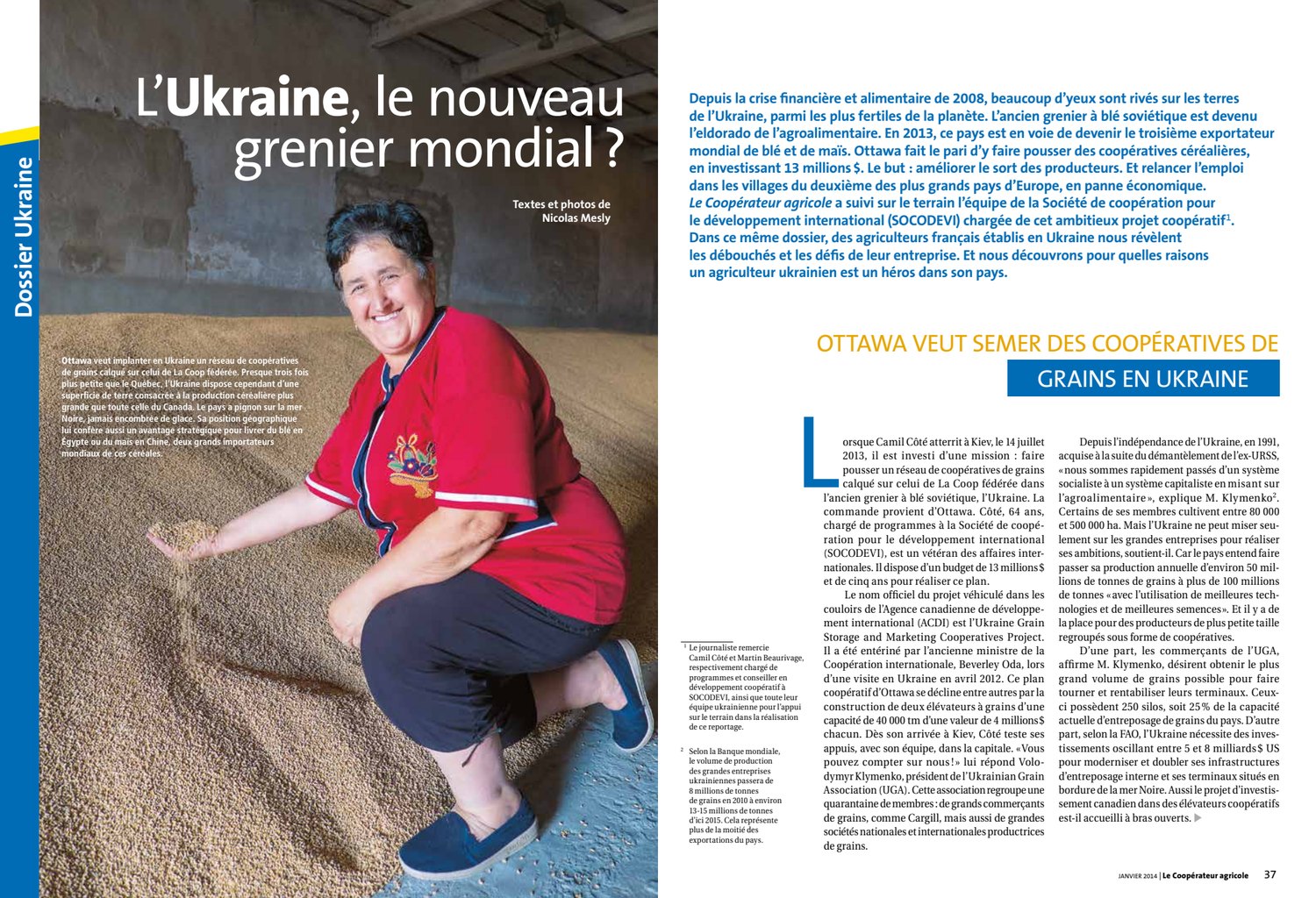
The complete story
Ukraine, the new world attic? Since the 2008 financial and food crisis, many of Ukraine's most fertile land has been washed out. The former Soviet wheat attic has become the agri-food attic. In 2013, Ukraine is on the verge of becoming the third largest exporter of wheat and maize in the world.
Ottawa is making the bet on growing cereal cooperatives, investing $13 million. The goal is to improve the lot of producers. And to boost employment in the villages of the second largest European countries, which are in economic breakdown. The Agricultural Co-operator has followed the team of the Society for International Development Cooperation (SOCODEVI) responsible for this ambitious cooperative project1.
In the same case, French farmers in Ukraine reveal the opportunities and challenges of their business and we discover why a Ukrainian farmer is a hero in his country. Since Ukraine's independence in 1991, acquired following the dismantling of the former USSR, "we have quickly moved from a socialist system to a capitalist system by relying on food processing," explains Mr. Some of its members grow between 80,000 and 500,000 ha.
But Ukraine cannot rely on large companies to achieve its ambitions, he says. For the country intends to increase its annual production from about 50 million tonnes of grain to over 100 million tonnes "with the use of better technologies and seeds." And there is room for smaller producers grouped in the form of cooperatives. On the one hand, the traders of the UGA, says Mr.
Klymenko, wants to obtain the largest possible volume of grain to run and make their terminals profitable, with 250 elevators, or 25% of the country's current grain storage capacity. Furthermore, according to FAO, Ukraine requires investments ranging from US$5 to US$8 billion to upgrade and double its internal storage infrastructure and terminals on the Black Sea. Therefore, the Canadian investment project in cooperative elevators is welcomed with open arms. u orsque Camil Côté landed in Kiev on July 14, 2013, with a mission to grow a network of grain co-operatives modelled on the network of the Federated Coop in the former Soviet wheat attic, Ukraine.
The order comes from Ottawa. 64-year-old Côté, a program manager at the Société de coopération - rations pour le développement international (SOCODEVI), is a veteran of international affairs. He has a budget of $13 million and five years to carry out this plan. The official name of the project carried out in the corridors of the Canadian International Development Agency (CIDA) is the Ukraine Grain Storage and Marketing Cooperatives Project.
It was endorsed by the former Minister of International Cooperation, Beverley Oda, during a visit to Ukraine in April 2012. This Ottawa cooperative plan is being developed by, among other things, the construction of two grain elevators with a capacity of 40,000 mt each worth $4 million. Upon arrival in Kiev, Côté tests its support, with its team, in the capital. "You can count on us!" says Volo - dymyr Klymenko, president of the Ukrainian Grain Association (UGA).
The association is composed of some 40 members: large grain traders, such as Cargill, but also large national and international grain-producing companies. L Texts and photos by Nicolas Mesly Ottawa wants to establish a network of grain cooperatives in Ukraine modelled on the network of the Federal Coop. Almost three times smaller than Quebec, however, Ukraine has a land area devoted to grain production larger than that of all of Canada. The country has a gable on the Black Sea, never cluttered with ice.
Its geographical position also gives it a strategic advantage in delivering wheat to Egypt or corn in China, two major world importers of these cereals. 1 Journalist thanks Camil Côté and Martin Beaurivage, respectively program manager and cooperative development advisor at SOCODEVI, as well as their entire Ukrainian team for supporting the production of this report on the ground. OTTAWA SEES GRAINS COOPERATIVES IN UKRAINE 2 According to the World Bank, the production volume of large Ukrainian companies will increase from 8 million tonnes of grain in 2010 to about 13-15 million tonnes by 2015.
This represents more than half of Ukraine's exports. JANUARY 2014: Agricultural Co-operator 37 Dossier Ukraine Dnipropetrovsk Crimea A cooperative elevator to protect Ukrainian producers Côté and its team are received with the same enthusiasm by Victor Andrievsky, president of the Agrarian Markets Development Institute (AMDI), an NGO based in Kiev. Following Ukraine's independence, the 600 state elevators were quickly privatized. Today, there are 751 elevators, 80 of which still belong to the state.
"Our producers are now in a serf situation, as in the medieval era. Due to a lack of storage capacity on the farm, they are forced to sell their grain at low prices to elevators, many of which cheat on the quality and volumes stored," he explains. Cooperative silos built along railway lines would create "a balance of power." By providing more storage flexibility to producers, market access and transparency in grain prices.
Andrievsky and his team are working to strengthen the national system of certification of Ukrainian elevators, by offering a guarantee of payment. In the event of a failure of a lift, for example, the producer would be assured of being paid for his stored grain. A lift as an economic lever But the arrival of one or more cooperative elevators would also be a formidable economic lever for Ukrainian producers, he insists that they are sorely lacking in money.
They have to deal with exorbitant interest rates of 25% or more to run their business."High interest rates are the Achilles heel of Ukrainian agriculture. For every $100 loan, the producer must give $250 to bankers," says Bodhan Chomiak, an original Ukrainian who lived in Alberta for 20 years. "The director of the consulting company Lapersa, based in Kiev, Chomiak believes that the only way to practice a profitable agri-culture in Ukraine is through the injection of substantial investment funds into large vertically integrated companies.
This is to "make size savings" and "not depend on local banks." But Victor Andrievsky and his NGO work to put money into the hands of Ukrainian producers. The plan is to establish a national grain warehouse receipts (GWR) or "lift guarantee vouchers" system, this time similar to Agriculture and Agri-Food Canada's Advance Payments Program (APP) for field crop producers.
This program allows producers to receive up to $400,000 per year at a very low interest rate by putting their future crops in storage as collateral. (In 2012–13, Quebec producers borrowed $50 million through the PPA3.) According to Andrievsky, this GWR system would allow Ukrainian producers to buy seeds, fertilizers, machinery, finance the construction of a silo on the farm or participate in the construction of a cooperative silo.
"But we are receiving US$250 million from FAO to set up the facility," says Victor Andrievsky. "A gift that is not understood. Strongly supported by the support that is being provided in Kiev, Côté and his team are leaving the metropolis for Dniprope - Trovsk. This city, located 400 km southeast, is the capital of the region of the same name. It is also Ukraine's third largest agricultural "province".
On 24 July, the group of a dozen people climbs into a minibus to go to Vasilkivka, a small village about 30 kilometers from Dnipro - petrovsk. The place seems suitable to build a first elevator. An important railway line runs along the hamlet. And above all, the area has 300 cereal producers, owners of 300 ha on average.
Their companies are all located within a radius of 30 km, an asset to reduce the cost of grain delivery to the future elevator. About 20 farmers are waiting for the Côté team in one of the halls of the city hall, a large monolith in grey cement whose entrance is monitored by a huge statue of Lenin. The trusted man and antenna on the ground of the Canadians, Maksym Maksymov, explains the advantages of a cooperative grain elevator. This would offer the services of storage, drying, cleaning, mixing of grains and sales by pool... at half the price received by the elevators of the region!
The project would be divided into three stages of construction: a first 20,000 mt silo would be raised along the railway line adjacent to the village, followed by two further 10,000 mt silos each. Questions and answers were raised on both sides, including the financial participation of farmers, and suddenly the tension and tone were rising, and a producer rose and left the hall, resulting in almost all others.
"The first drafts of this project started five years ago, and every time, Canadians change the rules of the game," explains Leonid Chernoknijiyj, president of the Local Producers' Association, who led his family out of the room. "The major dispute is the management of the elevator by producers: their share would have dropped from 80 to 30 per cent.
Under the new mill, the elevator would be administered jointly with a newly formed union of cooperatives, and part of the elevator's activities would be used to finance this union."We don't come to Ukraine to build a single elevator. We want to create a elevator network partly run by a cooperative union, so that the movement takes root throughout the country," explains Camil Côté.
In the hall, only three producers stayed to discuss the project, with the three producing 150 ha of land and less than 500 mt of grain. The Canadian team seems to be far from its goal, or to rally some 70 small and medium-sized producers to form a critical mass necessary to build a first 20,000 mt silo.
The two sides, Chernoknijiy, have been struggling to warm up the atmosphere, but they agree to work to settle their differences so that a first cooperative elevator can grow in Ukrainian soil. According to Vadim Udovitskiy, head of agricultural department in Dnipropetrovsk, it is difficult for producers to get rid of the "kolkhoze habit" they have carried for more than 60 years. It is under the regime of the bloody dictator - Joseph Stalin who was born in the 1930s, these huge state farms of more than 3000 ha resulting from the collection of private property.
"Our producers do not realize that they can make individual business decisions to propel their entre -prises into a collective movement," added Mr. Not a bit unsettled by the turn of the meeting in Vasilkivka, Camil Côté reformed his strategy to promote its two grain elevators and its cooperative union. Landed in Ukraine four years ago, he and his team succeeded in setting up seven dairy cooperatives there, which doubled the annual salary of 1100 farmers, which rose from US$1,500 to US$3,000, thanks, among other things, to technical support to increase milk production.
"We've been successful in the dairy sector. I don't see why we wouldn't succeed in the grain sector!" said the one who believes a cross knight. "In his bet on sowing cereal cooperatives in the former socialist republic, Ottawa seems to have bet on the right horse. u WHAT IS TCHERNOZIOM? Chernoziom is a black soil rich in organic matter, making it one of the most fertile soils on the planet.
Originally, it was the wind that transported tons of fine mineral particles from the bed of ancient glaciers and rivers over long distances. "The wind acted as a huge filter. It is for this reason that no stone is found in the Chernoziom," explains Professor Léon Hardy, a Quebec geomorphologist who met in Ukraine. Grasses and herbaceous plants then pushed to stabilize these huge deposits.
By decomposing, these plants supplied organic matter. According to the expert, Ukrainian producers are very lucky. Besides not having stones, this porous soil and naturally wavy fields do not require drainage or ditches. And since the Chernoziom contains limestone, never need to chaule!
The largest number of Chernoziom on the planet is found in Ukraine, accounting for 60% of the country's arable land and can reach depths of between one and six metres. Some of this type of soil is found on the border between the United States and western Canadian provinces. It is ideal for direct seeding. 3 Interviews with Yves Clavel, Fédération des producteurs de cultures commerciales du Québec, and Éric Andriamanjiay, Assistant Director of Analysis and Operations of the Régie des marchés agricoles et alimentaires du Québec, August 13, 2013.
Quebec engineer Pierre Giguère, an expert in grain elevator construction, and Camil Côté, a cooperative project in Ukraine. The two men discussed Canada's potential purchase of a 5 ha plot along a railway track in the village of Vasilkivka to build a first silo. Maksym Maksymov, a member of the Canadian team, explained the advantages of a cooperative elevator to some 20 Ukrainian farmers. The major dispute was the management of the elevator.
But also on the cultivation methods related to the project funded by Canada. CIDA requires, for example, that Ukrainian producers grow in direct seeding, which requires expensive equipment and advanced agronomic knowledge. JANUARY 2014
A first farm was acquired in 2006, and the second two years ago, near Dnipropetrvosk, an industrial city - triella and former Russian stockbuilding centre. In total, Agro KMR has grown 8,000 ha and invested US$6.5 million since its arrival in the former Soviet wheat attic. "The low price of the land has allowed us to invest in machinery, buildings and technology," explains Michel Jean-Loup, a French farmer and shareholder of the company. The company has 32 employees, including one full-time staff to administer the lease contracts with 1300 owners.
Agro KMR produces between 24,000 and 30,000 tonnes of wheat, rapeseed, sunflower and spring barley annually. All crops are grown without tillage, in direct seeding, to avoid losing any gram of the precious Chernoziom by erosion of the wind and, above all, to preserve moisture in the bowels of the earth. No question of financing the purchase of machinery or the improvement of storage buildings through a Ukrainian bank. The rent of the ENGLISH AGRICULTURALERS of money at 25% per year is prohibitive.
"The meter is running very fast," says Michel Jean-Loup. "So that Agro KMR is financed from a French bank, under the guarantee of the producers' assets in their home country. Producing in Ukraine is a source of its hazards, according to these producers. For example, broken machinery parts can put a barrier to delivery.
And they are not allowed to import seeds because of heavy re - ration inherited from the Soviet system. Another hazard, not the least: the excessive climate of Ukraine. "In France, we cry when we lose 20% of our crops; here, that's 50%," explains Michel Jean-Loup. "The other climate we have to deal with is business.
All the wheat production of Agro KMR is sold on the domestic market, sunflower is sold to an oil transforma, and rapeseed is destined for export. But the contracts signed involving volumes and prices are not always respected. "We always have trouble doing healthy business. We need to know how it works so that we do not get caught," he says. u INVESTENT IN UKRAINE Attracted by the Chernoziom, the French grain farmer Jean-Paul Khim and his group of investors have been operating an agricultural company in Ukraine since 2006.
The yields of wheat obtained in their Ukrainian company are around 4.5 tons l-hectare, while they reach 7 tons l-hectare in France. Ukraine's extensive production system resembles that of the Canadian Prairies, says Jean-Paul Khim. LUSKRAINE'S RECENT HISTORY: REPERS 1914-1918 – In the aftermath of the First World War, Ukraine tried to become independent. But in 1922, it became one of the founding members of the Union of Soviet Socialist Republics (USSR).
Second largest state in the Union after Russia, Ukraine became the wheat attic of the 15 republics of the USSR. 1927-1928 – Joseph Stalin came to power. He brutally emptied the countryside of their population to make the factories of the cities run. Under his first five-year plan, the industrial production quadruple. 1932-1933 – Between three and five million Ukrainians died from famine orchestrated by Stalin. This "holocaust" in the heart of Europe is called Holodomor.
The bloody dictator collects private farms. It is the birth of the kolkhozes, these huge collective farms run by the state. 1939-1945 – During the Second World War, more than six million Ukrainians lost their lives under the boot of the Nazis. Stalin liberated the country to better put it under its yoke. 1986 – The worst nuclear accident in humanity occurred at Chernobyl. The disaster was one of the factors leading to the dissolution of the USSR in 1991. 1991 – Ukraine gained independence.
A wild privatization leads to the creation of an oligarchy, a handful of people who are enriching themselves by taking over state-owned enterprises in the metallurgy, oil and gas sectors. 2008 – L的Ukraine is joining the World Trade Organization. In the wake of the financial and food crisis, FAO and major international institutions, such as the World Bank, consider this country as "strategic" to feed the planet. 2011 – Election of President Viktor Yanukovych, considered prorussian.
He won the elections after seven years in power of Viktor Yushchenko, one of the two leaders of the Orange Revolution, which was launched in 2004. The latter advocated democratic values and greater economic integration with the European Union.November 2013 – The same forces plunge the country into crisis following the president's refusal to sign a cooperation agreement with the European Union. Sources: Lonely Planet , FAO, World Bank Number of inhabitants: 44.5 million GDP/inhabitant: US$7500 (2013) (Source: statistics-global.com) The Ukrainian flag: the yellow horizontal band represents wheat and the blue one represents the sky.
"TO SELL AGRICULTURAL CO-OPERATIVES, THE LEASERS ARE FORTH!" – Ludmila Nikiforienko Ludmila Nikiforienko, 63, bought the old farm in the village of Andriivka in 1991, where she worked as a cow-traper with her husband Vladimir, 72. The couple started their cereal business with 50 ha and rented it 10 times more today. The producer would see with a good eye the construction of a cooperative silo near her village, to better sell its grain. "We have tried to form cooperatives, but it didn't work, because there are too many competing interests.
The biggest producers already have their storage infrastructure, while the smallest do not have one."In order to succeed, the projects of establishing agricultural cooperatives should be carried out by visionary leaders."I am too old for this task," she says laughing. "The biggest obstacle to establishing cooperatives in Ukraine is psychological.
Ukrainian producers believe that cooperatives are like kolkhozes. "It's seen as a backwards!" she says. "C-JAN-KAR 2014-The Agricultural Co-operator 4140 The Agricultural Co-operator-JAN-KAR 2014-Ukraine, in its fief, the port city of Mykolayiv, Oleksly Vadaturskyy is a hero in her country. In the aftermath of the fall of the former USSR, in 1991, this 66-year-old farmer founded Nibulon, a vertically integrated company that has become Ukraine's largest grain exporter.
Nibulon sells more than 3.2 million mt of grain (maize, wheat, soybean, soy, sorgo, etc.). It leases more than 81,000 ha of land and has a fleet of 550 agricultural machinery, not counting its own trucks. Nibulon, a network of 22 state-of-the-art grain elevators, has been set up by the major international bankers, along two major rivers in the country, including Dnipro, which is considered to be the ukrai Mississippi.
In November 2007, President Viktor Yushchenko awarded Oleksly Vadaturskyy the title of hero of Ukraine to recognize the economic and social contribution of his company. Vadaturskyy is also nominated for the prestigious World Food Award. This award, awarded annually in the United States, highlights the work of personalities in the fight against the scourge of hunger in the world. "Four million Ukrainians have experienced Holodomor [see box "Recent history of Ukraine: landmarks".
I want to make sure that as many people as possible have bread on their table," he says. "For Ukrainian journalist and specialist in agriculture - culture, Iurii Mykhailov, the general manager of Nibulon is above all a hero in his country "because he pays taxes and contributes to the economic development of Ukraine. Many Ukrainian agribusinesses have their headquarters outside the country to avoid paying taxes." The wake of Ukraine's independence, acquired in 1991, the kolkhozes (former collective farms) were privatized.
And the land has been redistributed. More than 7 million Ukrainians own 4 or 5 ha lots. In addition, the country has 43,000 "official" farms of 850 ha each. Agri-food companies rent to these owners areas ranging from 5000 to 500,000 hectares.
The rent, according to our information, varies between $80 and $120 per hectare. This rent is a "invisible pension" for thousands of Ukrainians. But the ownership of the land is also a matter of food security in a country where the inhabitants have experienced the horrors of famine. The Ukrainian government juggles with the idea of privatizing its Chernoziom deposit.
In January 2012, he was to lift a moratorium to achieve this privatisation. According to the Ukrainian Agrarian Confederation, the price per hectare of Ukrainian land could reach US$8,000. This privatization would have a good side, because "without being owners, producers cannot offer their land title as collateral to obtain credit from banks and develop their operations, as they do in France or Canada," says Michel Jean-Loup, whose company, Agro KMR, operates two cereal farms in eastern Ukraine.
But the government has not yet found mechanisms to carry out this safe passage. "Who would benefit from this privatization? To a handful of multinationals or Ukrainian lhe oligarchy?" asks Victor Andrievsky, director of the NGO Agrarian Markets Development Institute, whose headquarters are in Kiev. In the event that the government gives the green light to this privatization process, Andrievsky predicts "a bloody revolution".
The authorities have been silent on this issue, despite several requests for interviews with the Communications Officer of the Ministry of Agriculture of Ukraine, Vitaly Sabluk. PROPERTY OF AGRICULTURAL LANDS, A "PATATE CHAUDE"! AGRICULTURAL AND HEROS UKRAINIEN OLEKSLY VADATURSK Y Y, Main exporting countries of wheat, maize and sunflower oil Brazil Kazakhstan Argentina Ukraine Russian Federation Australia Canada EU27 United States 31751 29257 200001950019000 1700016500 800 18500 70007000 18000 35000 30000 25000 20000 15000 10000 5000 0 Exports (in thousands of tonnes) corn sunflower oil 3600 1150 Land used for cereal production 2008-2012 Land (in hundreds of thousands of thousands of hectares) France Brazil Australia Argentina United States Ukraine Canada Russian Federation 14,985,200 hectares 13,385 100 hectares 0 500100 200 300 400 600 LUSRAINE IN THE MIRE OF CHINES AND RUSSES COORDING FOR 10 YEARS OF PAHOPE AND REVENTION IN THE SURING OF THE SURING OF THE SURING OF THE SURING OF THE SURING OF THE SURING OF THE SURING OF THE SURING OF THE SUR THE SUR THE SUR THE SUR THE SUR THE SUR THE SUR THE SUR THE SUR THE SUR THE SUR THE SUR THE SUR THE SUR THE SUR THE SUR THE SUR THE SUR THE SUR THE SUR THE SUR THE SUR THE SUR THE SUR THE SUR THE SUR THE SUR THE SUR THE SUR THE SUR THE SUR THE SUR THE SUR THE SUR THE SUR THE SUR THE SUR THE SUR THE SUR THE SUR THE SUR THE SUR THE SUR THE SUR THE SUR THE SUR THE SUR THE SUR THE SUR THE SUR THE SUR THE SUR THE SUR THE SUR THE SUR THE SUR THE SUR THE SUR THE SUR THE SUR THE S S S S S S S S S
In return, Ukraine would supply between 4 and 5 million tonnes of wheat or maize annually to the Middle Empire, says Volodymyr Klymenko, President of the Ukrainian Grain Association. Russia would like to create a wheat OPEC to dictate the world price of this grain, "but we do not agree," he says. Ukraine, Russia and Kazakhstan are already exporting more wheat than the world's largest exporter, the United States. According to the U.S. Department of Agriculture, these three countries will process 29% of the world's wheat trade by 2021 (and 22% of the world's total grain trade).
THE MAI SUPPLANT LE BLÉ EN UKRAINE Oleksii Legkyi, manager of the seed production plant of the French cooperative Maisadour, located half an hour's drive from the city of Dnipropetrvosk. This plant, the most modern in Europe, opened its doors in 2010. It is developed varieties of non-GM corn and sunflower resistant to dryness. The factory serves as a springboard for the conquest of the Black Sea markets (Ukraine, Russia, Kazakhstan).
The Ukraine Agricultural Co-operator has been recognized as a wheat attic and is already the fourth largest exporter of corn. More than two million hectares of maize could be used to produce the small yellow grain in the south of the country. However, such a project requires a multi-billion dollar injection to produce under irrigation. Major exporting countries of wheat, maize and sunflower oil Brazil Kazakhstan Argentina Ukraine Russian Federation Australia Canada EU27 US 31751 29257 200001950019000 1700016500 800 18500 70007000 18000 35,000 30,000 25,000 2000000 15000 10000 5000 0 Exports (in thousands of tonnes) corn wheat sunflower oil 3600 1150 Land used for cereal production 2008-2012 Land (in hundreds of thousands of hectares) France Brazil Australia Argentina United States Ukraine Canada Russian Federation 14,985,200 hectares 13,385,100 hectares 0 500100 200 300 400 600 PHOTO : GRACIOUSTÉ DE NIBULON D R Source : World Bank Source : Indexmunid, USDA, estimated 2013 JANVIER 2014
Complete original publication
The complete facsimile presents the publication in its original editorial design.
Open original PDF ↗