The complete story
MARCH 2008: The Agricultural Co-operator 33 to break the world is no longer part of the role of the Quebec farmer, according to Françis Allard. After seeing his father fight his whole life like a devil in the blessed water, no question of taking over the market garden located in Saint-Roch-de-l-Achigan. The recent vertiginous increase in the Canadian dollar has made carrots and onions of the company very expensive for American buyers. And there is no way to negotiate the price of vegetables, except at a lower level, he believes, with the three supermarket chains where Quebecers make 70% of their shopping "at the lowest possible price".
This young engineer, a graduate of the University of Sherbrooke, abandoned a pre-favourous job and career at Bell Helicopter Textron. The call from the land was too strong. In 2006, he founded a small company, Agro-Énergie inc., with his father and a partner, and put his future on Salix viminalis or wicker willow, a low-demand plant, growing rapidly under northern conditions and whose annual yields range from 15 to 25 tons per hectare. As he looked at the state of the planet, Francis Allard relied on the production of green energy from this biomass to ensure the sustainability of the family farm.
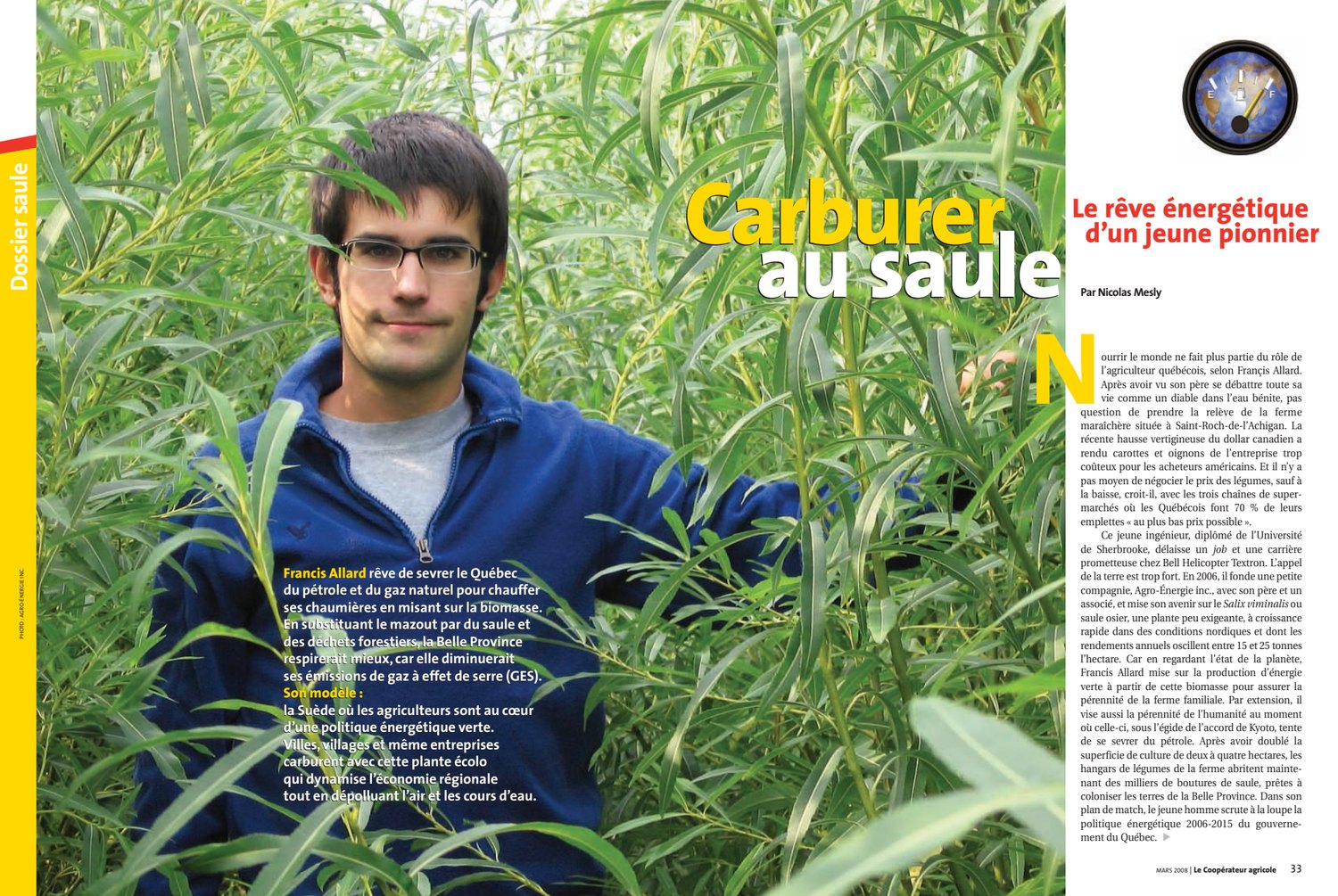
By extension, it also aims to ensure the sustainability of humanity as it, under the auspices of the Kyoto agreement, tries to wean oil. After doubling the area of cultivation from two to four hectares, the farm's vegetable sheds now house thousands of willow cuttings, ready to colonize the land of the Belle Province. In his match plan, the young man is scrutinizing the energy policy 2006-2015 of the Quebec government. The energy dream of a young pioneer By Nicolas Mesly Dossiersaule Francis Allard dreams of weaning Quebec from petrole and natural gas to heat its cottages by focusing on biomass.
By replacing oil with willow and forest waste, the Belle Province would breathe better, as it would reduce its greenhouse gas (GHG) emissions. Its model: Sweden where farmers are at the heart of a green energy policy. Cities, villages and even companies are propelled with this eco-friendly plant that boosts the regional economy while depolluting air and water. Francis Allard dreams of weaning Quebec from petrole and natural gas to heat its cottages by putting on biomass.
By replacing oil with willow and forest waste, the Belle Province would breathe better, as it would reduce its greenhouse gas (GHG) emissions. Its model: Sweden where farmers are at the heart of a green energy policy. Cities, villages and even companies are carbonizing with this eco-friendly plant that boosts the regional economy while depolluting air and water. at WillowCarburer at WillowCarburer PHOTO: AGRO-ENERGIE INC. N MARCH 2008: Agricultural Co-operator 35 will use enzymes similar to those used in the production of corn ethanol.
However, it is not possible to ferment a tree to distill it into alcohol as it is done by fermenting starch from corn. The technological lock consists first of extracting sugar from trees, much more hard than cereals, and then finding the most effective enzymes to convert this sugar into alcohol. "The cost of these enzymes is prohibitive!" explains Giust Frank, director of the chemical group at Tembec. The forestry company, located in Temiscamingue, produces 15 million litres of industrial ethanol per year from a soup of pulp residues.
A real race has begun between energy consumers in various countries, the United States in the first place, to find the most economical process of making cellulosic ethanol."The production costs of cellulosic ethanol could be between 40% and 50% lower than those of ethanol corn or other cereals," says Professor Esteban Chor net, director of the newly established Industrial Chair in Cellulosic Ethanol at the University of Sherbrooke. "The latter envisages for the Q uebec a model of plant development on a smaller scale than American gigantism.
"These would process 100,000 to 200,000 tonnes of wood, willow or straw for an annual production of 75 million litres of ethanol, and there could be one plant per region that would supply within 70 to 80 km. If this demonstration is successful, we will be in business." According to the expert, the first technological breakthroughs to produce cellulosic ethanol in a cost-effective manner are expected to be completed within two to three years.
"Celulosic ethanol is an interesting track, but it seems far away," says Francis Allard. "Not to mention that, in order to develop this sector, willow producers should have long-term supply contracts with ethanol plants, much like the present agreement between corn producers and the Varennes ethanol plant," says the young entrepreneur. "The latter dream is mostly of a Quebec inspired by Sweden, a country where farmers are at the heart of a green energy policy.
Swedish example Biomass accounts for only 10% of Quebec's energy needs, mainly in the form of logs to supply residential homes or forest waste to supply boilers for paper mills, while Belle Province uses electricity (38.8%) and oil (38%) as well as natural gas (12%) to satisfy its energy thirst. By increasing the use of biomass to replace oil and gas, Québec would reduce its greenhouse gases (GHGs), says Allard.
Sweden, for its part, is meeting 30% of its energy needs through agroforestry."We were interested in the willow in the 1960s to fill an anticipated shortage of short fibre paper. This lack never materialized. Then the first oil shock of the 1970s was the reason for our continued research on the "energy forest".
Next, all issues of local employment, regional development, environmental development and change were addressed. Coal 1.14% Biomass 1 0.00% Gas 12.20% Oil 38.0% Electricity 38. 80% Total Energy Consumption in Quebec 34 Agricultural Co-operators MARCH 2008 Produce "ecolo" gasoline "The willow has the advantage of not being a food plant like corn. It requires little fertilizer and no herbicides, except for the plantation, and it lasts 25 to 30 years.
And its annual yields are three times higher!" explains the young man, while noting that the Quebec government did not intend to call for a second controversial corn ethanol plant, such as the one built in Varennes, to fill the biofuel deficit. Q uebec has to take its green gasoline intake, from 120 to about 400 million litres by 2012, to meet its commitments that all gasoline is due to motorists in the province contains 5% ethanol.
Both O ttawa and Q uébec are trying to lay the foundations for a second generation ethanol industry by injecting half a billion dollars into it. In June, the Prime Minister, Jean Char, announced the creation in his county of a research chair at the University of Sherbrooke and two pilot plants of cellulose ethanol, which was liquefied by the firing of forest biomass, agricultural residues or urban waste. According to the Department of Natural Resources and the Fauna, the annual production of the only forest biomass, from cutting beds and non-commercial wood, would lead to the theory of producing up to 1.6 milliar d of ethanol, four times the requirements of the Quebec fleet.
"I have costs associated with the transport of forest waste. When we talk about the North Shore, it starts off in a distance from customers who buy ethanol. We are looking for raw materials including willow plantations," explains Vincent Chornet, president of , who will be opening in 2008 the first experimental cellulosic ethanol plant in Quebec in Westbury, Eastern Townships. L , a $10 million investment, will eventually increase its annual capacity of 5 million liters of ethanol by ten.
The iron company has called for a precedent called gasification, where waste from any kind of energy, urban or forestry - such as telephone poles or rail showers - is partially burned to form synthetic gas. It is then combined into a catalyst to produce ethanol. The second pilot plant planned in Bromptonville, with an annual capacity of 5 million liters, Willow Achev al between agriculture and forestry, the cultivation of willow is similar to traditional agricultural practices.
A motion was passed at the last UP A congress to recognize this agroforestry plant within crop insurance programs. PHOTOS: AGRO-ENERGIE INC. Source: Ministère des ressources naturelles, faunies et parcs du Québec MARS 2008
However, according to the mayor of R ochebaucourt, also a farmer, the pellet industry could be a carrier. According to a recent R oche study (July 2007), intended for potential investors, a wood pellet plant would cost just under $16 million and, to be retabled, would have to produce between 50,000 and 100,000 tonnes of granules per year. Quebec produces only 65% of its pellet manufacturing capacity due to lack of raw material. "Dried by-products are rare because particle board or MDF manufacturers are tearing them away," explains Sylvain Boucher, one of the authors of the study.
But the export markets are real. In the north of the United States, demand will double by 2010 to reach 600,000 tonnes. While in Europe, it will fall to 4 million tonnes! "The willow or any other fast growing plant could help develop these markets," notes the engineer, specifying that a willow willow densified granule has the same calorific capacity as maple wood.
While export markets seem promising, the Roche study finds that, unlike Europe, " neither Quebec nor Canada have an energy policy that promotes bioenergy in terms of the manufacture of densely-densified pellets and logs." "I doubt that the good sisters of the SacréCoeur in Montreal buy our granules unless it is by act of charity, a bit like fair trade," stresses the mayor of Rochebaucourt, whose distance from the major markets is a real curse, because it catapults transportation costs.
Indeed, to move from oil to green heating in the residential and commercial institutional sectors of a province or country, "it requires a genuine political will: aid to producers and various programmes of subsidies for cogeneration. One of the greatest lessons we have learned in Sweden is that a large-scale energy forest programme requires cooperation from all actors. Long-term contracts must be considered to distribute risks and profits among all actors.
Our biggest mistake was to let all the risks rest on the shoulders of the producers at the beginning of our project," notes Dr. Theo Verwijst. Intensive willow cultivation could help to make thousands of hectares of land waste. Michel Labrecque, of the Institute for Research in Plant Biology, is conducting experiments in about ten places in Quebec. To the right, Louis-Serge Boisvert, President of La Coop Amos.
PHOTO: NICOLAS MESLY North America Europe Other World production of wood pellets in 2006: 6,733,000 t Climate Willow of the 1980s and 1990s," explains Dr. Theo Verwijst, Dean of the Chair on Short-rotation cutlets in the Department of Ecological Productions of the Forest at the Swedish University of Agricultural Sciences. "The Swedish government has declared its intention to stop relying on oil to heat itself by 2020," continues Professor Verwijst. "And to achieve this, Sweden intends to triple the current area of 15,000 hectares planted in willow, mainly on agricultural land.
The biomass added to other forest waste feeds municipal facilities for combined heat and electricity production. In Quebec, we are only beginning to focus on the energy potential of biomass. Our forest waste is not yet recovered. These residues are equivalent to half a million litres of oil!
They could heat 1.5 million homes and remove 1000 tonnes of CO2 from the atmosphere," says Jean Baribeault, of the Hydro-Québec Research Institute. "The increase in fuel oil prices, the reduction of GHGs and the creation of local jobs will ensure that hospital or school managers will turn to biomass boilers," says the researcher. "Not to mention the increase in the price of electricity, still one of the lowest in the world, since Hydro-Québec's abandonment of its preferential tariff in April 2006.
The researcher works on several projects in close collaboration with forest co-ops to supply the boilers of public buildings in Amqui, Shawinigan and Quebec City. The profitability of these projects is closely linked to the availability of raw material that must be within a radius of 50 km to 100 km, in order to minimize the cost of transportation. Like Sweden, intensive willow crops, located in the peripetia of municipalities, could complement forest biomass, says Mr.
If, however, the snails were to travel a longer distance, it would have to be densified in granules "to increase the amount of energy per volume." A granule plant in Abitibi? "I don't know if it will be an ethanol plant or a granule plant that will revive us. I'm just a salesman of hope.
This is all we have left!" says Daniel Lalancette. "The mayor of Rochebaucourt likes to say, in a half-figue half-raisin tone, that the name of his village means in Amerindian "where asphalt stops." Québec's worst forest crisis has not spared the Coteaux sector, which has very many municipalities, in the heart of the East Abitibi. How can we revive the "mono-industrial" economy after the almost complete closure in 2005 of the sawmill of Abitibi Consolidated in Champneuf, the neighbouring hamlet?
And what is the future of the 600 or so inhabitants whose average age is 50? So, is the Rochebaucourt Municipal Hall crowded to listen to Michel Labrecque, a researcher at the University of Montreal's Plant Biology Research Institute and the expert in willow in Quebec. There are over 350 varieties in the world and the scientist has been working for 15 years to improve native varieties or adapted to the climate of the Belle Province. Easy to implant, undemanding, intensive, short-rotating willow cultivation grows rapidly in heavy and unfertile soils.
The availability of marginal agricultural land in Abitibi is an opportunity to launch an agroenergy sector. Less than 200 metres away, willow whips, planted in a square of experimental land belonging to the municipality in the summer of 2007, are floating under an icy wind. PHOTO: NICOLAS MESLY Willow to boost the regional economy? The agroforestry plant has many ictoral applications.
It can be used in the manufacture of paper, MDF panels, granules or densified logs. Source: WPAC MARS 2008: The Commission's recent 39 report on the future of Quebec's agriculture and agri-food sector. Jean Pronovost rightly expresses concern about the problems facing the agricultural sector. He refers to the potential of biofuels to replenish the income of producers.
But he does not comment on the possibility for Quebec to switch from oil to green heating. It is then unlikely that Liberal Prime Minister Jean Charest, also head of a minority government, will only release this rabbit from the hat. Could it be that Francis Allard's small carbide business too fast for his environment? In the meantime, the young man intends to re-enter the production of onions and carrots to make ends meet.
How long will it last? Planted along riparian bands, willow plantations would be a formidable plant filter to protect streams and rivers. In Sweden, this crop has decontamination of streams and cleaning up the Baltic Sea adjacent to the country. New economic activities in Quebec Institute for Plant Biology Research Michel Labrecque www.irbv.umontreal.ca Agro-Énergie inc.
Francis Allard www .agroenergie.ca Magical Saule www.saulemagique.com CERVEAU City of Boisbriand dlechasseur@ville .boisbriand.qc.ca Enviro-Saule Tel.: 418 354-2026 Plantations V ert Forêt Tel.: 450 792-6443 Sauletec Martin Boivin and Patrick Boivin Tel.: 450 658-4683 Francis Allard's eco-friendly village has certainly juggling with the idea of producing and exporting willow pellets or compressed logs instead of carrots to fill the appetite of the American energy glutton. But it has rather fallen on an idea that is financially appropriate, inspired by Enköping, a small town of 20,000 inhabitants in the heart of Sweden.
The municipal wastewater, rich in nitrogen, is used to irrigate intensive short-rotation willow plantations, which can absorb more than 200 kg of this element per hectare per year, which reduces the costs of treatment at the plant, but also helps to protect the streams. Municipal sludge, on the other hand, is used as fertilizer for plantations. The willow is then harvested and burned in a naise oven adjacent to it to heat the village's facilities.
This green, closed-circuit model inspired Francis Allard to submit an experimental project to the municipality of S aint-Roch-del-Achigan."By planting willows near the holding ponds, we will check the absorption capacity of the sewage components. And we plan to use municipal sludge as fertilizer on our land. The municipality must pay $40 to $50 per tonne to bury its sludge in a site.
We could be paid to collect the treated sludge so that it costs less to the municipality while building an income. In addition, we are exploring the possibility of selling our biomass to heat the schools of the school board of the region," explains the young man. The idea of recovering municipal sludge as fertilizer is not stupid, far from there. More than 80% of this sludge is buried or incinerated in Quebec and barely 20% is valued as fertilizing material, while this percentage is 60% in France and 55% in the United States.
However, things may change."The cost of landfilling municipal sludge varies depending on the distance from the site. Starting in 2009, several municipalities will not have sites due to the new standards and transportation costs will be priced. Therefore, the value of treated sludge should increase for agriculture and forestry," said Marc Hébert, a field specialist at the Ministry of Sustainable Development, Environment and Parks.
The willow is also a formidable slurry pump, which does not escape Francis, whose family farm is located in one of Quebec's por cine bastions."This intensive crop acts as a vegetal filter and would reduce the land area required for spreading and would prevent livestock producers from purchasing additional land or using slurry treatment systems."In addition, high yields of slurry willow planting and frequent harvests can also clean contaminated sites by absorbing heavy metals such as cadmium, one of the most dangerous to human health, or other pollutants contained in industrial wastewater or leachate landfill sites.
This process, called "phytoremediation," is very fashionable in Sweden. According to specialist Michel Labrecque, intensive willow plantations in the willow are also a fantastic carbon pump, because they can store "between 20 and 40 tonnes of CO2 per hectare per year." If the carbon exchange project is in the air, it is still far from generating revenue for producers. The fate of this scholarship lies in the hands of Prime Minister Stephen Harper, head of a minority Conservative government in Ottawa.
Its objective is to make Canada "an energy empire" by accelerating the exploitation of oil and natural gas in the western part of the country. On the other hand, Francis' dream of the Quebec green energy sector could be part of the future Quebec agricultural policy inspired by the Saule L'établissement des eaux wastees d'Enköping, Sweden, put on the willow to decontaminate the site. The plant is then used to produce electricity and heating in the village. % 5% 10% 15% 20% 25% 30% Finland Sweden Brazil China Denmark Quebec Austria Mexico Norway Canada Poland France Spain Switzerland Italy Belgium United Kingdom Germany 7.2 8.1 35.6 211.7 1.2 4.3 3.5 8.0 1.3 10.9 4.2 9.6 4.1 63.9 0.5 1.5 0.4 0.7 7.8 Total biomass consumption Proportion of total consumption Solid biomass consumption (million toe) (Tonnes oil equivalent) Proportion of total consumption PHOTO: I.
DIMITRIOU In Sweden, the cooperative Lantmännen, belonging to 52 000 producers, offers a range of environmental services and commercial products, granules, logs, drawn from the willow. The cooperative has subsidiaries in the United Kingdom, Denmark and Portugal. For more information , visit www .agrobransle .se.
Complete original publication
The complete facsimile presents the publication in its original editorial design.
Open original PDF ↗