LONG-FORM REPORT · 2018
Should we continue to cultivate the shore of Lake Saint-Pierre?
2 pages · 1972 words
Open original PDF ↗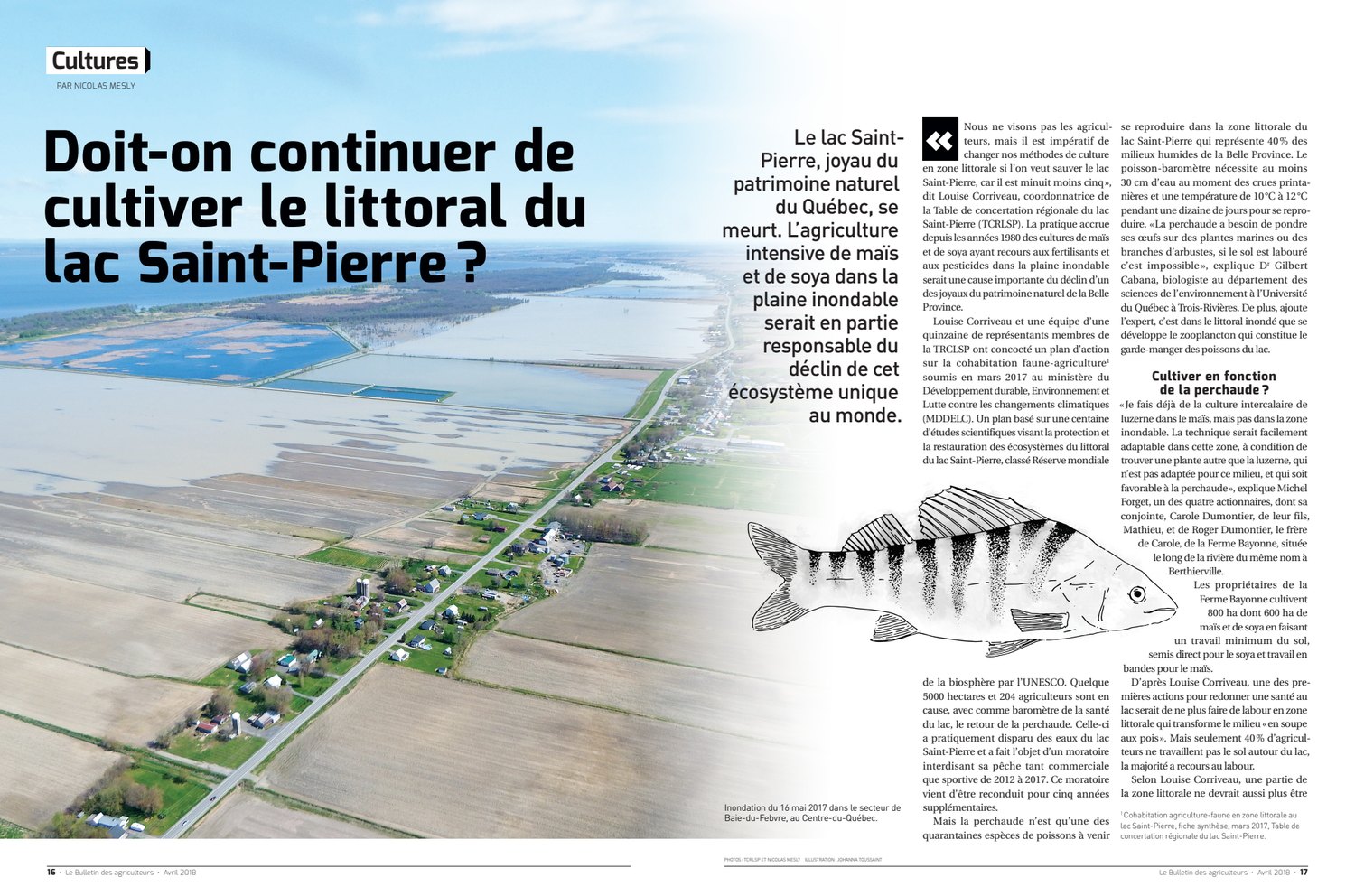
The complete story
16 • The Farmers' Bulletin • April 2018 The Farmers' Bulletin • April 2018 • 17 Should we continue to cultivate the shore of Lake Saint-Pierre? Lake SaintPierre, the jewel of Québec's natural heritage, is dying. The intensive maize and soybean farming on the floodplain would be partly responsible for the decline of this ecosystem unique to the world. Cultures BY NICOLAS MESLY "We do not aim at farmers, but it is imperative to change our methods of cultivation in the coastal zone if we want to save Lake SaintPierre, because it is midnight minus five", says Louise Corriveau, coordinator of the Lake SaintPierre Regional Consultation Table (TCRLSP).
The increased practice of maize and soybean crops using fertilizers and pesticides on the floodplain since the 1980s would be a major cause of the decline of one of the jewels of the Belle Province's natural heritage. Louise Corriveau and a team of about fifteen TRCLSP representatives have prepared an action plan on co-habitation wildlife agriculture 1 submitted in March 2017 to the Ministry of Sustainable Development, Environment and Climate Change Control (MDDELC).
A plan based on about 100 scientific studies aimed at protecting and restoring the ecosystems of the shore of Lake SaintPierre, classified as the World Biosphere Reserve by UNESCO. Some 5000 hectares and 204 farmers are involved, with the return of perch as a barometer of the health of the lake. It has practically disappeared from the waters of Lake SaintPierre and has been the subject of a moratorium prohibiting its fishing both commercial and sporting from 2012 to 2017. This moratorium has just been renewed for another five years.
But perch is just one of the forty species of fish to be reproduced in the coastal zone of Lake SaintPierre, which accounts for 40% of the wetlands in the Belle Province. The fishbarometer requires at least 30 cm of water at the time of spring floods and a temperature of 10 °C to 12 °C for about 10 days to reproduce. "Perchad needs to lay its eggs on marine plants or shrub branches, if the soil is ploughed is impossible," explains Dr Gilbert Cabana, biolo gist in the Department of Environmental Sciences at the Université du Québec à TroisRivières.
In addition, the expert adds, it is in the flooded coastline that zooplankton is developed, which is the diet of the fishes of the lake. Cultivating according to perch? "I already grow intercalar alfalfa in corn, but not in the flood zone. The technique would be easily adaptable in this area, provided that we find a plant other than alfalfa, which is not suitable for this medium, and which is favourable to perchude," explains Michel Forget, one of the four shareholders, including his spouse, Carole Dumontier, of their son, Mathieu, and Roger Dumontier, Carole's brother, of Bayonne Farm, located along the river of the same name in Berthierville.
The owners of Bayonne Farm grow 800 ha, of which 600 ha of corn and soybeans by doing a minimum tillage, seeding directly for soybeans and working in strips for corn. According to Louise Corriveau, one of the first actions to restore health to the lake would be to stop tilling in a coastal zone that transforms the environment "to soup with peas". But only 40% of farmers do not work the soil around the lake, the majority resorts to tilling. According to Louise Corriveau, part of the coastal zone should not be PHOTOS: TCRLSP AND NICOLAS MESLY Illusteration: JOHANNA ALLESSAINT Flooding of 16 May 2017 in the Bay-du-Febvre area, Centre-du-Québec. 1 Cohabitation agricultural-fauna in the coastal zone at Lac Saint-Pierre, summary sheet, March 2017, Lake Saint-Pierre Regional Consultation Table. 18 • The Farmers' Bulletin • April 2018 The Farmers' Bulletin • April 2018 • 19 "I am not ready to throw the stone to the farmers for the disappearance.
The river dredging, the passage of huge boats whose swell destroys the banks, the two large taps upstream of the bar rages of Beauharnois and Cornwall, and which control the flow of water flowing to the lake," explains Roger Michaud, president of the Association des pêchers commerciales du Lac SaintPierre and Mayor of Maskinongé. "The latter indicates that he lost 30% of his income with the imposition of the moratorium on perch fishing. Québec unties his stock exchange When he put in press, the new MDDELC minister, Isabelle Mélançon, accompanied by, among others, the Minister of Agriculture, Laurent Lessard, revealed on March 16th, the plan of the watering of Lac SaintPierre with a cap of $14 million over five years.
The plan will include a first component of financial assistance for "biodiversity or water quality conservation or restoration initiatives" and will be administered by the Fondation de la faunie du Québec. The second component of the plan will be the creation of a multidisciplinary cluster of expertise to develop a sustainable agri culture on the shores of Lake Saint Pierre, including farmers, university researchers and other experts.
But according to Louise Corriveau, the majority of the farmers concerned own 5% of their land in the coastal zone. In addition to agronomic issues, the hydrological issue is addressed, namely the maintenance of rivers on agricultural land "to restore connectivity with the lake." Some 42% of culverts in the coastal zone are obstructed, obsolete, or of inadequate size, read in the report of the TCRLSP. "Fissages remain caught in a pond at the end of one of our fields," says Michel Forget, whose 250 ha are affected by the lack of maintenance of the rivers.
The poor drainage of water and the use of machinery favour the modern scourge of soil compaction. However, the process of approving the clean-up of rivers is Kafkaian. And the UPA calls for the establishment of "a simplified protocol". Buying land or paying producers?
The government should buy out some of the coastal farmland on a voluntary basis? "This is an option I could consider for a small part of our cultivated land," says Michel Forget. "Or could we consider that agricultural producers should be paid for environmental services so that they do not grow certain areas of the shore of Lake SaintPierre?" "This is an option that we will study and develop with the creation of the pole, because it would allow us to make wildlife development while being owners," says Martin Caron.
He said that Quebec society was mature for this kind of service. Encouraged by the Quebec announcement, Louise Corriveau pointed out, however, that one cannot wait another ten years to save Lake SaintPierre. One can see the effectiveness of this rescue plan if, soon, he fishes again from the cultivated per. This is not Carole Dumontier's business.
"I am not prepared to sacrifice my standard of living by eliminating 25% of my cultivable land," says the producer. "However, she says she is prepared to explore accommodative formulas to promote perch habitat, provided they are economically viable. Hay cultivation is excluded. First, because even if Bayonne farm is a dairy herd of 40 cows, hay drowned in St. Lawrence waters "cows do not love it."
The company is then not equipped with machinery to make hay in large quantities. Despite many requests from the Ministry of Agriculture, Fisheries and Food (MAPAQ) to know what kind of specific plant is benefiting producers in order to adapt the crops in the coastal zone, relationist Yohan DallaireBoily has limited himself to saying: "Producers in the vertical-bed area have access to the same programs as others throughout the province." "MAPAQ has slept on gas," says Charles Bergeron, Technical Advisor of the Union of Agricultural Producers (UPA) to the TCRLSP.
In his view, the Ministry should have provided support to producers in the 1980s in the search for methods or diversification of crops in the coastal zone, because the latter is illegal.
The same ministry, said, gives the green light to farmers by endorsing the Agri-Environmental Fertilization Plans (AFP) for coastal enterprises. "For years and years there has been tolerance in these areas. We are told that this situation needs to be resolved, that there is a way to cultivate these good land," says Martin Caron, Senior Vice-President of the UPA. "Of the 53 organizations that have participated in the development of the CRLSP Action Plan, the UPA is the only one that has not endorsed it because "agriculture was the only sector targeted and that there was no overall view of all the actors."
Nicolas Mesly is an agro-economist and freelance journalist specializing in agri-food issues. He covers field crops for Le Bulletin. Regulatory inconsistencies Louise Corriveau, president of the Table de concertation régionale du lac Saint-Pierre (TCRLSP), notes that coastal agriculture is in contravention of several regulations of the Ministry of Sustainable Development, Environment and Climate Change (MDDELC), including: 1. The Law on the Protection of Shorelines, Coastals and Flood Plains that does not allow agriculture in these areas. 2.
The Farming Regulations (AFR) prevent fertilizers from being placed in a stream. 3. The Pesticide Management Code prohibits the placing of these substances in streams. Louise Corriveau, coordinator of the Lake Saint-Pierre Regional Consultation Table (LCPRT), argues that there is an urgent need to change agricultural practices to save a unique natural heritage in the world. Roger Michaud, president of the Association des anglers commercials du Lac Saint-Pierre and Mayor of Maskinongé, is not ready to throw the stone to farmers for the disappearance of the perch from Lake Saint-Pierre.
Michel Forget, co-owner of Bayonne Farm, cultivates ancestral lands. Produce corn and soybeans based on perch or find alternatives without losing income will not be a small deal. What is the flood rating? A flood rating is the probability that a flood will rise to a particular level during a given period.
It is based on the historical past water levels. In the coastal area of Lake St. Peter, more than 5000 ha of maize and soybeans are flooded on average every other year during spring flooding. It is the equivalent of growing near a large river, without riverbanks. The 2017 flood has far exceeded this coastal area and it was exceptional, especially because of its long duration.
However, similar floods occurred in 1976 and 1998, and experts point to climate change and expect more extreme events in the future. In blue: Lake Saint-Pierre and St. Lawrence River. Green: Unworked soil.
In grey: no information. Fall tillage in the coastal area in 2015
Complete original publication
The complete facsimile presents the publication in its original editorial design.
Open original PDF ↗