The complete story
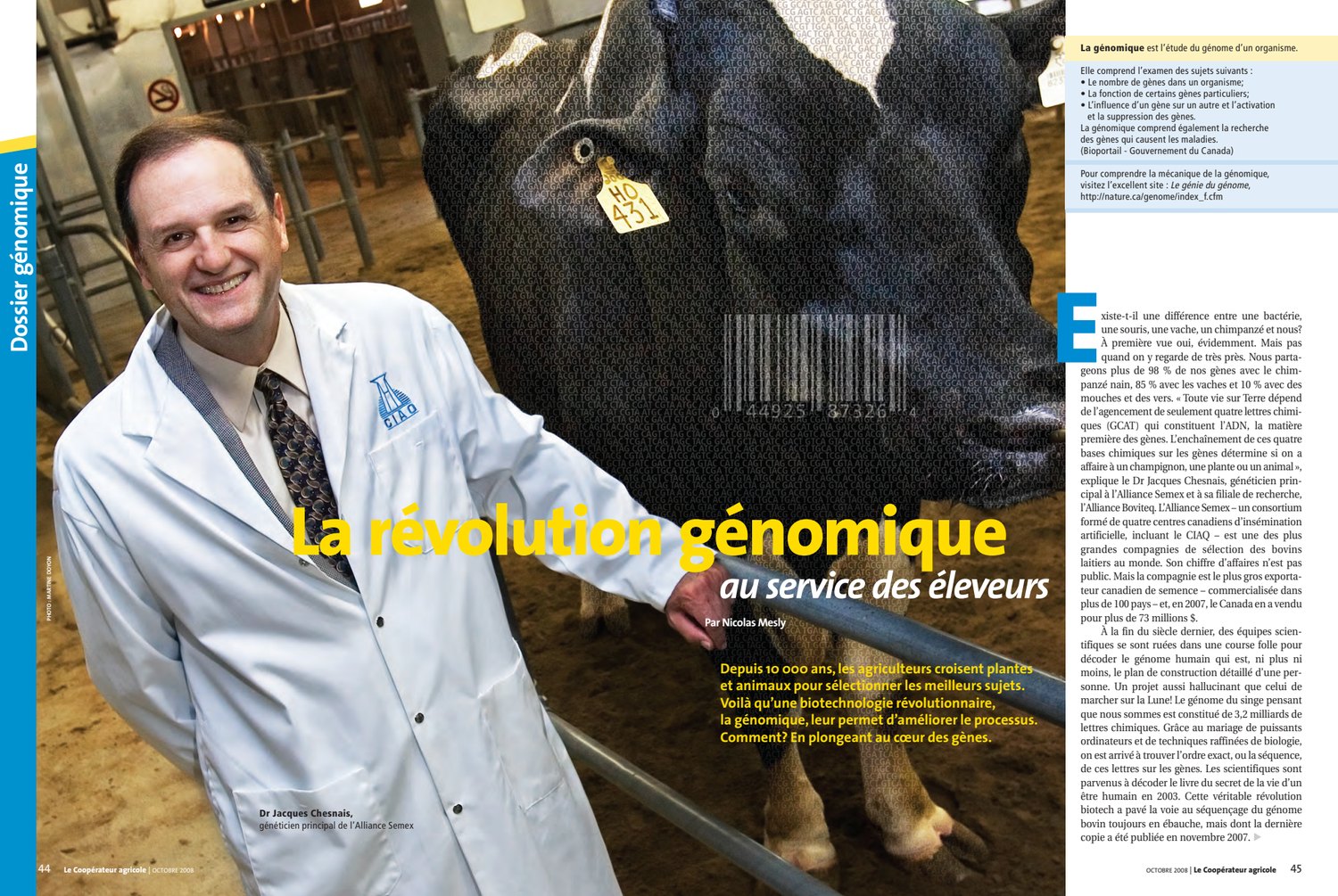
OCTOBER 2008: The Agricultural Co-operator 45 Genomics file PHOTO: MARTIN DOYON xist a difference between a bacteria, a mouse, a cow, a chimpanzee and us? At first glance yes, obviously. But not when you look at it very closely. We go - we manage more than 98% of our genes with dwarf chimpanzee, 85% with cows and 10% with flies and worms.
"Every life on Earth depends on the arrangement of only four chemi--needs (GCAT) letters that make up DNA, the raw material of genes. The chain of these four chemical bases on genes determines whether one is dealing with a fungus, plant or animal," explains Dr. Jacques Chesnais, a senior geneticist at the Semex Alliance and its research subsidiary, the Boviteq Alliance. The Semex Alliance – a consortium of four Canadian artificial insemination centres, including the CIAQ – is one of the largest dairy cattle breeding companies in the world.
Its turnover is not public, but the company is the largest Canadian exporter of seed – marketed in more than 100 countries – and in 2007 Canada sold more than $73 million in seed. By the end of the last century, scientific teams rushed into a crazy race to decode the human genome that is, no more than, a person's detailed construction plan. A project as delusional as walking on the Moon!
The genome of the monkey thinking we are is made up of 3.2 billion chemical letters. Thanks to the marriage of powerful computers and sophisticated biology techniques, we have managed to find the exact order, or sequence, of these letters on genes. Scientists have managed to decode the book of the secret of the life of a human being in 2003. This true biotech revolution paved the way for the sequencing of the bovine genome still in draft, but the last copy of which was published in November 2007.
Genomic revolution at the service of farmers For 10,000 years farmers have been crossing plants and animals to select the best subjects. This is a revolutionary biotechnology, genomics, which allows them to improve the process. By diving into the heart of genes. E By Nicolas Mesly Dr Jacques Chesnais, Senior Geneticist of the Semex Alliance Genomics is the study of the genome of an organism.
It includes the examination of the following topics: • Number of genes in an organism; • Function of specific genes; • Influence of one gene on another and activation and suppression of genes. Genomics also includes research into genes that cause disease. (Bioportail - Government of Canada) To understand genomics mechanics, visit the excellent site: Genome engineering, http://nature.ca/genome/index_e.cfm 44 The Agricultural Co-operator - OCTOBER 2008 102559_OCTO08_Pages44-53-_Layout 1 2015-05-07 18:42 Page44 OCTOBER 2008
These differences in DNA molecules, in their entirety, explain why I am different from you or why one bull is different from another," says Dr. Chesnais. "But these small differences within a single genome, the simplest of which are called SNP (and pronounced snip), have phenomenal implications! A joint study between the US Department of Agriculture (USDA), the leading artificial insemination centers in the United States and the Alliance Semex, conducted in 2007-2008, has tested a new technology: genomic selection.
The study is based on DNA testing of more than 5000 bulls tested with a panel containing 50,000 SNP used as markers, which has enabled the estimation of the expected effect of each marker for all caracs or bulls currently have tests (milk, fat and protein production, conformation, life, somatic cell count, fertility, ease of calving, etc.). "The same 50,000 SNP panel can then be used to evaluate the genome of a young animal, and better predict its genetic value."
The accuracy of this prediction, called genomic evaluation or GEBV , is much higher than the descent assessment (parent average) used previously for young animals. It varies between 40% and 70% depending on the character and is therefore still far from the accuracy obtained for one bull tested out of 100 girls. The method has been validated on over 1,700 proven bulls and offers consi- derable advantages for the selection of young bulls and heifers.
The Semex Alliance has sufficient confidence in this technology to have already genotyped more than 1000 bulls since the first results of the study in January 2008. The company intends to genotype about 2000 more by the end of the year. Genomics also helps to combat genetic defects. BLAD (Bovine leukocyte adhesion deficiency) is a genetic defect leading to the death of calves who have received the gene from both parents.
The use of the Penstate Ivanhoe Star bulls and his son Carlin-M Ivanhoe Bell caused another genetic defect to spread in the same race: CVM or complex vertebral malformation. Before having genomic tools, it was not clear whether a bull was carrying the defect by testing it on progeny.
Today, it is enough to take a hair or a drop of blood from a young bull to gain access to its genetic code and to know whether it carries the SNP responsible for these diseases. This information has considerably reduced the frequency of these defects in the Canadian herd. Traditional selection has so far greatly improved the production and confederation of dairy cattle in Canada. In 20 years, for example, in the Holstein breed, this selection has allowed a leap of 2200 kg of milk, 73 kg of fat and 71 kg of protein per lactation.
On the conformation side, the breast system improved by 10 points, feet and members of 4 points, milk power of 9 points and overall conformation of 11 points! The shock is that selection for production can have a long-term negative effect on reproduction and health. A cow that produces 10 tons of milk a year takes a medal at dairy olympiad, but such performance also imposes its dose of stress. Genomics will allow us to counterba - launch production by selecting at the same time the health and reproduction characters.
Unlike a disease like BLAD or CVM, which is a deficient gene inherited from parents, many genes are responsible for the characteristics that are selected in dairy production. When a cow is ill, it produces less milk. However, the characteristics such as health and fertility are not entirely the responsibility of heredity, but above all of the environment: heat of stable, bacterial environment... Genomics comes into play: "If we are able to find genetic differences in the DNA of animals that are responsible for susceptibility to certain diseases, selection will be much more effective," predicted Dr. Chesnais.
In the Canadian dairy industry, an already-developed data collection system for eight diseases is being addressed, including mastitis, boxing, ovarian cyst, caillette displacement, acetonemia, metritis, vitular fever and placental retention, which will allow genetic tools in animal health to be refined, and more effective selection for all economically important traits will allow genomics to develop another battlehorse.
The use of the most popular bulls by breeders inevitably contributes to the increase in inbreeding. Let's think about it, the CIAQ international star Starbuck has a record that a man is not close to holding: he has at least 200,000 girls in the world! And in Canada, this formidable breeder is found in the genealogy of 80% of Holstein-breeded dairy cattle."An older bull than Starbuck, Elevation, is found in the genealogy of 98% of our registered cows.
It's not so serious, as it's been several generations since these bulls were used," explains Dr. Chesnais. "However, the more brooders from the same families are used, the more inbreeding increases. It's going to be necessary to make sure that this increase isn't too fast in the future." Genomics A new look at agriculture Heifers with higher GEVBs will sell out more expensive.
Genomics will revolutionize the trade in animals. Genotype artificial insemination centres already bulls. As for the genotyping of cows and heifers, it is likely that breed associations offer this service to reduce costs to breeders. OCTOBER 2008
"We've created our own competitor," says Pierre Laliberté, Senior Vice President of Global Genetics and Exploitation Programs at the Semex Alliance. Canadian bovine genetics – seed, cattle, embryos – are popular in the international market. Sales in 2007 surpassed $100 million. But Canadian dairy imports this year amount to $621.4 million!
They are mostly from Europe and the United States, and are at the heart of the difficult negotiations led by the Canadian government at the WTO. More than 100 countries are tearing Canadian bovine genetics apart to meet specific needs. South American countries are looking for the volume, because of the demographic explosion.
While Europe, a mature market, is looking for dairy components. Genomics will allow the genetic traits sought to be refined according to the markets. PHOTO : NICOlas MEsly PHOTO : NICOlas MEsly PHOTO : NICOLAS MESLY PHOTO : JiM ROSE Starbuck 102559_OCTO08_Pages44-53-_Layout 1 2015-05-07 18:42 Page46 48 Agricultural Co-operators - OCTOBER 2008 Genomics - FAO - FAO - FAO - FAO - FAO - FAO - FAO - FAO - FAO - FAO - FAO - FAO - FAO - FAO - FAO - FAO - FAO - FAO - FAO - FAO - FAO - FAO - FAO - FAO - FAO - WHO - WHO - WHO - WHO - WHO - WHO - WHO - WHO - WHO - WHO - WHO - WHO - WHO - WHO - WHO - WHO - WHO - WHO - WHO - WHO - WHO - WHO - WHO - WHO - WHO - WHO - WHO - WHO - WHO - WHO - WHO - WHO - WHO - WHO - WHO - WHO - WHO - WHO - WHO - WHO - WHO - WHO - WHO - WHO - WHO - WHO - WHO - WHO - WHO - WHO - WHO - WHO - WHO - WHO - WHO - WHO - WHO - WHO - WHO - WHO - WHO - WHO - WHO - WHO - WHO - WHO - WHO - WHO - WHO - WHO - WHO - WHO - WHO - WHO - WHO - WHO - WHO - WHO - WHO - WHO - WHO - WHO - WHO - WHO - WHO - WHO - WHO - WHO - WHO - WHO - WHO - WHO - WHO - WHO - WHO - WHO - WHO - WHO - WHO - WHO - WHO - WHO - WHO - WHO - WHO - WHO - WHO - WHO - WHO - WHO - WHO - WHO - WHO - WHO - WHO - WHO - WHO - WHO - WHO - WHO - WHO - WHO - WHO - WHO - WHO - WHO - WHO - WHO - WHO - WHO - WHO - WHO - WHO - WHO - WHO - WHO - WHO - WHO - WHO - WHO - WHO - WHO - WHO - WHO - WHO - WHO - WHO - WHO - WHO - WHO - WHO - WHO - WHO - WHO - WHO - WHO - WHO - WHO - WHO - WHO - WHO - WHO - WHO - WHO - WHO - WHO - WHO - WHO - WHO - WHO - WHO - WHO - WHO - WHO
Other bonuses: "You can see which full brothers or sisters have received the best combinations of genes from their parents, and you can more easily spot exceptional animals in families that you didn't consider before. In doing so, you should diversify the genetic sources used and thus stop the increase in inbreeding."Dr. Chesnais said he was stunned by the speed at which genomics evolves. Sequencing the human genome cost $10 billion.
The cattle's, to which Canada has contributed financially, barely $55 million."Scientists are now working on new technologies to sequence an individual's genome so that in a few years it will cost just $1,000," he says. "The commercial impact of geno - mique is pharaaming. The Semex Alliance estimates the cost of testing a young bull at $50,000 and approximately 450 young people are tested each year.
Of these, only one in 20 will gain their stripes to be marketed on a large scale. Genomics will require fewer bulls tested on the offspring to produce the same number of elite bulls. However, artificial insemination centres will be able to diversify their offer by offering services of more elite bulls, some stronger in conformation, others in health, fertility, etc. According to Dr. Chesnais, genomics will become an essential tool for selection and traceability in both animal and plant reign (DNA being a natural bar code).
This new biotechnology is leading to a wild race for patents on particular genes and NPS. Because the bovine genome is not only of interest to breeders. Pharmaceutical giants are willing to take a deep hand in the genes responsible for resistance to disease, a better food conversion in animals, or, even, on the particular genes that give milk the reputation of a healthy food, even therapeutic, for the majority of people. Through the Semix Alliance, Canadian dairy farmers are at the heart of the biotech revolution.
However, for Canada to remain a world leader in dairy genetics, the country must quickly build a national DNA bank, says Dr. Chesnais. The main players – the Canadian Dairy Network, breed associations, artificial insemination centres, universities and other research centres in Canada – are looking at this issue, which would be used both for genomics research, for breeding, for cattle parenting control and, possibly, for support of traceability systems.
It would consolidate DNA collection and prevent a farmer from being repeatedly asked to provide biological samples on the same animals (a hair or a drop of blood, the latter is more revealing, but more expensive to collect). The challenge is to ensure a public and official genomics assessment system, for greater transparency. Otherwise, the companies involved in the selection could make their own genomic assessments "as is the case for poultry and pork selection".
Reference: CHENAIS, Dr. Jacques. Genomics, what can it do for the dairy producer?, Alliance Semex, November 15, 2007. CRAAQ (www.agrireseau.qc.ca). Scientists not only search for cattle DNA The genome of many species is under the powerful genomic magnifying glass: • The return of cod?
After salmon farming, which generates $200 million in New Brunswick alone, Canadian researchers want to find the cod farm. Genomics technologies are helping to find the best growth, breeding and resistance to disease and stress, such as increasing water temperature due to climate change. Will Newfoundland banks grow again to allow a miraculous fishery? • Tropical spruce growing!
To find the genes associated with growth, quality and value of wood, to study viruses that infect budworm, genomics aims to emerge from the wood a industry that is quite damaged by international competition and which generates $80 billion and 350,000 jobs annually. • Oats, shielded against fusariasis! Poor parent of cereals, oats are the fourth largest grain consumed in the world, but it is an important link in Quebec agriculture. The recent discovery of the rice genome allows advances in the fight against fusariasis that affects oats yields.
The Federal Coop and researcher François Belzile of the Department of Plantology at Laval University are working together to reduce the incidence of this disease through genomics tools. To learn about the various genomics projects in agriculture, fisheries, forestry and the environment, visit: Génome Québec: http://www.genomequebec.com Genome Canada: http://www.genomecanada.ca/en/portfolio/project/agriculture.aspx When a transgenic cow? Genomics can be used to create transgenic animals.
The insertion of genes from one species to another is common in plants: GM maize, for example, people our countryside. The company shown - Alise Nexia raises a herd of goats carrying a spider gene. The milk of these biques contains two proteins produced by spider to make elastic and ultra-resistant yarns from its web. The industrial applications of this modified milk are numerous: from the production of surgical wire to the sewing of wounds to the weaving of bulletproof vests.
However, this transgenic caprine milk is not found in the refrigerated supermarkets, says Dr. Chesnais. In 2001, researchers from the US Department of Agriculture (USDA) also transferred the gene of a non-pathogenic bacterium to a Jersey cow. This gene produces a protein, lysostaphine, which kills Staphylococcus aureus, a bacterium responsible for about 30% of the cases of mastitis. Cows carrying this gene have increased resistance to the nasty bacteria.
However, to be effective, the new protein must be present in milk. What raises avalanche of questions: what will be the effects on cows? But, above all, what would be the reaction of consumers? "The milk has always been presented as a natural product.
I doubt that the industry is looking to market genetically modified milk on tablets. To my knowledge, there are no such projects in the country. When we talk about the genomics of dairy cattle in Canada, we talk about the use of a better knowledge of the genome, not of the GMO," says Dr. Chesnais. It is not excluded that milk from transgenic cows is one day used to make medicines or vaccines.
According to the geneticist, genomics will remain primarily a selection tool. Maple Leaf In 2004, Maple Leaf Foods launched a traceability program using pig DNA. The company uses a technology using DNA markers, a natural barcode, which allows us to trace the path of the rib - a letter deposited in the consumer's plate to the sow that produced the slaughtered animal. However, this avant-garde program was abandoned.
We tried to find out why, but the company's spokesperson did not remind us, because of the listeriosis crisis that is taking place in the country's largest food processor. Canadian genetics is popular on the international market From left to right: Marcelino Balboa Guerra, Managing Director of the animal sector of Guanajuato State, Mexico; Lorenzo Mujica, a Cuban zootechnician, with Pierre Trudeau, Vice President Trudeau International and Dr. Alejandro Portales, Chief Veterinary Officer in Cuba, visiting Expo Québec last summer.
PHOTO: NICOLAS MESLY Spain 4%Butter and other fats 5.9% Dairy Genetic Exports - 2007 Canadian Dairy Imports - 2007 Japan 4% Netherlands 4% United Kingdom 6% Russia 9% United States 38% Others 35% whey products 10.6% Milk powders 11.7% Other 8.5% Ice cream 0.3% Milk and cream 2.2% 30.9 % Fine cheese 17.8% Casein TOTAL: $621,433,824 TOTAL: $102,621,528 2.4% Cheddar and other types of cheddar Melted cheese and fresh 3.9% Products made up of natural milk components 5.7% Source: Statistics Canada PHOTO: CIAQ 102559_OCTO08_Pages44-53-_Layout 1 2015-05-07 18:43 Page48 OCTOBER 2008
Margaret Somerville It allows us to understand how a healthy or sick body works under a brand new light. It is a discovery comparable to, but much deeper than, that of a world before and after the discovery of electricity or before and after the first written press. This gives us access to the mechanisms of life and the possibility of altering these mechanisms. You can touch the essence of life.
And that's where we're facing ethical problems. A. This discovery can have beneficial effects, for example, discover the gene responsible for obesity, Alzheimer's disease or even the farmer's lung? M.S. I'll be very careful. I wouldn't talk about a single gene, single gene diseases are very rare.
We know so much about genes for two years. We now know that there are triggers in the environment that activate or deactivate genes. And that this can influence your behavior. There is a very recent study on this subject that is called sociophenotype.
A. Could man's behavior be changed so that he would not wage war? M.S. On the contrary, we are talking about hyper-aggressive soldiers to wage more wars. In fact, Canadian scientists have transferred a gene found in an aggressive fish into a peaceful fish that did not possess this gene. This fish has become very aggressive even though in its natural state it is not.
So we could end up with a crazy dictator with an army of highly aggressive soldiers. I've been in the field long enough to know that this can happen. Science fiction is coming to reality. A. Critics say that with the biotech revolution, we could remake the world, play God, and cause irreparable damage to our own species and our environment.
The key word is "may." This does not mean that we will do it, that we must do it or that we can avoid it. That is why the notion of ethics is important and laws to implement ethical standards on which we will have agreed. The problem is that we cannot agree on what is ethical and what is not.
Then there is a lot of money injected into this new science of life. J-sweep all sorts of criticism for my positions that encourage prudence. A. Why this prudence? M.S.We now have the power to short-circuit 4.8 billion years of evolution of life on Earth.
We only recently appeared on stage, just 100,000 years ago. Not a living being could alter the evolution of time. But today, we can trade the essence of life. I say that we have an obligation to harness this new power.
We owe it to ourselves, to future generations and to the rest of the living beings. We should be inspired by the precautionary principle: is it safe? I compare this situation to that of climate change which, in my opinion, is a mini alarm signal with regard to the fire with which we play. A. You spoke of money.
Some critics say that we will be able to modify plants, animals and even humans to make specific biological weapons. I have worked with the World Health Organization on the future dangers of bioterrorism - the phenomena that are in the search for humanity. I co-authored an article on the subject "Ethics, a weapon to counter bioterrorism that has suddenly given me international fame." I have been working on the subject of bioterrorism, and I have been working on the subject of bioterrorism, and I have been working on it for a long time.
A. If we think we can create super soldiers, we could potentially make Olympic champions similar to the American swimmer Michael Phelps? M.S.I sit on the ethics committee of the World Anti-Doping Association. We met in St. Petersburg, Russia, a few weeks before the Beijing Olympics. The question of the hour and the future for the international sports community is that of the gene doping.
I don't know how it works, but it's not a science fiction issue. Representatives of a country, not Canada, asked if it was ethical to test 11-year-olds before giving them important scholarships for training for future Olympic games. There are genes, for example, that will give you short muscles perfect for a sprinter, others of elongated muscles made for a background runner. We know that these characters are genetic. between heaven and hell!
C GG GG GG GG GG GG GG GG GG GG GG GG GG GG GG GG GG GG GG GG GG GG GG GG GG GG GG GG GG GG GG GG GG GG GG GG GG GG GG GG GG GG GG GG GG GG GG GG GG GG GG GG GG GG GG GG GG GG GG GG GG GG GG GG GG GG GG GG GG GG GG GG GG GG GG GG GG GG GG GG GG GG GG GG GG GG A GG GG A GG GG A GG GG GG A GG GG GG GG GG A GG GG GG A GG GG A GG GG A GG GG GG A GG GG GG GG GG A GG GG GG GG GG GG GG A GG GG GG GG A GG GG A GG GG G G G G G G G G G G G G G G A G G G G G G G G G G G G G G G G G G G G G G G G A G G G G G G A G G G A G G G G A G A G G G G G G A G G G G G G A G G G A G G A G G G G G G G G G G A G A G A G A G A G A G A G A G A G G G A G G G A G A G A G A G A G A G G G A G A G G G A G A A A A A A G G G A A A A A G G G G G G G G A A A A A A A A A A A A A G G G G G G G G G G G G G G G A A A A A A A A A A A A A A A A A A A A A A A A A A A A A A A A A A A A A A A A G G G G G G G G G G G G G G G G
A. In the context of a food crisis, an increase in the human population, could genetically modified organisms not provide benefits for humanity? For example, could a fish gene be introduced into a cereal or strawberry to increase their resistance to cold? M.S.We must put limits. If there is a population suffering from malnutrition and we can introduce genes into plants capable of making natural vitamins and we save lives, I believe that this can be justified.
We have always crossed plants to find hybrids. So I always ask myself a first question of principle: does this process happen naturally in nature? If it is, it is not as delicate as if it does not happen in nature. Second question: do we fix something where nature has failed?
If this is the case, again, it is not as delicate as when the process is impossible in nature. A. So there are things you strongly oppose? M.S.Altering the genes of a human being is fundamentally wrong, as, for example, inserting pig genes into the human genome. Little is there any benefit in knowing that the process would be perfectly safe and that it would have no effect other than healing a deadly disease.
A.Why do you think that the general public is more inclined to accept a GM plant than a GMO animal? M.S.I think that a moral intuition comes into play. The less you see or taste the results of the transformations you have made, the less ethical question concerns you. It's normal because the human perceives things through his five senses.
There is no difference between GM corn and non-GMO corn. However, if you saw a chicken with three legs or four wings, the hair would raise you on the head! Biotechnology has allowed you to clone a great Quebec star, the Holstein breed bull, Starbuck. Do you think that the milk produced by the girls of its clone, Starbuck II, should be marketed?
M.S.C. is correct provided the product is reasonably safe. It should meet the same standards as other food products. However, this milk should be identified. People have the right to know.
In doing so, you put the ethical issue in the hands of the public. If you don't buy it, it won't produce it. A. Last January, the US Department of Agriculture (USDA) approved the steak of cloned cattle for dinner. Should Canada also put it on the table?
One of the questions to ask is whether this meat is safe for human health. The other is: What do we do to an animal to get cloned meat? That's where it has to be decided. I would add that, as in the case of milk, people have the right to decide whether they want to eat cloned steak or serve it to their children.
A. How can we prevent a slippage due to the use of this new science of life when we know that, for example, despite the laws and a good knowledge of nuclear technology, there have been accidents on Three Miles Island and Chernhobyl? M.S. There is a difference between an accident and a voluntary act. An accident is inevitable, but it is very different than plowing without looking forward, without thinking about the consequences. Let us think again how electricity, discovered in a very small laboratory, has changed our world.
It's the same with the human genome. We've discovered the electricity that drives life on Earth. Hence the importance of hannaking our discovery. J'appel c'est de l'éthique interdictuelle intelligent. 102559_OCTO08_Pages44-53-_Layout 1 2015-05-07 18:47 Page52
Complete original publication
The complete facsimile presents the publication in its original editorial design.
Open original PDF ↗