The complete story
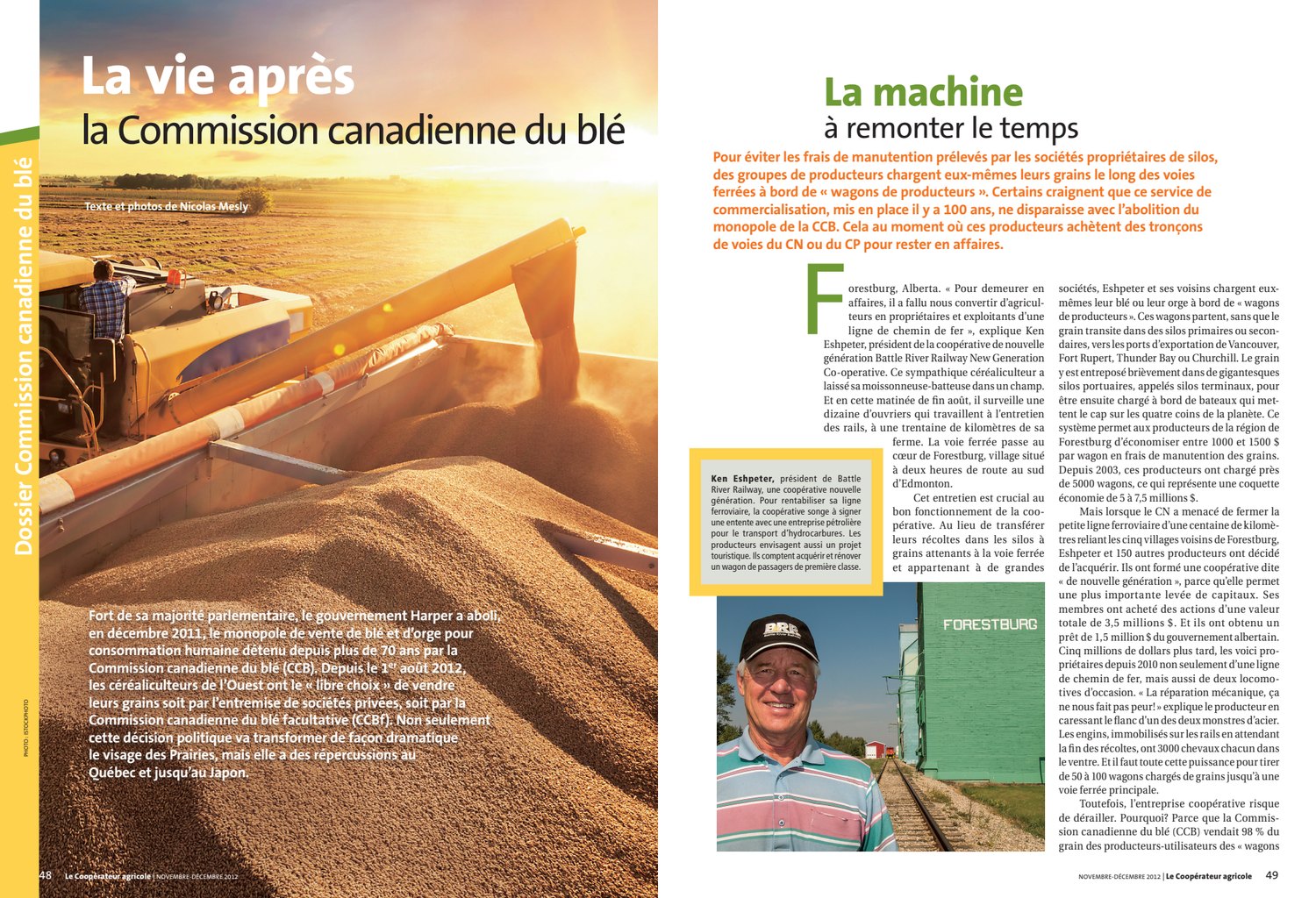
Life after the Canadian Wheat Board The Harper government, the majority of its members, abolished the monopoly on the sale of wheat and barley for human consumption held by the Canadian Wheat Board (CWB) for more than 70 years in December 2011. Since August 1, 2012, western grain farmers have had the "free choice" to sell their grain either through private companies or through the Canadian Optional Wheat Board (CWB). Not only will this political decision dramatically change the face of the Prairies, but it has repercussions in Quebec and Japan. Companies, Eshpeter and its neighbours themselves load their wheat or barley on board "producer cars."
The grain is stored briefly in huge port elevators, called terminal elevators, and then loaded on board ships heading all over the world, which saves producers in the Forestburg area between $1,000 and $1500 per car in grain handling costs, and has loaded nearly 5,000 cars since 2003, representing a coquette saving of $5 to $7.5 million.
But when CN threatened to close the small railway line of about 100 kilometres - linking the five neighbouring villages of Forestburg, Eshpeter and 150 other producers decided to acquire it - they formed a "new generation" cooperative because it allows for a larger capital raising. Its members bought shares worth a total of $3.5 million and they got a $1.5 million loan from the Alberta government.
Five million dollars later, they have been working since 2010 not only on a railway line, but also on two used locomo -tives. "Mechanical repair doesn't scare us!" explains the producer by scouring one of the two steel monsters. The machines, which are immobilized on the rails pending the end of the harvest, have 3000 horses each in their stomachs. And it takes all this power to pull 50 to 100 cars loaded with grain to a main track.
However, the cooperative venture is likely to derail. Because the Canadian Wheat Board (CWB) sold 98% of the grain from producers/users of the "Orestburg Cars, Alberta."To remain in business, we had to convert agriculture - owners and operators of a railway line," says Ken Eshpeter, president of the new generation cooperative Battle River Railway New Generation Co-operative. This friendly grain farmer left his combine harvester in a field.
And in the morning of late August, he oversees about ten workers who work on the maintenance of the rails, about 30 kilometers from his farm. The railway passes to the heart of Forestburg, a village two hours south of Edmonton. This maintenance is crucial to the proper functioning of the coo - operative. Instead of transferring their crops to the grain elevators adjoining the railway and belonging to large Fs Text and photos by Nicolas Mesly PHOTO: ISTOCKPHOTO Time-Turn Machine To avoid handling costs collected by the elevator companies, groups of producers themselves load their grain along the tracks on board "producer cars".
Some fear that this marketing service, which was set up 100 years ago, will disappear with the abolition of the CWB monopoly, as these producers purchase sections of CN or CP tracks to stay in business. Ken Eshpeter, president of Battle River Railway, a new generation cooperative, is considering signing an agreement with an oil company to make the company profitable.
Producers are also considering a tourism project. They plan to acquire and renovate a first-class passenger car. NOVEMBER-DECEMBER 2012
"Our problem is that now we have to go knock at the door of several companies to offer our grain. We're going to have to hire someone to sell it," says Ken Eshpeter. "To improve its service offer, the cooperative has set up a quality inspection and grain mixing service for its members."The customer knows exactly what quality he is buying," says the farmer.
The latter also plans to double rapidly, from 800 to 1600, the number of producer cars offered by the cooperative.1 Producers' right to load their own cars to avoid handling costs has remained for 100 years.2 Today, there are 15 projects in the Prairies - short lines similar to the Battle River Railway New Generation Co-operative. Grain producers themselves charge about 13,000 cars per year out of the approximately 200,000 that were chartered by the CWB.
Worried, Ken Eshpeter believes that companies will be more or less willing to sell wheat and barley transported in pro - ductor cars, because "they don't like to be short-circuited," he says. However, the president and CEO of the new CWB, Ian White, is reassuring. "We will continue to sell grain from producer cars and we have already signed agreements for 2012-2013," White said in an interview in Winnipeg, managing the privatization of the CWB imposed by Ottawa by 2017.
He believes that the large terminal elevator companies will be interested in the volume of grain offered by the Battle River Railway New Generation Co-operative, as well as by other short railway operators."Is it with the volume of grain transiting the new CWBf becoming a co-operative? Founded in 1935, the Canadian Wheat Board (CWB) was a shared-management Crown corporation. Since 1998, a board of directors composed of 10 peer-elected producers and five directors appointed by Ottawa had been watching over the fate of a company with revenues ranging from $4 billion to $8 billion.
In December 2011, the Harper government sent the producers back to their lands, and entrusted the President and CEO, Ian White, with the task of privatizing the CWB. The CWB is five years old, starting August 1, 2012, to carry out its mandate. The Co-operator met with him in his office at the company's head office in Winnipeg.
The Farm Co-operator Ian White The CWB still exists, but it no longer has a monopoly on the sale of wheat and barley for human consumption. Producers can sell their grain collectively, but voluntarily.
CA The CWB had some government guarantees to operate in the new context.
But our needs will be quite reduced, because we will sell much less grain and fewer customers. CA Can you give us an idea of this decrease? IW 2012-2013 will be our first year of operation on a voluntary basis. We have 30 to 40% of the grain volume compared to last year, where we are operating under one-stop operation.
CA How do you reassure the markets? IW Japanese, for example, know that we can provide them with 50% of their wheat needs. The rest will come from private companies. CA What budget or public funds do you have to privatize the CWB?
This amount is mainly used to cover pension funds. We have reduced the staff from 420 to about 100 people. We are also getting rid of a brand new computer system too powerful for our new needs. CA Why should producers do business with the new CWB, when they have no more elected representatives?
IW Because we are the only ones offering a collective sales system in the current market. And we have signed agreements with companies to transit the grain from our pools into their primary and port elevators. Most of the producers have only experienced the sale by the pools in their careers. We represent some stability and we offer an alternative to the cash price offered by the companies.
CA What are you going to do if one day Cargill, for example, decides to set up its own grain pools? IW It is not impossible that Cargill will one day offer its own pools. But for the moment, the companies have left this role to the CCBf. u Ken Eshpeter riding one of the two used SB40 locomotives, each paid $100,000. Mechanical maintenance does not pose any problem to the producers.
The locomotives were driven by a retired former CN driver. On the right side of the railway, the white silos where the grain is stored are visible before being loaded on board "producer cars." In their primary and port silos, these companies make their profit," he adds. "Only time will tell if Ken Eshpeter's concern is founded." Ironically, it is to deal with the abuse of grain handling costs charged by the companies that the three large cooperative pools in West 3 pushed along the Prairies in the 1930s.
And to market their grain, producers had also given their full support to the creation of the CWB... by a Conservative government."By abolishing the CWB, the Harper government invented the time machine. We went back to square one," says Ken Eshpeter, climbing on his locomotive. u 1 It takes 700 cars to load a Panamax cargo. The CWB was sailing 200 ships a year. 2 www.grainscanada.gc.ca/legislation-legislation/ act-law/cga-lgc-eng.htm 3 Alberta Wheat Pool, Saskatchewan Wheat Pool and Manitoba Pool Elevators.
For more information on the fate of these large co-operatives, read: "Agricore-United, in the pocket of the multinational ADM", The Agricultural Co-operator, December 2002; "Saskatchewan Wheat Pool, the fallen queen", The Agricultural Co-operator, May-June 2002. World Wheat Production Third World Wheat Exporter First World Durum Exporter 2% 3% 4% 21% 9% 61% 7% 10% 14% 15% 21% 33% Australia Argentina Canada European Union United States Other 4 7% 1 9% 1 4% 2 0% Canada European Union United States Other Australia Argentina Canada European Union United States Other TonnesWagons 1400 000 1200 000 1000 1999-00 2001-022000-01 2002-032003-042004-052005-062006-072007-082008-092009-102010-11 Wagons Tonnes Canada, the world's leading exporter of durum wheat, holds 50% of the market share.
Durum wheat is used for the manufacture of pasta and couscous. Grain volume and number of producer cars (1999 to 2011) Source: Canadian Grain Commission or quorum.net NOVEMBER-DECEMBER 2012
IW Companies are interested in the volume of CWB's pools because they have to make their silos profitable. Should CA Ottawa legislate on minimum access, for example 10%, for CWB's grain at port facilities of its choice, in the event of disagreements with the companies? IW This was not considered by the federal government at this time. CA When the Australian Wheat Board (AWB) was privatized by the Australian government, it was quickly sold to two private companies, Agrium and Cargill.
Is this the fate that awaits the CWBf? IW Minister Ritz has indicated that the CWBf was not for sale at this time. Note that the case of the AWB is different from that of the CWBf. L-AWB had been transformed into a share capital corporation before the producers sold their share.
We are at the very beginning of the privatization process, but we are considering a participation of producers, perhaps even in a cooperative formula. CA A cooperative formula? IW Yes, or what would be a cooperative formula.
We need to discuss this with producers, examine capital requirements and determine how to raise capital. We must not assume that we will remain static. It is not excluded that we will acquire silos, for example. We have until 2017 to submit a privatisation plan to the government.
Ian White, President and CEO of the CWBf, is considering the possibility of buying silos and marketing other grains than wheat and barley. For the first time in his history, at the request of producers, he says, the CWBf is offering pools this year to market canola. Gilbert Ferré's concerns "The marketing of wheat is much more complex than canola!" explains Gilbert Ferré in a telephone interview. This French-speaking producer of Breton origin is growing a 1000 hectare farm with his son in Zenon Park, north of Regina, Saskatchewan.
Canada has nine classes and 25 varieties of western wheat, with different protein levels, which are used to make pasta, couscous, pastries or bread from nations. (While canola, an industrial plant, has only three categories, classified according to their impurity: presence of soil, etc.) "The CWB was like a large farm of seven million hectares, allowing it to make wheat mixtures to better meet customer requirements," he adds. At the same time, the CWB was equivalent to a huge cooperative, "and it was a huge one, and it was a huge one, and it was a huge one, and it was a huge one, and it was a huge one.
The marketing company redistributed approximately $500 million in rebates each year, resulting from premiums negotiated with railways, grain traders and international customers in 70 countries. Ferré intends to continue selling its wheat and barley through the CCBf's pools, a company "emasculated" by the loss of its monopoly, he believes. The producer says he does not trust Chicago brokers after the MF Global scandal. The brokerage declared bankruptcy in the United States in November 2011 after a $1.2 billion fraud against 38,000 customers, mainly small farmers.
"This is the first time in our history that such a thing has happened," says David Lehman, the product research and stock-market development manager at the Chicago Mercantile Exchange (CME). "In March, the CME created a US$100 million fund to repay small producers if this happens again."Ferré believes that the abolition of the CWB monopoly will encourage the concentration of farms in large companies from 4000 to 12,000 hectares and more."It happens in my region," he says.
And he thinks that the land on these large farms will be passed to foreign investors, such as oil and potash."J-I raised this issue with politicians in Ottawa, but they remained silent," said the producer. "The producer testified before the Standing Senate Committee on Agriculture and Forestry in the National Capital in December 2011, which was responsible for weighing the consequences of the passage of Bill C-18 by Parliament, which allowed the dismantling of the CWB monopoly.
Kevin Bender, Apostle of the Free Market The president of the Western Canadian Wheat Growers Association (WCWGA), Kevin Bender, applauds the CWB's monopoly's end loudly and strongly. Even if he could make private sales through the CWB, he prefers to deal directly with the major grain traders."With the CWB, I had to wait 16 months before I received my final payment. There I made my cash sales and I was paid immediately.
It's a contribution to our company's working capital," he says. Kevin Bender applauds the CWB's monopoly. He is pleasantly surprised that Quebec wheat producers have also voted against mandatory collective marketing. The CWB was charging more than $6 million on its annual sales to fund R&D and after-sales service to its customers.
From now on, it will be the wheat producers of the country, headed by a national association including the Quebec grain farmers, who will have to take the note, says Bender. [NDLR: At the time of writing this article, the terms of the planned R&D levies were not yet determined precisely.] undercut crops 1740 hectares on the family farm, with his brother and father, a few kilometres from Red Deer, in central Alberta. He plans to sell part of his 2721 tonnes of wheat through the CWBf pools.
But he believes that he gets better prices by shopping with Viterra, Richardson, Cargill and Dreyfus, all of which have silos within 100 km of the company."We're already selling our canola, lentils and peas on the open market. Why we wouldn't be able to sell our wheat?" he said. Bender, like some of the 600 WCWGA members, is also looking on the US side to sell his grain.
The cash prices offered by American millers, "sometimes higher than those of the CWB pools," encouraged grain farmers to cross the border. The CWB had about 10% of its sales in the United States. And 14 times it had to defend itself against unfair competition complaints from US producers, both at the WTO and at NAFTA. The courts of both jurisdictions have each exempted Canadian buyers.
"The abolition of the CWB will allow greater freedom of trade on both sides of the border," he says. "He does not believe that American producers will press to close the border, as was the case for beef during the mad cow crisis or the – recurrent – timber sector. CWB is no longer there to defend the interests of western grain farmers, and the producer relies on Canada's Minister of Agriculture, Gerry Ritz, to settle trade disputes with the southern neighbours.
In addition, CWBf President and CEO Ian White believes that, in the new business environment, "the price of the bushel will be the same on both sides of the border." According to him, this situation defies the possibility of a border dispute. u B NOVEMBER-DECEMBER 2012
AO C is logically the next step. North America remains one of the only places in the world where independent producers still grow their own land. But this changes rapidly. In Canadian beef, pigs or potatoes production, the gran - companies are leading the ball, under vertical integration.
Producers are only becoming farmers, some still own some of their land, but not animals and genetics, and that will be the same in the grain sector. CA Canada had a reputation for producing the "Cadillac" of wheat in the international market.
We had several varieties of wheat and a targeted classification system, among other things, for very high value-added markets. I believe that the Canadian system will be harmonized with the U.S. system. Canada will become a producer of "Carry" wheat, a common consumption wheat, and producers and consumers will lose it at a change.
CA The CWB has always opposed the introduction of GMO wheat into the Prairies. Surveys of our customers indicated that they did not want GMO wheat, but as soon as it is registered in the United States, it will be registered in Canada. Once introduced into the system, GMO wheat will be very difficult to segregate.
CA In a completely different order of thought, would you have any advice to give to producers who operate under supply management (OG)? AO How can the current government be against the CWB while supporting the GO? It is pure hypocrisy. Both systems are similar.
And if there is one thing, it is that GO is much more restrictive, since it controls production. If I was a producer under GO, I would be very concerned. They are the next in the line of sight. [NDLR: The CWB and GO are issues that are substantially different and difficult to compare, especially because the CWB was challenged by a large proportion of producers, which is not the case for GO, as well as the presence of quotas in the GO, which represent a total value of more than $30 billion for Canada as a whole.] CA What do we do then?
AO Inherit your agricultural organizations such as UPA, your cooperatives, the Federal Co-op or others. They are not perfect, but if they disappear, they will be very difficult to recreate. And communicate the stakes better, not only to the producers, but also to the general public. A legal battle on two fronts Allen Oberg does not disembowel.
The former chairman of the CWB's board of directors would have been willing to do what producers wanted if they had wanted to eliminate their monopoly. He said the Harper government violated the Canadian Wheat Board Act by ignoring section 47.1. The Canadian Wheat Board required Ottawa to hold a referendum on whether or not to maintain this monopoly. An independent company plebiscite at the request of 8 of the 10 producers on the board of directors indicated in September 2012 that 62% of the 37,000 respondents were in favour of maintaining a single window for selling wheat for human consumption.
The producers are pursuing Ottawa on two fronts: — Did the Harper government act illegally by passing its free market law (Bill C-18) without a referendum? In December 2011, Justice Douglas Campbell of the Federal Court gave the CWB's eight elected producers a right. But this ruling was quashed in June 2012. The case is before the Supreme Court of Canada.
A final verdict is expected in December 2012 or early 2013. — A group of producers, The Friends of the Canadian Wheat Board, has initiated a class action against the Harper government. Producers estimate that the losses caused by the CWB's sales monopoly is $17 billion. This case is also expected to be resolved by the end of 2012 or early 2013. CWB was not in business to produce agricultural commodities, but rather was aimed at lucrative niche markets.
"We're moving from a system based on what consumers were willing to pay to a system based on what producers are willing to sell," he says. "The Harper government handed over the keys to the Canadian attic to multinationals." – Allen Oberg The Co-operator met with the former Chair of the CWB's board of directors, Allen Oberg, at his farm near the village of Forestburg, Alberta. He said the big winners of the CWB's abolition were the multi-national grain companies, and he does not believe that a Canadian Voluntary Wheat Board (CWBfC) could survive without its monopoly.
Former CWB President Allen Oberg in the middle of his Prairie gold field: Canadian western red spring wheat with 13.5% protein and destined for the lucrative Japanese market. Why do you think a CWBf is doomed to failure? Allen Oberg For the simple reason that the CWBf does not have any primary elevator and, more importantly, no silo in export ports. It's his heel of Achilles.
In the new free market system, the CWBf is in direct opposition to its competitors. It's like asking Ford to sell its cars through Toyota dealers. CA The CWB's sales monopoly was therefore essential? This monopoly represented a power ratio in a trading world dominated by giants.
The CWB, thanks to the volume of grain placed on the market, was able to negotiate better prices with international customers, with both railways, CN and CP, and with the three large elevator companies, who also had to bid against each other to get some of our grain. CA Can you quantify this bargaining power? AO $500 million per year.
CA Who will now earn these "premia"? AO The shareholders of these companies. They will no longer be producers, and this will have consequences on the viability of rural communities.
This money will no longer be used by producers to spend money at the garage, grocery store or local dealership. CA Will this affect farms? AO To stay in the race, farms will have to grow. And they will have to make their own marketing, which is a trade in itself.
They will have to hire experts, which the smallest farms will not be able to do. But even the largest producers will be only dwarfs in this commercial landscape. Highlights of the CWB Created in 1935. The CWB marketed between 18 and 24 million tonnes of wheat, durum wheat and barley for human consumption, and managed international sales of barley for animal feed.
The amount of sales in 70 countries ranged from $4 billion to $8 billion, less marketing costs, to producers. Number of producers: 75,000. International reputation as a supplier of premium wheat used in the manufacture of pasta, couscous and bread from nations.
Governance: 10 elected producers and 5 officers appointed by Ottawa. Abolished August 1, 2012 with the passage by Ottawa of the Free Marketing Choice for Grain Producers Act (Act C-18). NOVEMBER-DECEMBER 2012
Complete original publication
The complete facsimile presents the publication in its original editorial design.
Open original PDF ↗