The complete story
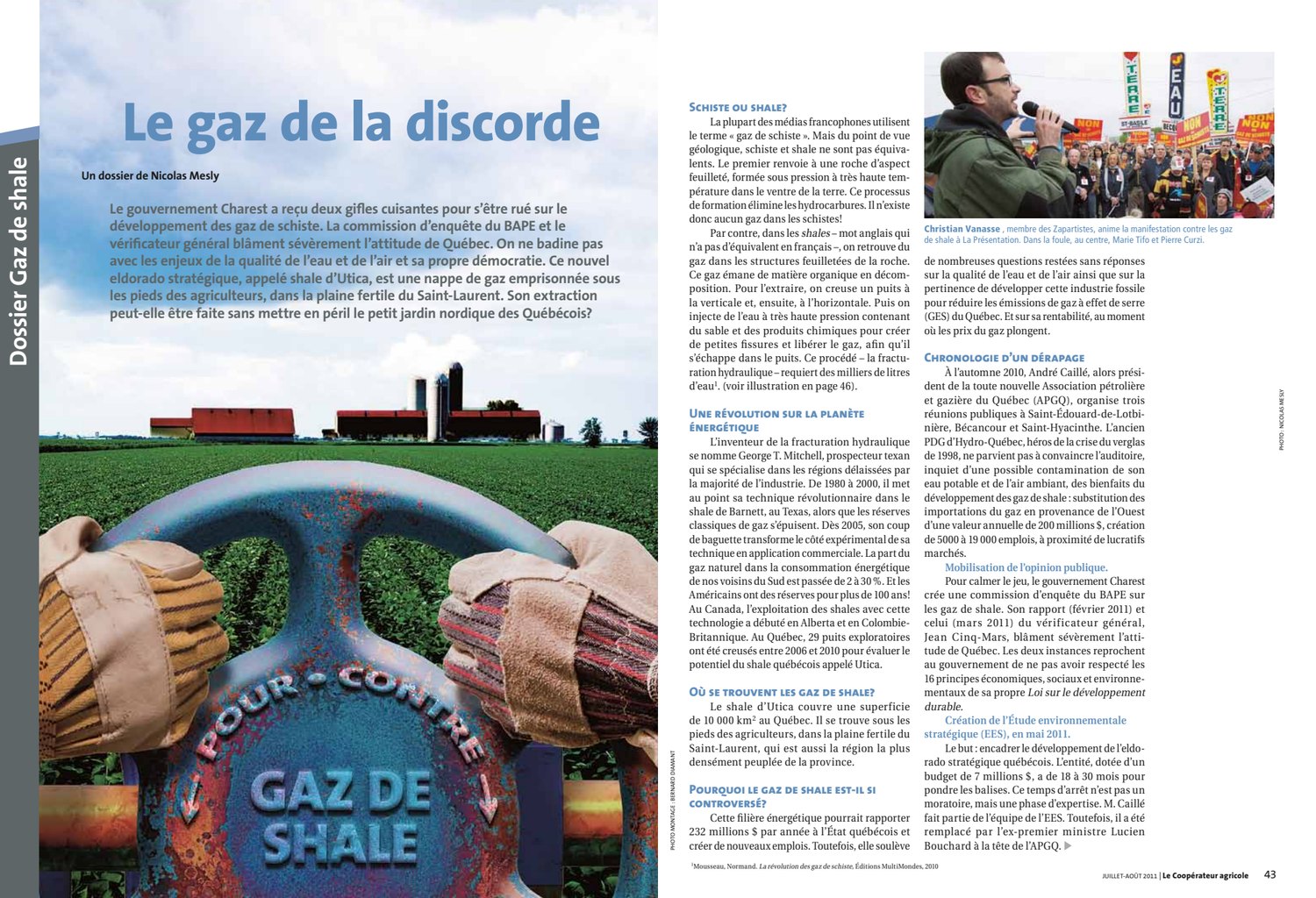
Gas of Discord The Charest government received two slaps to be rushed into the development of shale gas. The BAPE commission of inquiry and the Auditor General severely blame the Quebec attitude. One does not shove with the stakes of water and air quality and his own democracy. This new strategic eldorado, called shale d'Utica, is a table of gas trapped under the feet of farmers, in the fertile plain of the St. Lawrence.
Can its extraction be done without endangering the small northern garden of Quebecers? A dossier by Nicolas Mesly Schiste or shale? Most French-speaking media use the term "shist gas." But from a geological, shale and shale point of view are not equal - slow.
The first refers to a laminated rock formed under pressure at very high tem - perature in the belly of the earth. This process of formation eliminates hydrocarbons. So there is no gas in the shales! On the other hand, in the shales – an English word that has no equivalent in French – gas is found in the laminated structures of the rock.
This gas is produced from organic matter in decomposition. To extract it, a well is dug vertically and then horizontally. Then, very high pressure water containing sand and chemicals is injected to create small cracks and release the gas, so that it escapes into the well. This process – the hydraulic fracture – requires thousands of litres of water1. (see illustration on page 46).
A revolution on the energy planet The inventor of hydraulic fracturing is named George T. Mitchell, a Texas prospector who specializes in areas left out by the majority of industry. From 1980 to 2000, he developed his revolutionary technique in the Barnett Shale, Texas, while conventional gas reserves were exhausted. As early as 2005, his wand blow transformed the experimental side of his technique into commercial application.
The share of natural gas in the energy consumption of our southern neighbours has increased from 2 to 30%. And the Americans have reserves for more than 100 years! In Canada, the exploitation of the shales with this technology has begun in Alberta and British Columbia. In Quebec, 29 exploratory wells were dug between 2006 and 2010 to assess the potential of the Quebec shale called Utica.
Where are the shale gas? The shale d-Utica covers an area of 10,000 km 2 in Quebec. It is located under the feet of farmers, in the fertile plain of the St. Lawrence, which is also the most densely populated area of the province. Why is the shale gas so controversial?
This energy sector could bring $232 million a year to the Quebec state and create new jobs. However, it raises many questions that remain unanswered about water and air quality and the relevance of developing this fossil industry to reduce Quebec's greenhouse gas (GHG) emissions. And about its profitability, as gas prices dive into the water and air. Timeline of a slip In the fall of 2010, André Caillé, then president of the newly-established Quebec Oil and Gas Association (QPGA), organized three public meetings in Saint-Édouard-de-Lotbi - nière, Bécancour and Saint-Hyacinthe.
The former CEO of Hydro-Québec, a hero of the 1998 ice crisis, fails to convince the audience, concerned about possible contamination of its drinking water and ambient air, of the benefits of the development of shale gases: substitution of imports of gas from the West of an annual value of $200 million, creation of 5000 to 19,000 jobs, close to lucrative markets. Mobilization of public opinion. To calm the game, the Charest government created a BAPE commission of inquiry on shale gases.
His report (February 2011) and the one (March 2011) of the verif icator generated, Jean Cinq-Mars, severely blame l'atti - tude de Québec. Both bodies blame the government for failing to respect the 16 economic, social and environmental principles of his own Sustainable Development Act. Creation of the Strategic Environmental Study (SEA), in May 2011. The goal: to frame the development of the strategic Quebec Eldorado.
The entity, with a budget of $7 million, has 18 to 30 months to lay the tags. This stopping time is not a moratorium, but a phase of expertise. Caillé is part of the team of the EES. However, it was replaced by former Prime Minister Lucien Bouchard at the head of the APGQ.
X Christian Vanasse , a member of the Zapartists, hosts the demonstration against shale gases in La Présentation. In the crowd, in the center, Marie Tifo and Pierre Curzi. PHOTO : NICOLAS MESLY 1Mousseau, Normand. La révolution des gaz de schiste, Éditions MultiMondes, 2010 PHOTO MONTAGE : BERNARD DIAMANT JUILLE T-AUGUST 2011
I'm going with him on his truck to see the state of the place. Talisman drilled two wells of shale gas in 2009 10 minutes from his farm, located in the heart of the village. And the citizen tension has climbed as high as the flames from the flare that lit the sky of the whole region."I don't blame the company.
It had all the permits! But we, the elected ones, found ourselves on the fire line," he adds. The mayor is not close to forgetting the stormy assembly of September 21, 2010 at the village community centre, chaired and organized by André Caillé, president of the newly formed Association petro-leière et gas du Québec (APGQ), 14 months after the drilling. Rather, he blames the Quebec government and its Mining Act, which gives precedence to mining companies over the agricultural and municipal worlds.
The essential part reads as follows: "No one shall prohibit or make difficult access to land containing mineral subsidies which are part of the State's domain to the person who has the right to prospect or stake it if the latter identifies on request and, in the case of the licensee, if he shows his permit." "As producers, the subsoil does not belong to us. We cannot oppose the development of shale gas," explains Mr. Québec, who owns the shale d'Utica, granted exploration rights to 10¢ lbs per year for an area of 10 million hectares, an annual annuity of $1 million.
"By referring to the average price of $500 per hectare of Alberta, Quebec could have collected $5 billion. [...] These revenues would have been retained by the state, whether or not there had been development of gas deposits," notes the BAPE's commission of inquiry. The president of the APGQ and former Premier of Quebec, Lucien Bouchard, contests the $5 billion of this loss. Unlike Alberta, hydrocarbon reserves are not proven in Quebec. The province cannot therefore demand an equivalent amount for these duties, he believes.
A worried producer The Talisman site is a huge four-hectare-scraped clai in the middle of the public forest of the Lotbinière Lordship. A barrier blocks access to the road and a security guard keeps the place day and night. "A drilling, it's correct in the middle of the woods. But I wouldn't be able to live with a well in my fields because of all the trouble associated with this acti - live, unless it is located at the end of my land," says the producer.
And there are disturbances! Intensive trucking, heavy machinery, noise, dust... The development of a site, drilling and completion of a necessary horizontal well - site "about 1000 truck trips, or 2000 trips, including 600 tanker trips spread over a period of 20 days for the transport of water necessary for fracturing", reports the APGQ. The traffic was less intense in Saint-Édouard, because the company pumped the water of fracturing direc - the Huron River, next to the well.
And this chemical soup did not have to be treated in Alain Soucy's new sewage treatment plant at the heart of the turmoil Like many elected representatives of the 1000 small municipalities in Quebec, Alain Soucy wears two caps: that of agricultural producer and that of mayor. Here is the story of his meeting with gas companies. Saint-Édouard, built for a cost of $13 million, but considered inadequate for this type of treatment. "Because the Saint-Édouard frac-ration water was pure enough, it was recycled to dig another well in Gentilly," explains Vincent Perron, spokesman for Talisman.
L-APGQ plans to dig the d-Utica shale at a rate of 150 to 600 wells per year. Most of the 20,000 wells envisaged to develop the shale gas pipeline will be on agricultural soil. They will slurve 5000 hectares of land, according to the figures quoted by the BAPE's commission of inquiry. Half of this area could be returned to agriculture once the installation works are completed and the wells are in operation.
L的UPA is currently negotiating a framework agreement with the APGQ to compensate producers (see page 47 for an interview with the vice-president of the UPA, Pierre Lemieux). A Mayor without power "As mayors, too, we have no power. We can regulate the place where pigs can be moved, but not wells!" Québec has just introduced a new bill (Bill 14, May 2011) to modernize the Mines Act.
The mining companies' projects will now be subject to social acceptability. However, this project does not include a hydrocarbon law to regulate the gas industry more specifically. X Natural gas reserves for different shales Country Estimated recoverable reserves (Tcf)* Main Shales Total United States 862 Barnett (Texas) 44 Marcellus (Pennsylvania, New York 262 Haynesville (Louisiane, Texas) 251 Canada 388 Horn River (British Columbia) 100 Colorado (Alberta, Saskatchewan) n.d. Utica (Québec) 40 France 180 China 1.275 Mexico 681 Argentina 774 Other 2.502 TOTAL 6.662 Sources: Report # 273 Bape and US Energy Information Administration (EIA) * Tcf (trillion cubic fee) = 1000 billion cubic feet Oil, natural gas and underground reservoirs - Lower St. Lawrence River Source: Department of Natural Resources and Wildlife Permit Holders and Leases 333817 Alberta Ltd 9161-7795 Québec Inc. 9220-5558 Québec Inc.
Abba Québec Resources Inc. Bertrand Brassard Canadian Quantum Energy Corporation Corridor Ressources inc. Greencastle Resources Ltd Intragaz Exploration, Sec Junex inc. Ltée Marzcorp Oil & Gas inc.
Molopo Canada Inc Mundiregina Resources Canada inc. Petrolia inc Petrolympia inc. Questerre Energy Corporation Resources & Energy Squatex inc. Richard Marc Lacasse Softrock Minerals Ltd Stelmine Canada Ltd Talisman Energy inc.
Transamerican Energy Inc. X-Terra Resources Corporation Call for tenders Quebec Administrative Regions Quebec MRC Municipalities of Québec International Frontier Interprovincial or Interstate Frontier Quebec – Newfoundland and Labrador (this boundary is not final) Aboriginal Territory Parks and Ecological Reserves Operating Lease Control Points for Licence Energy Transportation Lines Highways Frontiers Various JULY T-AUGUST 2011
Pierre Lemieux: It's worrying, but we're committed to the Strategic Environmental Study (SEE). And we hope that the contribution of agriculture to society will be well taken into account. LCA: What is the risk for farmers?
PL: Water, its quality and quantity for agricultural enterprises. And there is the health and safety of producers, because exploration and exploitation generate a lot of traffic with heavy machinery. Then there is the return of the land to cultivation once the wells are drilled or after their useful life. LCA: What are you negotiating with the Quebec Oil and Gas Association?
PL: Negotiations are slowing down. We are very pleased with the government's decision to pause by setting up the EES. In addition, a mission is being organized in Pennsylvania in June this year to see how the soil is being rehabilitated and how to choose the sites, so that there is the least possible impact on agriculture. This will allow us to better identify the issues with the APGQ.
LCA: A Pennsylvania producer can earn $30,000 per hectare plus a 20% rent per well for the entire life of the farm. Are you going to ask for the same? PL: We can't do that. In the United States, people own the basement.
This is the big difference. LCA: What are you negotiating, then? PL: We don't know yet whether the deal will be in the form of compensation or royalties. But we want everyone to be compensated, the producer who has wellheads at home like his neighbour, because we have to connect these wells with pipes.
LCA: In the event of an accident – the loss of drinking water on the farm, for example – the government requires gas companies to have a liability insurance policy of $1 million. PL: It is not the intention of producers to eco-finance. If it takes a water system to supply the companies with quantity and quality, the responsibility will be on the gas companies, municipalities or the government. It is up to the government to introduce control, monitoring and operation measures that are strict enough to avoid contamination.
And to demand a large enough bail to cover damage or disaster. LCA: The government just tabled Bill 14 last May to modernize the Mines Act. PL: It's a deplorable thing. There's nothing about royalties.
The least that can be done is that the government ensures that the benefits to Quebec are as high as possible. And most importantly, this initiative lacks a hydrocarbon law to regulate the shale gas industry. LCA: Does the draft Mines Act provide for the exclusion of mining activities in certain sectors? PL: It provides for the exclusion of mining in towns and resorts, but not on agricultural land!
Mining is prioritized before the agricultural world. That's why we have no choice but to negotiate with the APGQ for the installation of wells, protection perimeters, etc. LCA: Is the balance of power equal? PL: We have the Commission de protection du territoire agricole (CPTAQ).
It is our last protection barrier, and we hope it will hold. X Despite the risk of methane contamination in groundwater, hydraulic fracturing does not scare Mr. "Compa - gnies like Talisman know their business," he says.
But he is counting on the government to establish safe separative distances between gas wells and drinking water sources in farms and urban perimeters. Nicolas Bégin, spokesman for the Ministry of Natural Resources and Wildlife (MRNF), said that the results of the Strategic Environmental Study (SEE) would have to be waited for before he could get a regulation specific to shale gas. Meanwhile, the relations between the mayor of Saint-Édouard and the citizen company Talisman were cordial.
At the wheel of his truck, Mr. Soucy shows a section of road repaired by the municipality for a cost of $50,000 and paid ruby on the nail by the company."The time to repair the broken pots is over. We want more than a proposed compensation of $100,000 per well, regressive over 10 years.
We want real royalties," Bernard Généreux, president of the Fédération québécoise des munici - palités (FQM), will say on the phone later. "This organization, which brings together 1,000 rural municipalities, also calls for the creation of a fund in the event of an eco-logical disaster. The talks on this subject with the vice-prime minister, Nathalie Normandeau, are summed up "to a dialogue of deaf people." We follow part of the journey queem - will take the future gas pipeline of Gaz Métro, a length of 28 km.
The large pipe must connect the wells of Saint-Édouard and Leclercville to the underground natural gas reservoir located at Saint-Fla - vien. But, following the wave of protests, the project is put on the stand and no machinery is in sight. Soucy points to a map pinned to the wall of his office and provided by the company Questerre Energy. The territory of the municipality is gridded by red lines to plan seismic exploration work on 600 lots.
The latter were to be completed by April 30, 2011, and 90% of the owners had negotiated the company's presence on their land. The mayor believes that the percentage of signatories will be lower in 2012. For the moment, the village is free.
I thank the mayor-elevator, too happy to head to the stable to find his cows. The different forms of a well for gas extraction. Hydraulic fracturing Example of drilling and fracturing Cement Cement Intermediate tubing Production tubing Cement Cement Surface tubing Pierre Lemieux PHOTO: BETRIZ SALAS JULY T-AUGUST 2011
The Co-operator made a point four years after a report in the province known as "Alberta Arabia." "My cow was peeing blood through the eyes, mouth, nose, ears and back. She was plowing her belly with her hooves. My vet - nair had never seen that!"
This nightmare, Dale Zimmerman, told us about it in 2007.1 Westakiwin, a village near Edmonton, believes that 13 of his cows and one horse "lifted their feet" after drinking water contaminated with the drilling of a natural coal gas (NGC) well in a nearby ranch. Its water tests revealed a staggering amount of methane. Zimmerman never - day did not drink water.
He travels 30 km, three times a week, to buy the 750 litres needed for his domestic needs, and his animals graze on another land. He is still awaiting the start of his trial against the company responsible for drilling, Quicksilver Resources Canada. In 2000, the Alberta industry turned to natural gas from coal or coal.
Unlike the Quebec Shale, these deposits are at a shallow depth (between 250 and 600 m from the surface) and are near the groundwater table. But the technology used to extract CNG is the same: hydraulic fracturing. Some 14,000 CNG wells have been dug and the industry plans to drill 50,000. "Our industry is doing things in the way of art.
And many producers are happy to have wells on their land and to receive an annuity," says Mike Dawson, president of the Canadian Society for Unconven -ional Gas (CSUG), adding, based on the findings of a 2008 survey published by the Alberta Research Council, that "there have been only five cases of methane contamination, four of which are related to the nature of the Alberta basement." According to Karlis Muehlenbachs, a natural gas expert and professor at the University of Alberta, there is no doubt: 70 years of oil and gas exploration have necessarily contaminated groundwater.
The problem is to prove it. "Before you start operating shale gas in Quebec, make sure you know what the methane content is in your groundwater and establish a data proto - col," advises the Liberal energy critic, David Swann. "Make companies bear full responsibility for a change in the water quality in your wells, and that all the measures necessary to restore its original state are at their own expense," says Glenn Norman, a farmer and one of the Alberta Surface Right Federation administrators.
The farmer estimates that the activity of gas companies and the density of wells drilled on Quebec lands will be much more harmful to agricultural activities than in Alberta's agricultural operations, which range from 4000 to 12,000 ha in size, compared to an average of 113 ha in the Belle Province. "Do you really need this energy?" he asks. Alberta's echoes Jessica Ernst, a 25-year-old consultant in the oil industry, was invited to New York on May 3rd at the 19th session of the UN Commission on Sustainable Development to witness her experience on hydraulic fracturing.
Ms. Ersnt, a resident of Rosebud, Alberta, continues the Alberta state and accuses Encana of ruining the water in its well and the village aquifer. The 33 million-dollar pursuit is the most important of its kind in North America."Alberta has the most binding laws in the world against the oil and gas industry. The problem is that it does not apply them!
And look at the situation in Quebec, where you don't have any regulations yet: 29 wells have been drilled and more than half had leaks!" she says, citing an inspection report from the Quebec Ministry of Natural Resources and Wildlife. Products used for hydraulic fracturing are as benign as those used to clean her kitchen, invokes the Quebec Oil and Gas Association (QPGA) on its website. Not if we believe a report from the Energy and Trade Committee of the United States Chamber of Representatives (April 2011).
The committee's survey of 14 gas companies revealed that between 2005 and 2009 they used 2,500 fracturing products containing 750 chemicals and others. Many of these products are safe, such as citric acid, a food preservative, or coffee or ground nut shells! But there are also carcinogens, such as benzene and lead.
A pure chemical cocktail equivalent to 16,000 Montreal Olympic pools was injected into the bowels of the U.S. basement to recover the precious gas. And this does not include the phenomenal amount of water to break the wells."A forty chemicals would have been used so far in Quebec for hydraulic fracturing," notes the BAPE Commission of Inquiry. And industry representatives have invoked industrial secrecy to avoid revealing the concentrations of the products used in the mixtures.
The Commission believes that reporting inputs by gas companies should be mandatory and public, and recommends that any chemical additive that could pose a risk to health and the environment be banned in fracturing waters."We provide the full list of our fracturing products and their concentrations to the Department of Sustainable Development and Parks," says Vincent Perron, Spokesman for Talisman. "We also show that hydraulic fractionation revenues vary from geological formation to geological formation: "In Quebec, we do not use benzene and diesel, as in the United States."
The company used three harmless chemical additives in the fracture of its five wells: a biocide, a friction reducing agent and a thickening gel. The representative believed that the Strategic Environmental Study (SEE) was a "very good thing", as pilot wells would allow for the development of technical knowledge to drill the d-Utica shale. Talisman was one of the 14 companies that were members of the Quebec Oil and Gas Association. "Our new regulations state that, in order to obtain a certificate of authorization, any company wishing to drill in Quebec will have to commit to providing information on hydraulic fracturing products and concentrations used," explains Hélène Simard, spokesperson for the Ministère du Développement durable, de l'Environnement et des Parcs (MDDEP).
The release of these permits and the technical monitoring of drilling will be carried out under the supervision of the EES. "We have not found any trace of the chemicals used in hydraulic fracture," explains Robert Jackson, director of the Duke Center for Global Change, located in North Carolina. "The Duke Center's research team found high concentrations of methane in the water of residential wells less than one kilometre from a drilling site. The study (May 2011) was conducted in 68 wells in northern Pennsylvania and New York.
These two states are based on the Marcellus Shale deposit, and industry drilled nearly 2000 wells from 2007 to 2009. The high concentration of gas in the water, 17 times higher, was established by comparing the isotopic signature of methane – a sort of fingerprint – between the low-deep residential wells (between 100 and 250 m) and the industrial wells (over 1500 m). Methane did not migrate from the deep to the surface, but instead escaped "from poorly constructed well casing," says Mr.
Quebec has a very incom - a very large inventory of the quality of its groundwaters where wells are located (between 100 and 150 m) and has no data on water quality at more than 1000 m depth, where drilling will concentrate. L
Professor Jackson recommends that agricultural producers have water analyzed on their farms to "comparable before and after drilling." Water quality and quantity are raw for Quebec producers. A dairy cow consumes 115 litres of water per day, 1000 chickens to be grilled consume 450 litres, and a pig with fertilizer, 9 litres. If some "secret" were to go back to the pipe of a farm one day, they could ignite a new political crisis. 的 Secrets buried underground Member of the Bécancour-Lotbinière Schist Gas Watch Committee, Sonia Lafond, Leclercville producer, says he is happy with the BAPE's "citizen victory".
In 2009, the producer signed a contract with Talisman to conduct seismic surveys of her property. The operation consists of making a three-dimensional ultrasound of the earth's belly, using small explosive charges placed at regular intervals in the fields. Ms. Lafond had accepted the company's presence, but no blasting on her land.
However, the company did. "There were communication problems with our subcontractor. We revised our protocol so that the situation would not happen again," said Vincent Perron, spokesman for Talisman. Ms. Lafond was compensated. 1 See "In Alberta, water is burning!", www.lacoop. coop/cooper/articles/09/09/p46.asp PHOTOS: NICOLAS MESLY JULY T-AUGUST 2011: Agricultural Co-operator 4948 Agricultural Co-operator - JULY T-AUGUST 2011 Shale Gas
Complete original publication
The complete facsimile presents the publication in its original editorial design.
Open original PDF ↗