LONG-FORM REPORT · 2015
The sinking of AgriFoods International
8 pages · 5734 words
Open original PDF ↗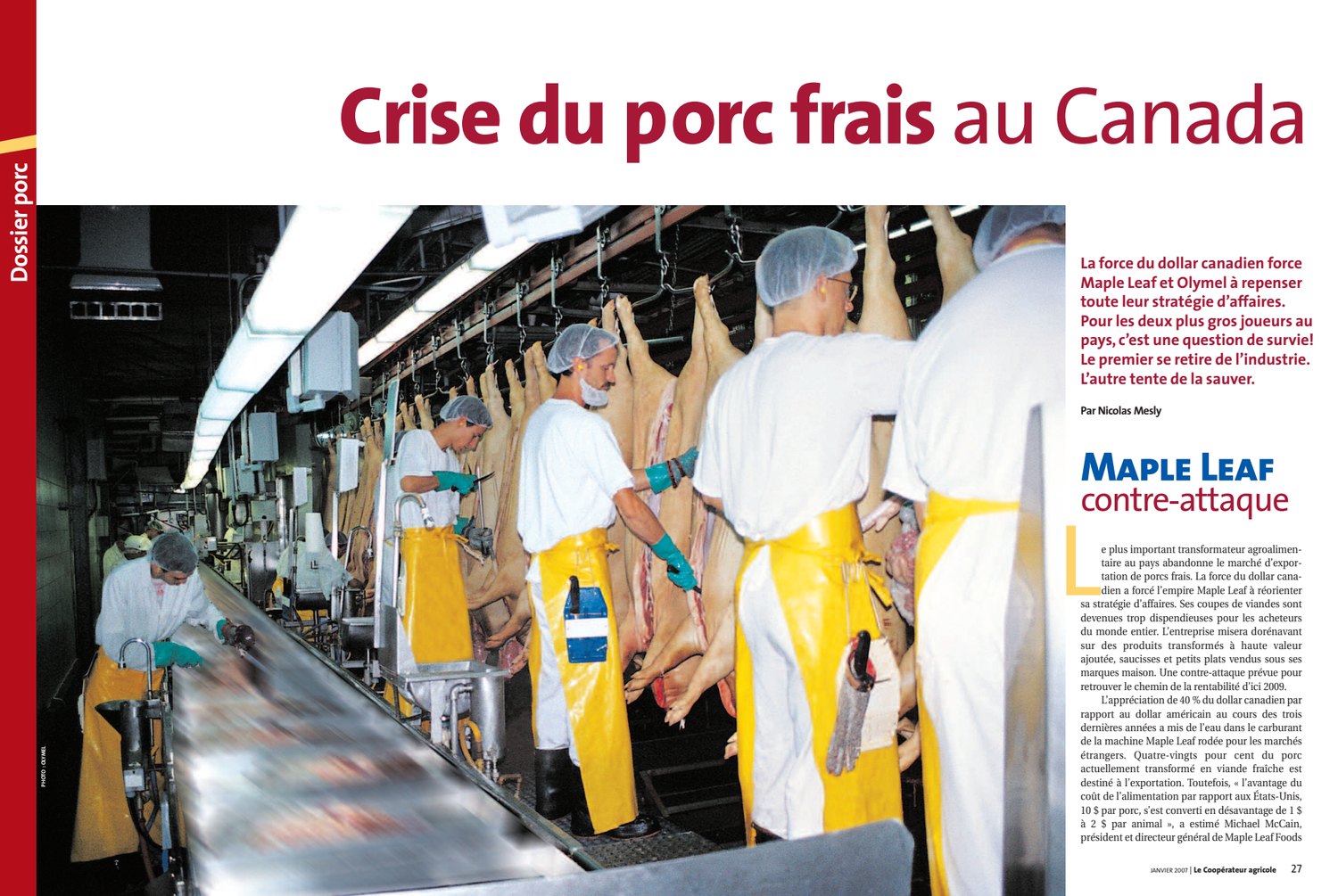
The complete story
JANUARY 2007: Agricultural Co-operator 27 Pork file PHOTO: OLYMEL Fresh Pork Crisisin Canada The strength of the Canadian dollar forces Maple Leaf and Olymel to rethink their entire business strategy. For the two biggest players in the country, it's a survival issue! The first one is withdrawing from the industry. The other is trying to save it. e largest agri-food processor in the country is abandoning the export market for fresh pigs.
The strength of the Canadian dollar has forced the Maple Leaf empire to reorient its business strategy. Its cuts of meat have become too expensive for buyers around the world. The company will now rely on high-value processed products, sausages and small dishes sold under its home brands. A counter-attack planned to regain the path of profitability by 2009.
The 40 per cent appreciation of the Canadian dollar against the US dollar over the past three years has put water into the fuel of the Maple Leaf machine for foreign markets. Eighty per cent of the pork currently processed in fresh meat is destined for export. However, "the advantage of the cost of feeding compared to the US, $10 per pig, has been converted to a disadvantage of $1 to $2 per animal," said Michael McCain, President and CEO of Maple Leaf Foods L Maple Leaf counterattack By Nicolas Mesly Bravo!
Enterisol ® Ileitis A RELATIVE PREVENTION You have chosen a better way to do this with Enterisol Ileitis. A progressive attitude, the adoption of new technologies and attention to consumer preferences have long been the keys to success in the pork industry. Enterisol Ileitis, the first and only vaccine against ileitis, offers a new direction in the management of this disease. By stimulating the pig's own immunity, a single oral dose given in the water helps to ensure optimal performance until slaughter, while reducing the dependence on antibiotics in the mould.
This is the direction that the industry takes. Talk to your veterinarian about this best way to proceed. Enterisol Ileitis is a Registered Trade Mark from Boehringer Ingelheim Vetmedica, GmbH. abcd PHOTO: FEDERAL COOP 28 The Agricultural Co-operator: JANUARY 2007 in a press release issued by the company. The company estimates that the company's annual profit loss of $100 million is directly attributable to its lack of competitiveness.
Maple Leaf's share value fell by 25% in 2005 on the Toronto stock exchange parquet. One Large Abattoir The new Maple Leaf strategy will have consequences for the Canadian pork industry. The company intends to consolidate all its fresh pork slaughter operations into one of its slaughterhouses, Brandon, Manitoba. It is expected to add a second shift of work and slaughter more than 80,000 pigs per week.
"In Canada, three out of 23 slaughterhouses operate on two shifts. While 17 of the top 20 American slaughterhouses operate on two shifts and produce 50% of U.S. pig production," said Mr. The consolidation of fresh pig slaughter in Brandon's only slaughterhouse is considered essential to achieve a scale economy, counter the effect of the booming dollar, halt the inefficiency of this system, and face competition from the U.S. and emerging countries such as China and Latin America that produce pork kilo at a lower cost.
The addition of a second shift to Brandon's slaughterhouse is expected to create 1,000 new jobs. However, Maple Leaf will have to enter into an agreement with the City of Brandon to modernize the wastewater treatment plant and meet the new provincial standards for "one of the most stringent" phosphorus and nitrate discharges in North America. Maple Leaf plans to inject $50 million into Brandon's operations and the second shift is expected to begin in late 2007. The other five slaughterhouses, owned by the agri-food empire, are for sale, including two old-school plants in Winnipeg and Saskatoon, involving the future of 1,450 employees.
Maple Leaf has killed $110 million in egg money to replace the 65-year-old Saskatoon slaughterhouse with a modern cutting plant. The company also intends to divest itself of its plants in Lethbrige, Alberta and Berwick, Nova Scotia, which employ 815 people. Burlington's largest slaughterhouse in Ontario, with 1,000 employees, could be the most attractive for a potential buyer, but what price would be willing to pay for a abandoned slaughterhouse because it is uneconomic.
Integration from A to Z Maple Leaf adopts a completely integrated production model. The company will now only slaughter its livestock and feed a slimming diet. The largest Canadian pork producer plans to reduce its sow herd from 125,000 to 50,000 animals. It holds 22% interest in farmed pigs through a series of agreements with small producers.
The company also plans to reduce the number of its feedlots from 17 to "one or two." Over the next three years, Maple Leaf plans to reduce the volume of pork slaughtered from 7 million to 3 or 4 million animals. 70% of these animals will be used to produce value-added products, a 20% increase over the current processing process."The result will be a more efficient meat and bakery company, much less vulnerable to exchange rate fluctuations and commodity markets," said Michael McCain.
The reorganisation of the agri-food giant's value chain is expected to generate 100 million profits before taxes in 2009. However, the costs of implementing the new strategy are estimated at between $80 and $120 million. 0 500 1000 1500 2000 Europe 15-25 USA Canada Brazil China 1997 1999 2001 2003 2005 2007 Table 1 Export trends of exporting countries (in thousands of tonnes) 1997-2007 Source: USDA, FAS World Market and Trade. Europe data: 2000 and over are for Europe at 25, before 2000 Europe at 15 (adapted by AGEC Group, 2006) Canada is losing momentum!
He is moving from second-largest exporter to third-largest in the United States. Pork file With the help of Maple Leaf takes an axis to pork operations , David Parkinson and Handy Hoffman, The Globe and Mail , October 13, 2006, and Strong Canadian dollar rapids Maple Leaf expansion , Laura Rance, Farmer, Independent Weekly , October 5, 2006. JANUARY 2007: Agricultural Co-operator 31 PHOTO: FEDERAL COOP 30 Agricultural Co-operator , JANUARY 2007 "We are looking at all possibilities. We will definitely make sure that there is a global player in Ontario, whether Japanese, European, Chinese, American or the United Kingdom!" says Curtis Littlejohn, President of Ontario Porcine Producers, after Maple Leaf's decision to concentrate all of his slaughter operations in a single slaughterhouse located further west in Brandon, Manitoba.
Maple Leaf transforms 50% of pigs slaughtered in Ontario."As a producer of pork that has been a supplier to Maple Leaf for almost ten years, my initial reaction was shocking and treachery. Our pork production partner seems to be giving up when pig producers are already stuck with low incomes and high costs. If Maple Leaf closes its doors in Burlington, it will cost $40 million a year to transport these pigs to the U.S. markets," writes David Vandewalle, in a letter posted on the Ontario Pork website (www.ontariopork.on.ca/counties/perth.htm).
Vandewalle is proposing the construction of a new cutting plant in Ontario "comparable to that built in Denmark by the Danish Crown cooperative, using robotics, double shifts, etc. Whether in partnership with a major processor or by themselves, Ontario's producers have the opportunity to define their future.
Curtis Littlejohn, who recently visited the Danish plant (cost $350 million), does not exclude this type of scenario. Neither the purchase of the Maple Leaf slaughterhouse in Burlington, "discussions are underway." Ontario Pork plans to contract a consulting firm to evaluate the various scenarios including the viability of the Ontario market in relation to Quebec and western Canada."Ontario producers represent a $800 million business.
We will take our time to determine our business plan. It will be ready in six or eight months," says Mr. On the other hand, the announced closure of the Maple Leaf plant in Saskatoon is not really a surprise."Maple Leaf has never made the investments it had to make to build a new slaughterhouse.
But closing it is a real step backwards for Saskatchewan hog producers," says Ross Johnson, one of Saskpork's directors. The agri-food giant slaughters one million pigs a year in Saskatchewan at a factory built in 1930 and acquired from Schneider three years ago. Here too, producers are concerned about transportation costs, estimated at between $6 and $9 per head, and the logistical organization required to redirect 18,000 pigs a week to the Olymel plants in Red Deer, from Maple Leaf to Brandon or the United States.
But it is mainly the slaughter capacity of these new animals by the two plants that concerns: "The Maple Leaf slaughterhouse in Brandon is still not operating with a second shift. Olymel has tried unsuccessfully to establish a second quarter at his Red Deer plant to slaughter 90,000 pigs per week. Labour is scarce in Alberta due to the oil boom," says Saskpork's CEO, Neil Ketilson. ALBERTA MANITOBA ONTARIO QUEBEC NEWBRUNSWICK NEWBRUNSWICK NEWBRIEF ILE-PRINCE-EDWARD SCOTIA SASKATCHEWAN NEWBRIEF LABOUR LABOUR 350 employees 6,500 pigs/week Brandon 1,515 employees (+1.000) 45,000 pigs/week * Berwick 465 pigs/weekWinnipeg 455 employees 18,000 pigs/week Red Deer 1,483 employees (+900) 45,000 pigs/weekly workers 45,000 pigs/weekly workers 45,000 pigs/weekly workers 55,000 pigs/week Burlington
SASKATCHEWAN Market shares of slaughtered pigs: 100% Maple Leaf. 300 producers: four of them produce 50% of production; the others market between 25 and 10,000 pigs per year. MANITOBA Market shares of slaughtered pigs: 75-80% Maple Leaf. 1,400 producers: of varying sizes including Hytech and Elite Swine, among the largest producers in Canada. ONTARIO Market shares of slaughtered pigs: 50% Maple Leaf. 3,300 producers: 42% market less than 500 pigs per year.
The majority sells between 500 and 3000 animals. QUEBEC Market share of slaughtered pigs: 65% Olymel. 4111 producers: 50% own an average of 225 sows and sell 5,000 pigs per year. NEW ECOSSE Market share of slaughtered pigs: 100% Maple Leaf. 60 producers: produce 185,000 pigs. Maple Leaf restructuring feeds pan-Canadian thinking * Wants to double the number of slaughters ** Sold: PEI Pork Plus and Garden Province Meats purchased Maple Leaf slaughterhouse in 2006 to produce organic pork *** Expected closure in April 2007 Sources: George Morris Center, FPPPQ, Ontario Pork, Saskpork, Albertapork, Pork Nova Scotia, Canadian Pork Pork Nova Scotia, Canadian Pork Council/Statistics Canada.
CANADIAN PORC INDUSTRY (EN 2005) • 31 million pigs placed on the market. • One in two pigs is exported. • Value of pork meat exports: > $2.8 billion. • Export jobs: 42,000. Saskpork pork file also envisages several scenarios to save the sale of which the Maple Leaf slaughterhouse is to be bought. A meeting is planned between the two parties. Another processor in the province is also thought to be interested: "Olymel or an American company".
And we don't exclude a partnership with a smaller player to develop an export niche from the million animals. However, the names of the companies approached by Saspork remain secret at the moment. On the Manitoba side, the closure of the Maple Leaf slaughterhouse in Winnipeg, to concentrate all its slaughter operations in Brandon, is well received. This plant, which has two shifts of operation and a slaughter capacity of more than 80,000 pigs per week, is expected to start operations in 2007.
"This is a long-term security issue," says Karl Kynoch, President of the Minitoba Pigs. "The province, with a record 9 million pigs in 2006, has become the largest pig producer in Canada. However, the recent introduction of a mor atoire is stopping this tremendous growth. It will be necessary to wait for the results of the Government's Clean Environment Commission's work to see the future of this production.
"We're looking for solutions to keep it open because it's a volume of 10,000 animals we don't know where to get. The absence of a second shift of work at the Olymel factory is playing against us," says Bill Mullen of Alberta Pork. "We're looking for solutions to keep it open because it's a volume of 10,000 animals that we don't know where to get to.
At the other end of the country, in Berwick, Nova Scotia, a sigh of relief is being pushed."Michael McCain assured us that he would not sell the slaughterhouse at the moment because of over-transformation and the profitability of the slaughterhouse," says Martin Proskamp, president of the provincial por c producers. "The future of the 465 factory employees and about 60 producers is suspended in one of the McCain Empire fiefs.32 Agricultural Co-operator: OLYMEL JANUARY 2007: OLYMEL JANUARY 2007: The normal average agricultural co-operator 35 is 4% to 5%.
"Tolerance has been called on on behalf of 215 producers."Not a financial man is interested in operating a pig farm himself, especially since gust failures would have a domino effect, with a negative impact on land prices.For his part, the flagship of the Quebec pig industry, Olymel, has lost more than $150 million in its fresh pork operations over three years, including more than $55 million in 2006, which also puts a severe strain on the stomach of lenders. To stop the hemorrhage, La Coop fédéréée (CF), the main shareholder of Olymel, demanded from the agri-food giant a strategy of recovery by 2007-2009.
"Lossing money is not part of our cooperative values," said Claude Lafleur, CF Chief Operating Officer. "For his part, O lymel, who had come to the 8th rang of the world's fresh pork marketers, recruited the former Premier of Quebec, L ucien B ouchard, to negotiate av ec l'assembly of filiér e. The challenge is great for the negotiating skill that will have to reconcile the interests of the Union des prducants agricoles (UPA), the Federation of Québec's (FPPQ) por ers, and the union organizations of the CSN and the FTQ.
Some 4000 unionized workers work in four slaughterhouses and a cutting plant in Olymel located in the province. The size of the factories, salaries and collective agreements, as well as the current marketing system are at stake. Olymel has already announced the closure in Quebec of the production complex in SaintValérien and Saint-Simon scheduled for March and which causes the lay-off of 559 employees. In the West, the company is making a $200 million slaughterhouse construction project in partnership with the Big Sky Farms companies in Manitoba and Hytech in Saskatchewan.
Olymel also has a state-of-the-art plant in R ed Deer, Alberta, capable of competing with its global competitors. But to make the 1300-employee slaughterhouse profitable, the volume of 45,000-90,000 pigs slaughtered per week would have to be doubled. The experience of a second shift was attempted in spring 2006 but resulted in a $10 million failure. The turnover rate for these employees is 130%.
And it was impossible for the slaughterhouse to recruit 900 more people, because of the unprecedented oil boom in Alberta "Saudi Arabia." However, despite these difficulties, "Albertan pig producers are interested in participating in the Red Deer slaughterhouse. Due to the insecurity caused by the Maple Leaf announcements, they want to secure an outlet for their production," says Claude Lafleur. As for the future of Olymel in Quebec, we will have to wait for the outcome of the negotiations led by Lucien Bouchard.
The latter is planning a very hot January. Quebec's second flagship of the agri-food industry is on the brink of bankruptcy. In 2006 and early 2007, the Farm Financial, which administers the Income Stabilization Insurance Program (ASAR), plans to contribute $246 million to bail out pig and piglet producers, ten times higher than the previous year. While the price of Quebec pork was previously a premium, it is now below Ontario and US prices.
"There is a problem of profitability in slaughterhouses," says Jacques Brinds, President and CEO of Agricultural Finance. "Circovirus also devastated the province's livestock farms. Some 500,000 pigs were not debited in 2006, depriving producers of their income."In normal times, the disease is taking 200,000 animals.
The situation is expected to improve in 2007," says Mr. But the banker must calm down his colleagues in the Desjardins caisse, his main client, who manages the accounts of the majority of Quebec pig producers. The percentage of producers who fail to pay in 2006 is 17% while a pig file Table 3 Comparison of wages and benefits ($CAN): hourly rate $24.18 $15.83 $15.82 $18.13 Olymel (average CSN) Maple Leaf (Brandon, Mn) Du Breton (CSN) American Packers (according to Agrometrics) The Quebec pig industry on the bank road?
Table 2 Concentration Processing Slaughter Capacity Transformer Pigs per day Annual Smithfield Foods* Danish Crown Tyson Foods (incl. Cargill (formerly Excel) Olymel Hormel Foods Maple Leaf Premium Standard Farms* * The 2006 merger of Smithfield F oods and Premium Standard F arms will make the world's largest pork processor. Sources: Mary Hendrickson and William Hefferman, Concentration of Agricultural Markets, Department of Rural Sociology, University of Missouri, February 2005; Whole Hog, May 4, 2005; Canadian Pork Council, August 2005; Olymel, November 2006.
PHOTO : OLYMEL JANUARY 2007
Olymel, the Brochu family, the SGF and the majority shareholder La Coop, face an impossible situation, losing $55 million a year in fresh pork in Quebec alone. Name me a company that agrees to lose $55 million all the time.
There's no light at the end of the tunnel? There's a light, but it shows us that it's going to get even. So, it's an industry that's not more viable under the current conditions, and not for small factors.
First, the revaluation of the Canadian dollar. For a long time, the level of the Canadian dollar against the US dollar has hidden the structural deficiencies of the industry. It's a bit like there was a water level in a lake where you can navigate very well. But a good day, the lake falls by two feet.
The reefs appear and your propeller hangs. Our dollar was an artificial advantage. That was not the case 20 years ago. We had a high-performance agricultural industry, a meat quality unique in the world, in any case in North America.
Our competitors also put on the market high quality products. First factor, the dollar. The Americans have integrated vertically. They control all their costs, from production to processed products.
They have slaughterhouses with a slaughter capacity of 90,000 pigs a week. With two of their plants, they can slaughter all of our pigs. In Quebec, our largest factory has 35,000 pigs a week and we have 11 slaughterhouses, some of which are in places where there are not even enough pigs to feed them. Pork file PHOTO: MARTINE DOYON Master Lucien Bouchard will save the Quebec fresh pork industry?
The former Prime Minister, mandated by Olymel last fall, is focusing on three factors to re-establish the agri-food giant: a reduction in the wage bill, a reduction in the cost of supply and a forced consolidation of the slaughter plants. The negotiating skill is very hot in January. I'm back at the cutting plant in Saint-Simon. Have you tried to negotiate with his union?
It cannot remain open, but have you tried to negotiate? We cannot save it. Studies carried out in January 2006, before I arrived in the file, concluded that Saint-Simon was not viable.
And an arbitral award interpreted a letter of understanding between the union and Olymel: the factory could not be closed since it was planned to transfer production elsewhere. The employer challenged this award in Superior Court. But anyway, the announcement of closure of the complex, scheduled for March 2007, is in another context. The slaughterhouse of Saint-Valérien feeds the cutting factory of Saint-Simon.
Both will be closed and there will be no transfer of production elsewhere that can be interpreted as contrary to the letter of understanding. It was impossible to close the Saint-Simon cutting plant while it was supplied? Did the supplier, the St. Valerian slaughterhouse and its 153 employees have been sacrificed because of an arbitral decision? This is a point of view that is not to be debated.
Olymel announced, at the same time as the closure of the Saint-Simon-Saint-Valérien complex, a reduction in the overall level of supply and supply. So, the company complies with the requirements of the decision insofar as it is applicable. Should we expect the closure of other factories? We will fight for it to be non-existent.
We are currently working with Vallée-Jonction to convince employees to accept a reduction in wages. On the other hand, the levels of Princeville and Holy Spirit's salary are acceptable. Can we expect a very hot January? Is it all v has the impression that it will unblock in January.
Because, at the same time as the CSN is discussed with the company, there is a discussion with producers about the marketing, costs, supply patterns and possible partnership with producers. PHOTO: FEDERAL COOP A. This is a competitive factor? Live pigs are transported to slaughterhouses without taking into account transportation costs.
This is part of the collective marketing package. It's very uneconomic, and it causes a competitive situation that makes Olymel often pay his pigs more expensive than small slaughterhouses. This fragmentation of slaughtering activities puts us in a very bad position against the Americans. So, in the medium and long term, we have to consolidate.
The marketing system is to be rethought? The marketing mechanisms were very innovative! But with the changes that have occurred, it doesn't work anymore. You see, we had to suspend the auction system and make temporary agreements.
The Régie decided on a price until January, considered by Olymel too high. Olymel loses money every week. And there are labour costs. Olymel announced the closure of a factory complex scheduled for March 2007, those of Saint-Simon and Saint-Valérien.
Nearly 600 jobs lost are going to be dramatic? But the Saint-Simon factory was not profitable. If we want to save the industry, there are measures to be taken. In several sectors in Quebec, we have had to refocus our economic activities in the face of Asian challenges.
Textiles, for example, will not be much more because of the strong competition, but we think that there is a way to save the fresh pig industry. This survival, in your opinion, is a reduction in workers' wages. Have collective agreements been poorly negotiated?
This was acceptable at a time when other factors were making up for it, but it is no longer the case. It is confirmed by independent studies. Yes, there are structural problems and the fresh pork industry in Quebec is no longer viable under the present conditions.
So there are two solutions. Since this is more viable, we stop everything. Or, before doing such a thing, we work hard to save the 4000 jobs in the fresh por c, and that, counting only those of Olymel. We will not save them all, but we believe we can limit these losses.
By convincing the parties, unions and workers of Vallée-Jonction, to reduce labour costs (wages and benefits) by 30%. It is hard, especially since the workers have acquired these conditions over time. But even with this reduction, they will still, by negotiation, be paid more than any factory in the same sector of activity in North America! Pork file "If we allow the current conditions to prevail, we go straight to the precipice.
There will be no more produc tion in Quebec! JANUARY 2007
It won't be decided today, but let's remember that we're working on the international market! The benchmark price is American and we're producing for the mass market. Americans are gaining to the point that they export more to us.
It's high time to get back together! Where would the funding come from? If it's profitable, the players will find the money. When a project has a common commercial and economic sense, there is always a way to make financial arrangements.
Can we expect Quebec to produce the same volumes of pigs as before? It doesn't seem obvious right now, but if we can build a viable base, there is no reason why we can't get back to the export markets. Do you think that the planned restructuring of Olymel will allow producers to pay a better price, the US price?
It's one of the goals pursued. It's important that producers can live on it. We can't have processors making money, and at the bottom of the chain, producers pulling the devil by the tail. We need the whole chain to work.
We cannot think of investing in large slaughterhouses if the first link in the chain is anemic. For this, we must work on the side of a partnership with producers. Does that mean that producers could become partners in Olymel? We must not miss an option like this.
On the contrary, it is probably on this side that the solution is found. In any case, this is what is discussed with them. From the point of view of social acceptability, pigs do not have the odds in a part of the population of Quebec, and there has been a moratorium. Does this sector have a future in Quebec?
I do not understand why we would be one of the only countries in the world that would refuse to produce pork. Why impose restrictions on us and refuse to work on mitigation and balance measures to continue to be present in such an important market and where we have developed internationally recognized expertise. Why can the French, Danes, Americans produce pork and find equilibrium measures? Are we so different?
There are Quebecers who oppose... L.B. When Quebecers find that they will lose thousands of jobs, that it will affect all sectors, I'm not sure they will continue to make this point. Besides, there are technological means and solutions to mitigate the impacts of production. We are talking about megaporcheries.
What does it mean for megaporcheries? First, we have to define the terms. But we certainly need to rationalize the farming industry. Why not if we see that larger production centres will have the means to pay for the environmental technologies required for environmental protection?
We're not gonna stop the world from spinning. People will not stop feeding. Are we going to stop producing pork to buy from the United States? We were better than we were before.
The agricultural industry is not a sin. It is one of the foundations of the economy of Quebec. A question of clarity? People do not always realize that until recently, the export of pork to the United States was more important than the export of electricity.
There are more jobs in pig production than electricity! And it makes live regions. PHOTO: FEDERAL COOP A.C. Scenarios are exchanged with the Federation of Pig Producers and UPA, at the highest level, with Mr.
Olymel shoots 75,000 pigs a week. In case it goes off with the unions and the producers, if there's a part of these animals that are on Highway 20, what are you going to recommend to the government? I'm not in the government. But two things are certain.
We will do everything possible to define viable conditions to save this industry. In general, 500 jobs are lost, but it is in order to save 3500 more at the same time as a whole of the Quebec agri-food industry. Let us not forget the economic impact of this activity. We cannot afford to lose these jobs, nor the economic contribution of this agricultural component.
It would affect the entire agri-food industry. For producers, the situation is disastrous! They too, I am convinced, want a viable industry. They have considerable investments.
Whole families have put the assets of a generation of work in it. Are you considering a metamorphosis? Not only in Quebec, across Canada. Olymel even withdraws from OlyWest.
And if we don't transform the Quebec industry, we can't go on. We want to avoid making decisions with far greater consequences than those already announced. It's been months since people were warned of these consequences. Do people imagine thatOlymel will continue to lose $55 million a year?
At one point, it has to stop. Why not try to avoid the crisis? Olymel does not negotiate for the pleasure in the sense that if it does not work, we would still continue. Maple Leaf, the main Canadian competitor of Olymel, announced its colours three months ago.
Not only does the Ontario company consolidate its slaughter in a single slaughterhouse, but it abandons fresh pork to bet on overprocessing. Is Olymel late? Maple Leaf announced its changes for 2007. We start with the closure of two factories.
But the difference is that we didn't issue a statement saying we were shutting down everything. We want to save this industry in Quebec. The decision announced by Maple Leaf confirms the diagnosis that it is structural and global problems. They are not specific to Saint-Simon or ValléeJonction but to the Canadian whole.
In addition, labour costs are lower in English Canada. Will Olymel have to adopt Maple Leaf's strategy, focus more on over-processing, where it pays, and foam its own trademarks? Over-transformation and trademarks are very important, but to over-transform, you need pork.
It's not much smarter to produce it ourselves than to buy it in the United States. On the English side of Canada, there will be no more fresh pork. There is a clear fact: if we let the current conditions prevail, we go straight to the precipice. There will be no more pig production in Quebec!
In your strategy, do you consider the construction of a new slaughterhouse on the same model as your international competitors or the expansion of a present slaughterhouse in a key region? This is something that is invoked in the works to which I am assisting. The UPA even made a study, a few years ago, which concludes that there is a need to build larger establishments, with more efficiency. But it is a medium-term solution.
We're talking about a mega slaughterhouse, hundreds of millions of dollars.
Complete original publication
The complete facsimile presents the publication in its original editorial design.
Open original PDF ↗