The complete story
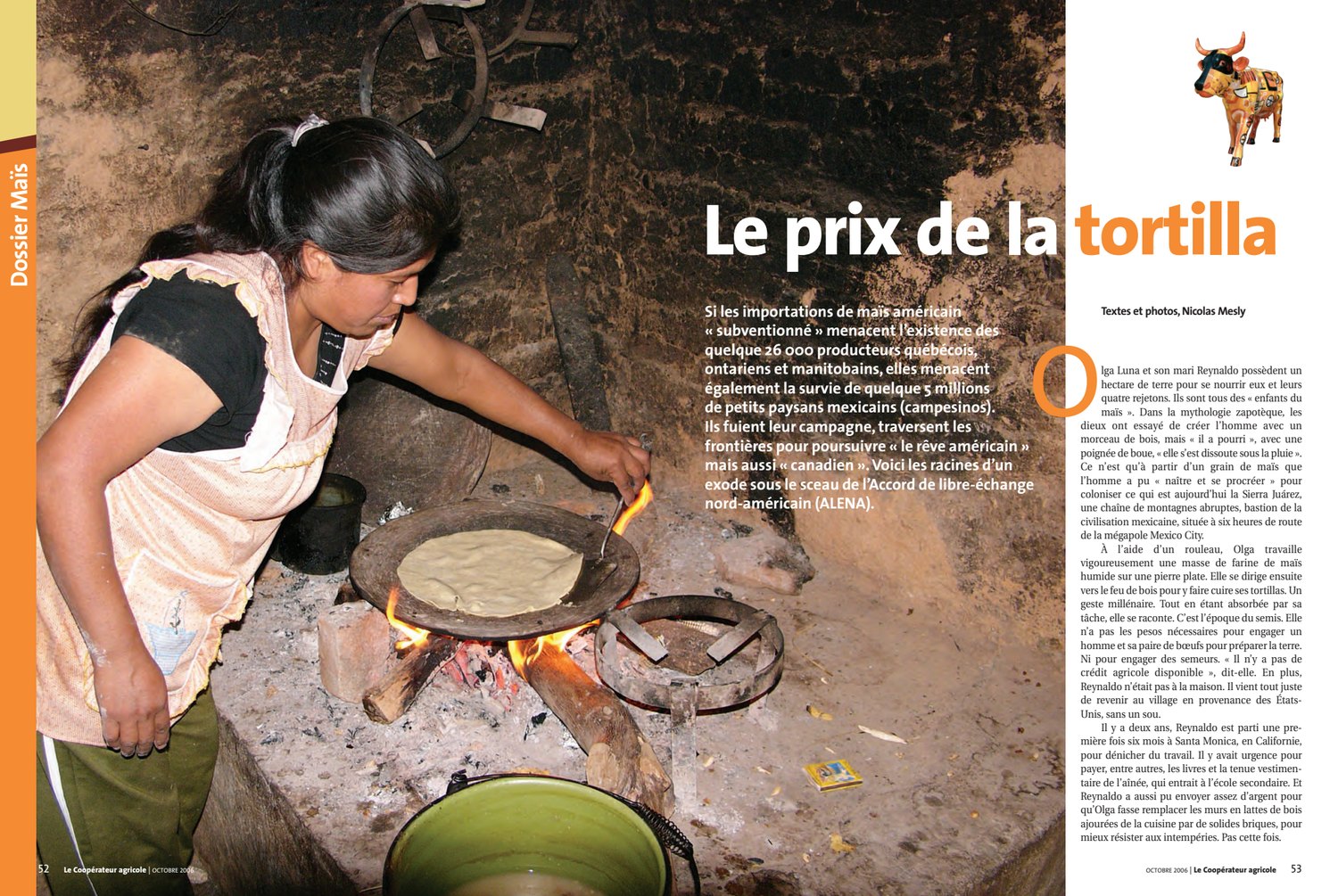
OCTOBER 2006: The Agricultural Co-operator 53 lga Luna and her husband Reynaldo have one hectare of land to feed them and their four offspring. They are all "children of corn." In Zapotec mythology, the gods tried to create man with a piece of wood, but "he rotted", with a handful of mud, "she dissolved under the rain." It was only from a grain of corn that man could "born and procreate" to colonize what is now the Sierra Juárez, a chain of steep mountains, bastion of Mexican civilization, located six hours drive from the megapolis Mexico City.
Olga works vigorously with a roll of wet corn flour on a flat stone, then goes to the wood fire to cook her tortillas. While she is absorbed by her task, she tells herself: she does not have the pesos to hire a man and her pair of oxen to prepare the earth.
Nor to hire sowers."There is no agricultural credit available," she says. "In addition, Reynaldo was not home. He just returned to the village from the United States, without a penny.
Two years ago Reynaldo left for the first time six months in Santa Monica, California, to find work. There was an urgent need to pay, among other things, the books and dress of the elder, who entered high school. And Reynaldo was also able to send enough money to have Olga replace the walls of open-worked wood slats of the kitchen with solid bricks, to better withstand the weather. 52 The Agricultural Co-operator, OCTOBER 2006 Dossier Corn The price of tortilla If imports of "subsidized" American corn threaten the existence of some 26,000 producers in Quebec, Ontario and Manitoba, they also threaten the survival of some 5 million small Mexican farmers (campesinos).
They flee their campaign, cross borders to pursue "the American dream" but also "Canadian." Here are the roots of an exodus under the seal of the North American Free Trade Agreement (NAFTA). O T extes and photos, Nicolas Mesly 100560_OCT06_Pages 44-69_Layout 1 2015-05-07 18:55 Page52 mainly yellow corn for fattening livestock and poultry and for industrial purposes, in the form of starch, fructose or ethanol. Villamar refutes one of the state reasons invoked by the Mexican government, namely drought, to justify the massive import of American corn.
"Not only have Mexicans eaten StarLink GM corn for cows, but also neighboring GM corn threatens our biodiversity," he says. "American corn now accounts for 30% of our consumption. It's about our food security," says Ivan Polanco, economist with the National Association of Country Product Sales Companies (ANEC). "As for the argument that Mexican authorities have not collected tariffs on imports of American white corn to keep prices as low as possible to consumers, "the price of tortilla has increased by more than 150% in the last three years!"
In January 2008, as foreseen by NAFTA, all U.S. grain corn exports will enter Mexico "free" of all tariffs."No question," says Mr. "Since 2002, we have managed to impose tariffs of 3% on white corn and 1% on U.S. yellow corn."A number of producer associations have been working closely with MP Victor Suarez Carrera of the Democratic Revolution Party (DRP), who is asking to renegotiate the agricultural chapter of the NAFTA agreement.
In Pancho Villa, corn, like some staples, is now at the heart of the PRD's electoral campaign, whose star candidate, Manuel Lopez Obrador, brigged the country's presidency on 2 July. Lopez Obrador presents himself as the champion of peasant and indigenous organizations, by endorsing a project of "a fairer, more productive and sustainable society", grouped under the "Coalition for the Good of All". Obrador lost the elections to Felipe Calderon, a right-wing centre candidate (PAN, National Action Party), by a margin of 244,000 votes out of 42 million votes.
And thousands of supporters are currently camping in downtown Mexico City asking for a recount. However, the Federal Electoral Institute confirmed the winner on 6 September, and Mr Calderon is scheduled to take over the presidency from 1 December next. Several observers hope that the situation will be resolved in a "peaceful" manner.
The anger of the campesinos During his term, the outgoing Mexican ex-president, Vicente Fox of the PAN, (National Action Party, the same as Felipe Calderon), sowed the anger of the campesinos by his inability to respond to their demand. In 2002-2003, more than 150,000 of them rushed into the capital of Mexico City with the rallying cry: "El campo no aguanta mas!" (the campaign can't be more!). To calm the game, the Fox administration created an emergency fund to help rural areas of US$260 million. However, "President Fox's national agreement with the agricultural and indigenous community has not resolved anything, including the mediated conflict led by Commander Marcos in Chiapas," explains Emilio Lopez Gomez, of the Independent Central of Mexican Agricultural and Peasant Workers.
PHOTO: The federated COOP Reynaldo was snatched by fake smugglers in Tijuana, a border town and one of Mexico's main gateways to the United States. Although he lost all his meagre baggage, luck still smiled at him on a hell trip. With the sum of $2,500, a real coyote took him across the border in a desert area. The heat there exceeded 40°C and the "wall of death" claimed 473 victims in 2005.
Reynaldo also escaped the surveillance of the American patrollers, who arrested more than 1.2 million people that year. And he finally joined the acquaintances of his village who emigrated to Santa Monica. They paid the "coyote". And, from the first day of his arrival, Reynaldo had to look for work to repay his illegal passage and pay his pension.
"Show me your hands!" Olga continues her story by turning a tortilla on the fire while her six-year-old son Jonatan has fun with a kitten on the floor of the new kitchen. When illegal workers wait online on the corner of a street to get work, "Reynaldo ms said that the first thing an employer asks them is: show me your hands!" Those with callous hands are immediately recruited as pickers, gardeners, painters or carpenters.
The others, good luck. During his stay, Reynaldo had multiple small jobs, lasting three or four days at a time. Enough to pay off his passage and his pension expenses. But never to save.
"I told him that at least he had returned with his health," Olga says. "If Reynaldo failed in his last adventure, more than a million Mexican campesinos left their homeland to pursue "the American dream," leaving behind "were widows of corn." These small peasants are swelling the ranks of some 12 million Mexicans, including half of them illegal, who are turning the American economy at a time when the immigration debate is shaking President Bush's America. The roots of the exodus "We don't understand why American corn is entering the country for free.
We would like the Mexican government to impose countervailing duties, as the Canadian government has done with US corn. But we have the impression that our government is in the US government's balance," explains Dr. Alejandro Villamar of the Mexican Free Trade Action Network. Since NAFTA's signing in 1994, US corn exports to Mexico have jumped from 300,000 tonnes to 7 million tonnes per year, without any part of them being subject to a customs duty as expected.
More than US$3.4 billion were not collected by the Mexican authorities, Villamar says: "These funds could have been allocated to irrigation and technical support programmes for small Mexican producers. How do you want us to compete with the technology and subsidies of the US Midwest corn producers?" Mexico traditionally produces white corn mainly for the daily production of some 300 types of tortillas.
While the United States (and Canada) produce 54 The Agricultural Co-operators - OCTOBER 2006 File Pays Corn with its pair of beef on the mountainside near the village of San Juan Luvina where Olga Luna resides. Is the future funny? 1991 1993 1995 1997 1999 2001 2003 2005 White corn Yellow corn Broken corn Million metric tonnes EXPORT OF AMERICAN MAIS TO MEXICO (1991-2005) 100560_OCT06_Pages 44-69_Layout 1 2015-05-07 18:55 Page54 l'arrival de Jacques Cartier à Montréal (Hoche - laga) en 1535, the Iroquois were already growing corn, as were many Indian tribes in North America.
The plant was quickly adopted by the new settlers, and today Quebec producers produce about 3 million tons of corn a year, mainly to feed cows, poultry and pigs, and their American colleagues produce a hundred times more. The price and imports of American corn, known as the Coalition of Cana-Dien Corn Producers (Quebec, Ontario, Manitoba), which has 26,000 members, threaten their survival.
This is the third time in 10 years that Canadian producers have taken legal action to protect their livelihood. In the last dispute, the Canadian Fronta - Lier Services Agency (CBSA) agreed with the coalition's arguments that "US corn is subsidized and that this grain crosses the border at a dumping price," explains Benoît Legault, Director General of the Fédération des producteurs de cultures commerciales du Québec (FPCCQ). The CBSA has therefore collected an average countervailing duty of $70.00 per tonne on imports of US corn from mid-December 2005 with the provisional consent of the Canadian International Trade Tribunal (CITT).
However, the same court, after considering the case, ruled in mid-April 2006 that U.S. practices did not cause injury to Canadian producers, attributing the price decline in the Canadian market "to currency fluctuations." As soon as the CBSA ceased to collect these countervailing duties, the price of corn in the Quebec market is approximately $115 per tonne, while "production costs are around $175 to $180 per tonne. Countervailing duties were to level the ground," continued Mr.
The coalition will appeal this decision to the Federal Court of Canada in October, with under the arm the amount of "enhanced" subsidies to American producers since 1998, but especially during the last Farm Bill 2002; these US subsidies, while encouraging overproduction, keep prices down, says Mr. And they would be largely responsible for the accumulated deficit of nearly $200 million, according to the latest data available in 2004, of the grain corn stabilization insurance program administered by Farm Financial.
However, some sources indicate that this deficit could increase to $350 million in 2005 and possibly reach half a billion in 2006. PhOTO: Federally-owned COOP This agrarian conflict is being fuelled by the 1992 amendment of article 27 of the Constitution, which allows the creation of a land market by privatizing agrarian communities, such as cooperatives, and ejidos, communal lands distributed by the government to peasants since 1917, the date of Mexico's first land reform.
In exchange for individual or common-use title, this "second agrarian reform", while legalizing its situation, allows a peasant to contract a bank loan by putting his land as a guarantee. And to return to the productive system on a level level."This has mostly paved the way for foreign investors under NAFTA. Half of Mexico's land is occupied by indigenous communities and campesinos.
"This is where the natural resources are needed for the country's so-called economic development," says Mr. Mexican Land Reform Secretariat says it has provided more than 8.5 million titles since 1993. But the institution does not have data on the resale of these properties to domestic or foreign-owned companies.In Cancun, Fox is asking for Harper's help Meeting in Cancun last March to discuss NAFTA and evaluate the results of the first year of the North American Security and Prosperity Partnership, the handshakes exchanged between the three heads of state were rather adamant for two of them, President Bush and President Fox.
Among the priorities discussed were the "militaryization" of the Mexico-United States border to control the flow of illegal immigrants and the strengthening of a high-tech border between Canada and the United States. The three heads of state also agreed to join forces in the face of the yellow peril, China, the world's leading manufacturer, which blows the textile industry in each of the three amigos. And at the end of the journey, Mexican ex-president Vicente Fox also asked his newly elected Canadian counterpart, Stephen Harper, to increase the number of temporary agricultural workers in Canada.
About 12,000 Mexican agricultural workers migrate to the north of the 49th parallel every year, and some 3,000 of them harvest vegetables and small fruits on the farms of the Belle Province. "Without them, the Québé - Coise market industry would not generate $300 million in revenue today," explains Hélène Varvaressos, general director of the Sectoral Committee for Agricultural Production Labour (COSE). "The dependence of Quebec marketers on "Mexico's hands" is such that they seek to diversify the source of foreign labour in Guatemala, El Salvador and Honduras.
The last wage agreement negotiated between the Mexican and Canadian governments "disastrophed" them. In excess of the minimum wage of $7.75, the agreement provides for an 11 per cent increase over three years from 2005 to 2007. If some 3000 Mexican workers are turning a portion of the Quebec economy, one can imagine the contribution to the American economy of the 36 million Latinos, legal and illegal, living in the United States. The only certainty, the ancestral corn It is possible that one day Reynaldo, the husband of Olga, could succeed in infiltrating the appropriate network to try "the Canadian dream" because, for him, "the American dream" is buried.
If Reynaldo is absent while Olga prepares the tortillas on fire, it is that he went to search for the equipment promised by the federal authorities, cement and boards, to rebuild part of the houses of the village destroyed following the passage of Hurricane Stan, six months ago. Promise filled, even late, year of election obliges. In the face of an uncertain future, the only certainty for Reynaldo and Olga, are these grains of native orange-coloured corn, as if they held the rays of the sun setting on the surrounding mountains, stored in an adjacent room.
The first is the "Croat of the Earth" and the second is the "Croat of the Earth" and the second is the "Croat of the Earth" and the second is the "Croat of the Earth" and the second is the "Croat of the Earth".
"J--I was curious to increase my yields. The rumor was that this corn was coming from the coast and that it was very productive. Moreover, there was nothing written on the bag to the effect that it was forbidden to sow this corn," says the peasant sitting in the shade of a small room paired with her house juried on the mountain chain called Sierra Juarez de Oaxaca. "Diconsa" food bank sells through community stores some 30 subsidized commodities: corn, oil, sugar, beans, etc. to the poorest families at some 22,000 points in Mexico.
The 44-year-old campesina (peasant) who is to feed her six children is a great surprise to the "Diconsa" corn. The yields are 25% higher than the maize inherited from these Zapotec ancestors! "It was smaller than my Creole corn, but it gave three ears instead of two. And it suffered less thirst!"
The next year Olga Toro reseeds her field with seeds from the second generation of "Diconsa" corn. A bad surprise awaits her this time: the plants do not have a seed or they are then stunted. Olga has not known how to plant hybrid corn that loses its qualities after a generation. She therefore abandons her experience.
But in 2001, a professor and a student from the University of California published the results of their research in the Sierra de Oaxaca in Nature magazine. The news has the effect of a bomb: the native corn of the region is conta - mined by GM hybrid corn! Mexico is the origin of the corn. In indigenous mythology, it is the god Quetzacoal who would have given this plant to the first inhabitants to reproduce and perpetuate.
The International Centre for the Improvement of Corn and Wheat in Mexico City, an international seed bank linked to FAO, houses more than 37,000 samples of maize and its ancestor, the teosinte, which still grows in the fields of campesinos alongside indigenous maize. Environmentalists and peasants fear that GMO maize will forever "pollute" this heritage of humanity. And it would be through the intermediation of Diconsa that GMO maize would have been introduced in Mexico! An act of high treason towards "the people of maize", on one hand.
On the other hand, a real diplomatic slap for the country, signatory to the Convention on Biological Diversity and which bans the cultivation of GMO maize since 1998. "We do not need transgenic maize that resists a herbicide or insect that we do not have here. This type of maize does not suit the need of the 3 million campesinos that sow for their food self-sufficiency and for local sale. That Mosanto leaves the camp Dossier Mais E Mexico, at the time of transgenic tortilla?
If the Court decides in favour of the Coalition of Canadian Corn Producers, it will require the CITT to go back to its duties. And the countervailing duties will be collected again by the CBSA, as long as the court validates its first decision or not. However, this is not the case tomorrow, as the Court takes an average year to make its decision, which leads to the outcome of this case at the end of 2007. However, ten Canadian companies, refiners, have said that they are relieved of the elimination of countervailing duties.
They are calling for a NAFTA panel to review the CBSA's findings."We understand processors, they don't have to pay more for their raw materials, and countervailing duties should be paid by the federal government in the form of direct assistance to producers," said Mr.
The Coalition of Cana Corn Producers is trying to bring together Mexican producer organizations that want to renegotiate the NAFTA agricultural chapter."To renegotiate this agreement, the three governments must sit down at the table. The legal and technical parties could be renegotiated, but for political reasons, I doubt that the US government is renegotiating this agreement.
"It is also the same for Harper's current government that will not want to frown his neighbour," says Jonathan Hood, a lawyer delegated by the Coalition to the Forum on Assessment and Proposals to Renegotiate the NAFTA Agricultural Chapter held in Mexico City from August 2 to 4. "However, it is possible that Harper will provide more financial assistance to Quebec and Canadian corn producers to seek votes.
But, unlike Canadian producers, Mexican farmers have no safety net, and their situation is desperate!" explains the lawyer of the Toronto-based Associate McMillan Binch Mendelsohn. The Coalition of Cana Corn Producers - Canadians blame Ottawa for not doing their job."The federal government should present our case to the WTO to impose a surtax on US corn, as Brazil did, which won the cause of its cotton producers!"
In protest against federal inaction, producers have undertaken a series of symbolic grain corn unloadings throughout the province. Olga Toro has pushed one of the world's largest GMO scandal, in Capulalpam de Mendez, Mexico. ,6,20.6 9.2 MAIS PRODUCTION in Canada, Mexico and the United States (million metric tonnes) The trucks of the government food bank Diconsa distribute food supplies throughout Mexico. 100560_OCT06_Pages 44-69_Layout 1 2015-05-07 18:55 Page58 hybrid, GMO or not, and the selection by farmers of the desired line.
In 2005, a new research in Sierra Juarez contradicted the results of the very first study to the effect that primitive maize had been contaminated with GMO maize. Regulating the account between pro or anti-GMO scientists with, as a backdrop, the formidable commercial interests of the biotechnology industry? Or the result of "decontamination" attributed to the efforts of the farmers of Sierra to protect their ancestral seeds? "I do not believe in this very last study.
They are no longer in control!" says Baldemar Mendoza Jimenez, UNOSJO, who gives the journalist a photo of a mutant epi "monstrous" taken in the region. "Our strategy to protect our biodiversity is to never stop planting our own corn." But at 24, the young farmer activist does not cultivate the land. Of 24 students in the village class, only he and his brother remained in the Sierra.
All the others have gone into exile to live "the American dream." So who will cultivate the ancestral corn if all the young Zapotecs leave their native land? Baldemar Jimenez avoids the question twice. Olga, for his part, still wonders today about the origin of Diconsa corn, "we still don't know where Diconsa corn comes from.
We are told that he comes from Africa and the United States," she says. "And the peasant is concerned about the effects of transgenic corn on the health of her children, because no one of the competent has come to the village to inform her."No one can guarantee 100% that there is no risk of eating GMOs. If, in North America and the rest of the world, there has been a refusal to eat GMO wheat, why would Mexicans not have the right to refuse to eat GMO corn, are they a subspecies?" said a Canadian CEC representative who prefers to keep anonymity.
In the rural warehouse of Diconsa, located in Ixlan de Juarez, about 80 kilometres from the village of Olga, the food distribution manager, Arisbel Vasquez, indicates that the grain arrives "by boat at the port of Vera Cruz", without being able to specify its origin. Although the CCE recommended the labelling of the bags of grain, containers and grain silos of Diconsa, the 150 tons of maize distributed each month to the campesinos of Sierra in bags of 52 kilos do not display any instructions for use as to the prohibition of sowing or indication of nutritional qualities.
"These are recycled sugar bags," says Vasquez. "The head of Diconsa in Oaxaca, Antonio Lopez Hernandez, says that the 70,000 tonnes of maize distributed in the region come from four Mexican producing states, following "a national purchasing policy introduced in 2002-2003." In 2002, a study by the Mexican government, which is not widely publicized, revealed that three out of ten corn grains distributed by Diconsa stores were transgenic. How does the food bank guarantee today that these grains are not GMOs?
"Our corn certification is a responsibility of the laboratories of the Ministries of Agriculture and Environment," says Lopez d'un ton laconique. "In Oaxaca, a colonial city and tourist Mecca where gringos trade in English their purchases of crafts from indigenous people, Gaby Fernandez and Amado Ramirez Liba own two restaurants "Itanoni". The couple hear their "organic" menu which includes dozens of tortillas made from eight varieties of corn in yellow, orange and blue from the Sierra.
How can we guarantee that maize will not be contaminated with GMOs? "We buy our maize from remote areas," says Gaby. "The Mexican government, even though the credits have been voted, has still not put in place another recommendation - a system for the certification and analysis of indigenous seeds, including a laboratory, to detect the presence of GMOs in the region. Dr Zafra Gloria, a sociologist, is a fervently speaking about the new revolution in the country of Pancho Villa, "the tortilla revolution".
"We are invaded by American culture and products, but we will conquer them in our turn simply because there are 36 million Latinos living in the United States. And they do not lose their eating habits!" explains the author of several books on tortilleras, these women who work daily corn in the Oaxaca region. Whether, in the future, Mexican tortillas will be made with varieties of corn - whether or not they are mined by GMOs, no one can guarantee it. . Mexico!", Baldemar rage Mendoza Jimenez, agronomist at the Union of Organizations of Sierra Juarez de Oaxaca (UNOSJO), bastion of the fight against GMOs.
"Very few of our recommendations to prevent genetic flow, protect biodiversity and health have been put in place by the Mexican government," says José Sakuran of the National Autonomous University of Mexico, who coordinated the Commission for Environmental Cooperation (CEC) survey on corn and biodiversity. "Report and recommendations were revealed at a seminar held in the city of Oaxaca in 2004. The CCE acts as the environmental watchdog of the North American Free Trade Agreement (NAFTA), which includes Canada, the United States and Mexico.
Since the signing of NAFTA in 1994, the "corn people" have become dependent on imports of US maize, at a rate of 7 million tonnes per year, one third of which is transgenic grain "of yellow corn intended for animal feed", the CEC estimates. In addition to the import of processed products, many Mexicans do not have to eat GM maize, which amounts to "food for the gods." However, "no government or private companies have agreed to label products made with GMO maize," Sakuran continues.
"It's like not telling Jews and Arabs that there is pork meat in the processed products they buy."To prevent genetic contamination of primitive corn varieties, the CEC recommends, among other things, labeling the lots and even banning imports of these fertile transgenic grains unless they are moulded to reduce their accidental spread."It seems that the cost of this measure and its restrictive effect on trade for both the United States and Mexico are too large to be accessed - tables," says José Sakuran.
After being at the centre of a media cyclone, Olga Toro swears never to sow "Diconsa" corn again. She destroyed her "contaminated" ancestral seeds and reconstructed her "pure" genetic stock by supplying it to other producers. The word "no longer plant "foreign" maize was given to the campesinos of Sierra Juarez. The persistence or not of new genes in indigenous maize depends on several factors including the repeated introduction of corn Dossier Mais The two brothers Wilfred and Baldemar Mendoza Jimenez agroecologists at UNOSJO.
The mutant Arisbel Vasquez,responsible for the distribution of food, in front of bags of maize whose origin the peasants still ignore. OCTOBER 2006
Complete original publication
The complete facsimile presents the publication in its original editorial design.
Open original PDF ↗