The complete story
Photo: Bernard diamond What is your profile? The constant enrichment of knowledge in livestock, nutrition and genetics undoubtedly leads to improved performance. Therefore, we need to adjust the food over time to meet the needs of the evolving chickens. In a context where the cost of food is high, as is the case in Quebec, there are a few points to observe: • Reduce the time spent in raising chickens (getting out as quickly as possible – reaching the target slaughter weight as quickly as possible) • Aim for the lowest possible food conversion • Invest in a food that is a little more expensive, but more dense in nutrients • Respect the target slaughter weight (i.e. not to exceed it, because the " Record" weights are very expensive to achieve) In the current context, these factors motivate us to prefer the denser nutritional profile, provided that we are aware that this profile requires more attention or, in other words, reduces the right to error during breeding.
Although standard profile foods are more conservative in terms of results, it is still important to keep our birds in the same position and to ensure that they are managed at a high level. The Coop network offers two options: to achieve more "conservative" results with a basic food, or to invest a little more in a denser food and in return to achieve higher yields. It is like an investor profile when you shop for financial products: you have to be comfortable enough with your choice to accept the consequences.
Your co-operative's poultry advisor is best placed to evaluate your "profile." Good success in your broiler farms! In order to stay in the lead, the La Coop network's chicken meat products are now available with two nutritional profiles. As presented at last year's poultry farm day La Coop (June 2012), a basic profile ensures satisfactory results, and a more nutrient-intensive profile allows you to achieve superior results. We constantly test our food under commercial conditions, and these tests have enabled us to quantify the impacts of the two nutritional levels of our food.
The data are confirmed over time, as the differences between the results obtained with the two nutritional densities are repeated and maintained. The major difference in results between the two nutritional densities is found in the food conversion of birds. As a result of the division of the amount of food consumed by the slaughter weight of birds, the denser program will reduce the quotient of this calculation by 0.070 (or 4%), resulting in increased economic efficiency.
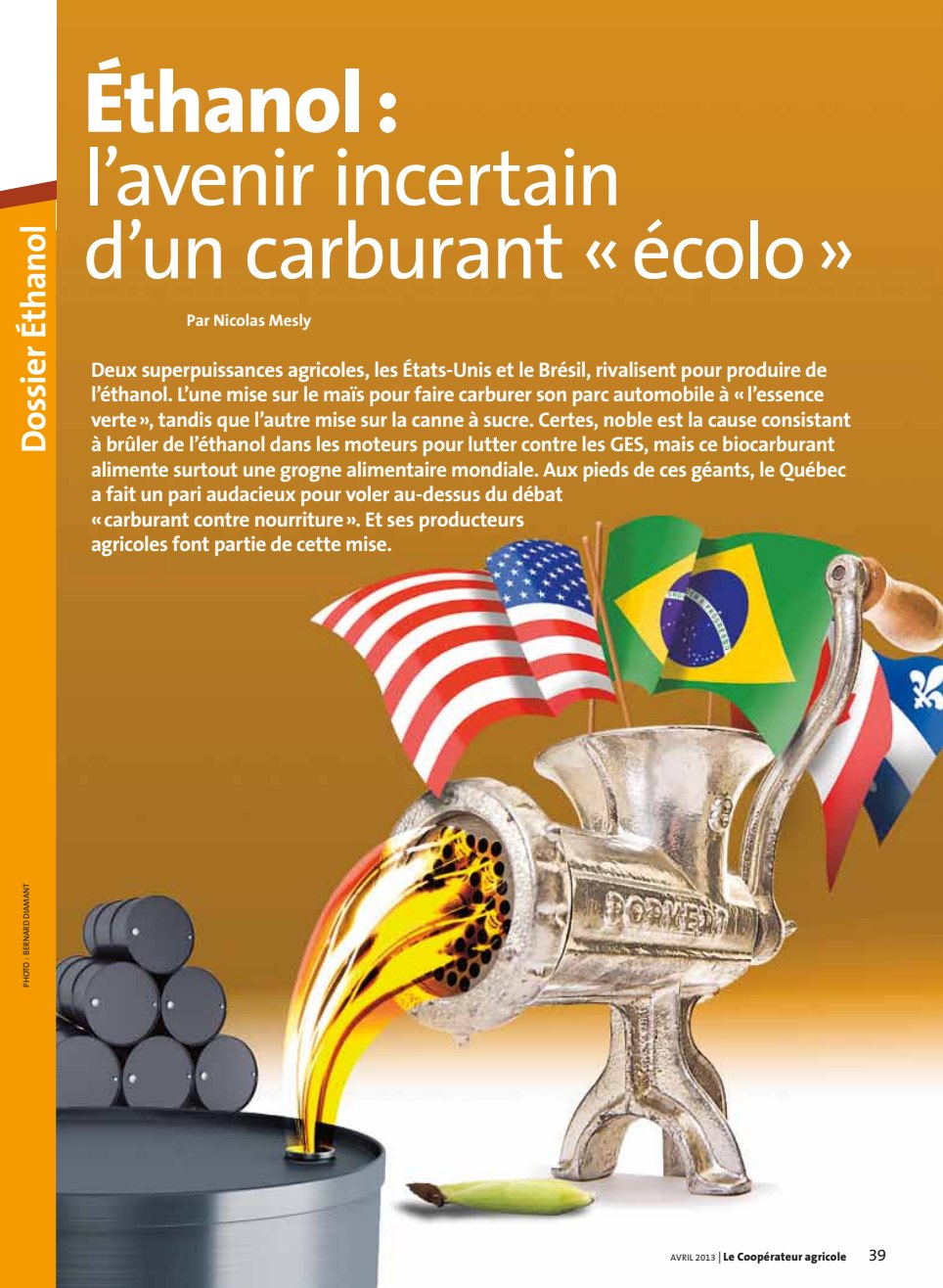
Increased daily weight gain is also a consequence of higher nutrient content (achieving the desired slaughter weight faster). In Denis Caron, agronomist, Mr. Nutritionist in poultry production La Coop fedéréée denis.caron@lacoop.coop Photos: Jean-marc raymond Ethanol: the uncertain future of an "ecolo" fuel Two agricultural superpowers, the United States and Brazil, compete to produce ethanol.
One bet on corn to carbide its fleet with "green gasoline", while the other bet on sugar cane. Certainly, noble is the cause of burning ethanol in engines to fight GHGs, but this biofuel mainly feeds a global food grunt. At the feet of these giants, Quebec has made a bold bet to fly over the debate "fuel for food". And its agricultural producers are part of this bet.
By Nicolas Mesly aVriL 2013
And man kept his word. The United States put gas to produce ethanol from corn, mainly to wean black gold and no longer finance enemy countries, i.e. Iran, Iraq, Venezuela... Over the last decade, factories have grown like mushrooms in the "corn Belt", the American food attic. Their number has increased from 68 to 211. Ethanol production has increased fivefold! And the United States has quickly haired Brazil, the world champion of this biofuel, made in this country from sugar cane.
Sold at the pump under the acronym E10 (a mixture of 10% ethanol and 90% gasoline), ethanol corn represents 10% of the US car's gasoline stock. Last year, this "green gasoline" made in USA substituted 460 million barrels of oil that would otherwise have been imported from Saudi Arabia, according to the FRG. If the American ethanol industry has grown tremendously, it is partly due to the adoption in 2007 of the Energy Independence and Security Act, under the chairmanship of George W.
The Act provides for a renewable fuel production quota of 137 billion litres by 2022 (Renewable Fuel Standard or RFS). On the other hand, the American ethanol industry would not have been created without generous subsidies: US$41 billion since the early 1980s, according to a study by the Congressional Budget Office (CBO). Bob Dinneen, however, does not fail to recall that the oil industry is receiving much more subsidies. And he takes advantage of this to skin Canada by the way: "The ethanol industry is much more environmentally friendly than the non-conventional oil oil sands in Alberta!" he launched.
However, the ecological virtues of ethanol have been disassembled. True, a mixture of gasoline – ethanol-corn can reduce greenhouse gas (GHG) emissions by 20% and this biofuel reduces the use of toxic additives, such as benzene, in motor vehicles. But the amount of energy required to produce corn in the x United States is colossal: diesel needed for seedlings, for fertilizer and pesticide application and for harvesting. Besides the fact that there are no pipelines to transport ethanol produced in the Midwest to the populous markets of the east and west coasts of the United States. (L'Ethanol, a corrosive product, corrupts piping.) Several studies corroborate the fact that the energy consumption of ethanol-corn production cancels its environmental benefits.
During the 2008 financial, economic and food crisis, the American ethanol industry was at the heart of the oil-for-food controversy, a "emotional" debate, according to Mr. The United States is the world's largest corn producer (100 times Quebec production), and 40% of this production is now devoted to bioethanol production. "The only responsibility for increasing grain prices was unfairly attributed to biofuels in 2008.
Even FAO has recognized that big speculators, such as hedge funds, and demand from emerging countries, such as China, have played a very important role," he says. Last summer, the United States experienced the worst drought in 56 years, and the price of corn jumped by 60%! The biofuel industry has again been plunged into controversy, this time in the midst of an election campaign. Four governors, dozens of senators and 150 elected members of the House of Representatives asked Obama's administration, through petition, to renounce the ethanol-maize quota.
This is to lower the price of small yellow grain, and their complaints echoed those of cattle, pigs and chicken producers. "Ethanol production, aided by Washington subsidies, artificially inflates the price of corn. It is a sprain on the free market," said the president of the National Cattlemen's Beef Association in an interview with the New York Times.
To farmers complaining about the price of corn, Mr. Dinneen replied that one third of every bushel of corn processed into ethanol returned to them in the form of high quality foods, and that they contributed positively to the country's trade balance."In 2011, we produced 39 million tons of drêche, of which 8 million were exported," he said.
A study by Texas's A&M University also revealed that the transformation of corn into ethanol results in an annual increase in the US's grocery bill of US$40 billion. Until the FAO Director General, concerned about a repeated hunger riots in 2008, which asked Washington to suspend US bioethanol legislation for food and feed. Neither the Democratic presidential candidate Barack Obama nor his Republican rival Mitt Romney, had been in favour of this request.
In an election campaign focused on creating jobs to build a moribund economy, the President of the Federal Republic of Germany has been able to make the importance of "the 400,000 jobs generated by the biofuels industry" resonate. On the other hand, neither candidate could alienate voters in Iowa. This small rural state of just three million inhabitants is the cradle of the ethanol-maize industry. This is where the most factories are found.
And it is especially one of the nine key states whose votes usually decide who will occupy the White House chair. In addition to this political reality, last November, the powerful US Environmental Protection Agency (EPA) concluded in its analyses that the suspension of the ethanol-maize production quota "would have reduced corn prices by an average of only 1%." Dinneen welcomed this finding by means of a press release. Giants, however, are taking control of the corn price, but the price booms are causing collateral casualties within ethanol producers.
In 2008, the main victims were agricultural cooperatives. "These were the backbone of this industry, producing almost 50% of ethanol, but in 2009 their share fell to 38%," says John Urbanchuk, a consultant at Cardno Entrix and author of a report on the state of the American ethanol industry (2010) for Commerce Department 2.
The low profit margins explain the phenomenon. POET became the first producer of ethanol maize in the United States by taking over the setting up of several agricultural cooperatives. And Valero, oil refiner and owner of Ultramar, catapulted to third place by acquiring VeraSun, a large producer of ethanol that is forced to fail. The second place belongs to ADM, the third multinational agri-food company in the world and queen of technology for the transformation of maize into ethanol and other compounds.
Urbanchuk, the American ethanol-maize industry is now "a mature market." And it is evolving in a context more 1 "The stakes of an eco-fuel", The Agricultural Co-operator, January 2004 edition www.lacoop.coop/cooperator/articles/2004/01/ p34.asp 2 "Current State of the U.S. Ethanol Industry", John Urbanchuk, Cardno Entrix, U.S. Department of Energy, 2010 Robert Dinneen, President of the Renewable Fuel Association, one of the leading pro-ethanol groups in the United States.
Tom Vilsack, Secretary of Agriculture in the United States. L aVriL 2013
Third generation ethanol = algal-based production Ethanol - co-operatives vs. private companies 2005 2006 2007 2008 2009 Number of co-operatives Private companies Production capacity, co-operatives (G litres) 5.2 6.3 6.9 6.1 7.7 Production capacity, companies (G litres) 8, Source: Renewable Fuel Association and Cardno ENTRIX competitive. In 2011, President Obama put an end to the two main measures that allowed this industry to grow rapidly in the heart of America.
One favoured the sale of a 10% ethanol-corn mixture to the gasoline pump by subsidizing refiners. The other protected the emerging US industry from Brazilian ethanol imports through a tariff. The analyst plans a new wave of acquisitions and concentration of the industry, following the rise in corn prices last summer, which forced the permanent or temporary closure of 26 plants. Among the players to be monitored on this new chessboard, according to him: the second oil company in the world, Shell, and the agrochemical giant, DuPont.
The US bioethanol industry wall is now facing a first wall called blodding wall, because the law limits the sale to motorists of a blend of E10 gasoline. Last year, however, Congress approved the sale of a blend of E15 gasoline. This decision, warmly applauded by the FRG, will create an additional demand of several thousand litres of ethanol. Dinneen would like America, like Brazil, to build a fleet of hybrid vehicles that carbide with E85 (15 % gasoline and 85 % ethanol).
The three car giants – Ford, Chrysler and GM – have expressed their intention to build these vehicles. But the owners of these super-eco-friendly vehicles can only supply at 2100 petrol stations, less than 2% of all fuel outlets in the United States. However, the real wall in which this industry operates is "technological". By 2022, to avoid the tenacious "fuel for food" controversy and to have a better ecological footprint, almost 60% of the biofuel produced or imported into the United States must be manufactured with something other than corn starch.
This ethanol of the second or even third generation can be designed from sweet sorghum, sugar cane, sugar beet, corn beet, pineapple, forest waste, urban waste and seaweed. Since the last Farm Bill (2008), the Obama administration has provided $2 billion in industry aid and research grants. Result: in 2013, eight new second generation ethanol plants will start producing this biofuel at Uncle Sam, including a subsidiary of the Quebec company Energem (see article "Ethanol: Québec, a world leader?").
However, these biorefineries are low at a low level of 90, and are not sufficient to meet the needs of the industry.
The United Nations has put a flat on each production by targeting its footprint on the planet according to these criteria: • The number of hectares of land required to grow the energy plant • The protection of biodiversity • The need for water • The impact on food security DuPont will prefer to invest in South America rather than in North America. The reason: investors will rely on proven technology. Brazilian sugar cane already produces twice as much ethanol per hectare as corn.
And the South American green giant's plants convert their production to the international price of either sugar or ethanol."If, in addition, researchers manage to extract cellulosic ethanol from the bagusse [fibrous cane residues], Brazilians will have the wind in the sails!" he believes. According to him, in the future, the American fleet will roll more with green gasoline produced in Brazil or in neighbouring countries. Brazilian ethanol imports have tripled in the United States in 2012.
What is the truth?What rabbit Mr. Dinneen will come out of his hat to counter the phenomenon.Note: *Diesel = 83 kg CO 2/MJ fuels Source: M. Groom et al., Biofuels and Biodiversity: Principles for Creating Better Policies for Biofuel Production, Consevation Biology, 2008; CIA, The World Factbook, 2010. aVriL 2013
Jean Roberge has already given the province his first ethanol-maize plant. Together with his partners, he intends to set up an integrated biorefinery in Quebec that will beat the giant producers "d'espe verte" of the Americans and Brazilians. Here is his plan. e Managing Director of the Éthanol GreenField plant, Jean Roberge, is categorical: "It is important to stop thinking that one plant will produce ethanol, whether corn or sugar cane!" Six years ago, this engineer with the football player's tile inaugurated a ethanol-maize plant in Varennes.
As a result, it offered a new market to some 400 grain producers in the province. In its strategy to combat GHGs, Quebec planned to build a single round of ethanol-maize finestry, precisely to avoid the controversial "fuel for food" debate. Roberge wants to put the clocks back on time. His factory drains 350,000 tons of corn annually, about 10% of Quebec production, a drop in water compared to American production.
This is 100 times more important than Quebec production, and 40% of American production of small yellow grain is allocated to ethanol production."It's not us who will influence the Chicago Stock Exchange," he says. Varennes' ethanol-maize refinery produces a third of ethanol, a third of drêche, which has returned to the farmers, and a third of CO2, which is found in the bottles of soft drinks or in the form of dry ice used to smoke the scenes of artists "like Celine Dion," says Mr.
Roberge, smile in the corner. According to him, his factory is "one of the three most efficient among the 200 or so plants in North America. Moreover, it has an exceptional environmental - mental footprint!" The Varennes factory can be effective, but it produces only one third of the ethanol needs of the Belle Province.
Ottawa has decreed that the Canadian fleet, including Quebec, has been rolling with an E5 mixture (5% ethanol and 95% gasoline) since December 2010. "This decision is a disaster! In Quebec, 160 million litres of ethanol are produced and 250 million litres of ethanol must be imported from the U.S. Midwest. To meet the federal standard, we would have to produce about 450 million litres," says the engineer.
Quebec stands out While other provinces produce ethanol from corn and wheat, Quebec has focused on the manufacture of biofuel made from non-corn plants, urban waste or forest biomass. In 2007, it created the Industrial Research Chair in Cellulosic Ethanol (CRIEC) at the University of Sherbrooke. "We support research and technology development in our companies," summarized its holder, Jean-Michel Lavoie. And these researches are beginning to bear fruit.
To fill the 250 million litre deficit, Roberge plans to build one of the world's first gas-fired plants at the end of 2013! This second generation ethanol plant will grow on the Varennes site itself, in part - partnership with the Quebec company Energem. Québec is investing $27 million in the project.
With the help of CRIEC and after several years of research at its pilot plant in Westbury, Energem managed to produce synthetic gas from old hydro-Québec poles. And the company is now ready for commercial adventure."We will convert 100,000 tonnes of ultimate solid waste, such as non-recyclable plastic, contaminated wood and polystyrene foam [styrofoam], into ethanol," says Marie-Hélène Labrie, Vice President of Government and Communications at Energem.
A first such plant is already being built in Edmonton, Alberta, where 30 employees were hired to start production this year. But the Americans are so interested in the promising Quebec technology that the US departments of Agriculture and Energy are also financing the construction of an Enerkem plant in Mississippi this year. At $100 million a unit, these plants cost three times that of the traditional ethanol-maize industry. The annual production of each of these three state-of-the-art plants will be 38 million litres of ethanol.
Enerkem is also working on technologies to convert residual biomass from forestry and agriculture in Quebec. According to company calculations, this biomass, combined with urban waste, represents a theoretical deposit of 6.5 billion litres of ethanol! It is almost 15 times the needs of the province and more than four times that of Canada. Looking for a "Northern sugar cane"
"Ethanol can be extracted from all plants, but the process can be more complicated from one plant to another," says Olivier Lalonde, coordinator of the Réseau de plantes bio-industrielles du Québec (RPBQ), at the Centre de recherche sur les grains (CEROM).Since 2010, this network has sponsored the work of three rural laboratories: one in Outaouais (sweet bead millet, sweet sorghum), one in Abitibi (fast growing salt) and one in Bas-Saint-Laurent ( giant miscanthus). Among the plants under study, the most promising among the producers and in test plots are sweet bead millet and sweet sorghum.
"It's our North sugar cane! But if we want to produce an adequate volume of ethanol, we're going to have to integrate these two forage plants into the rotations of the producers," says Mr. Various experiments have taken place in the Outaouais to squeeze these plants and extract a sweet liquor.
Roberge plans to acquire a 200 000-litre fermenter in 2014 to study the fermentation techniques and characterize the sugars of these different plants. According to Patrick Girouard, coordinator of renewable energies at La Coop federated, sowing plants for the sole purpose of producing ethanol will never be profitable for producers."Biorefineries must layer oil refineries," he says. "Half of their production is devoted to making gasoline and half is devoted to all kinds of petrochemical products: plastics, dyes, etc."
In addition to biofuel, these new plants will have to design a range of profitable products based on green chemistry: bioplastics, natural dyes, beauty products, pressed panels, insulating foams and litter. Roberge is also keen to do the same. He does not see any plans to integrate this type of biorefinery into the Varennes plant site by five or seven years or more, as this would require the establishment of a whole industry, from production to the marketing of these new products.
"But," he insists, "my goal is to create jobs here, with our expertise." And who knows, exporting one day more than Quebec ethanol across borders. In a project other than the construction of the d'Enerkem plant at the Varennes site, Jean Roberge intends to substitute 25% of the natural gas imported from Alberta to heat the distillery. Methane produced with the organic materials of the three MRCs next to the factory.
About 40,000 tonnes of waste will be treated annually - on the Varennes site. And the approximately 6,000 tonnes of residual material will be applied in the fields of the maize producers supplying the plant. This organic fertilizer will replace 10 to 15% of the mineral fertilizers used by the grain growers. L Sugar plants Sugar Cereals Amidon Residues, dedicated plants Cellulose Sugar Urban waste, agricultural residues, wood, dedicated plants, industrial residues Gasification Conventional Fermentation Fermentation New Technologies Synthesis Gases Carbon dioxide (CO2) Coproducts Biorefining Ethanol Enzymes Bioplastics Ethanol Natural gas AVriL 2013
"Canada already produces 90% of the ethanol needed to drive the Canadian fleet with a 5% ethanol mix," he explained in a telephone interview. "This Ottawa directive to combat GHGs has been in effect since December 2010. This first-generation ethanol is produced with wheat and corn in 21 plants across the country. Invited to comment on the decision of Iogen Corporation (located in Ottawa) and Shell to kill in the egg last August the project to build a second-generation plant in Manitoba, Mr.
Thurlow indicated that both of its members "made a business decision." Iogen's research to convert wheat straw, corn ears or other agricultural residues into cellulosic ethanol made it the Canadian showcase of this technology on the international stage. Turning the technological lock to remove sugars from cellulose from vegetable fibres to make ethanol is a feat. Iogen became known to supply biofuel to the circuit of major automobile racing.
"To compete with the United States, Ottawa should be quick to distribute the ProGen Biofuels Fund to Canadian companies to help them grow second generation biofuels plants in Canada," said Mr. S.A.'s $500 million fund, launched in 2007, is administered by Sustainable Development Technology Canada (SDTC). "The federal agency is responsible for promoting the marketing of ethanol cellulosic, which is part of the Ottawa strategy to combat greenhouse gases (GHGs).
Meanwhile, eight commercial cellulosic ethanol plants are being built south of the Canadian border. Rather than investing in Manitoba in a bioethanol plant made from corn ears or in the United States, Iogen-Energy Corporation, a consortium formed by Iogen and Shell, has preferred to invest in Brazil. The tandem has partnered with the Brazilian company Raizen to continue its work on cellulosic ethanol. Raizen is the largest Brazilian producer of ethanol made from sugar cane.
This decision could challenge North America's ambition to be the first to supply biofuels - the world's largest biofuel producer."Canada is primarily an oil producer, and the interest in biofuels is linked to the price of black gold barrels. The higher its price, the more attention is paid to biofuels as an alternative," says Dr. Donald Smith, Director of Biofuel Net (McGill University), a pan-Canadian network to promote the use of bio-industrial plants to manufacture biofuels.
He believes that the reduction in energy prices due to new technologies for the exploitation of gas and shale oil will slow Canada's ambition to become "a green superpower". Sweet sorghum plantation m 46 Agricultural Co-operators - aVriL 2013 Ethanol
Complete original publication
The complete facsimile presents the publication in its original editorial design.
Open original PDF ↗