The complete story
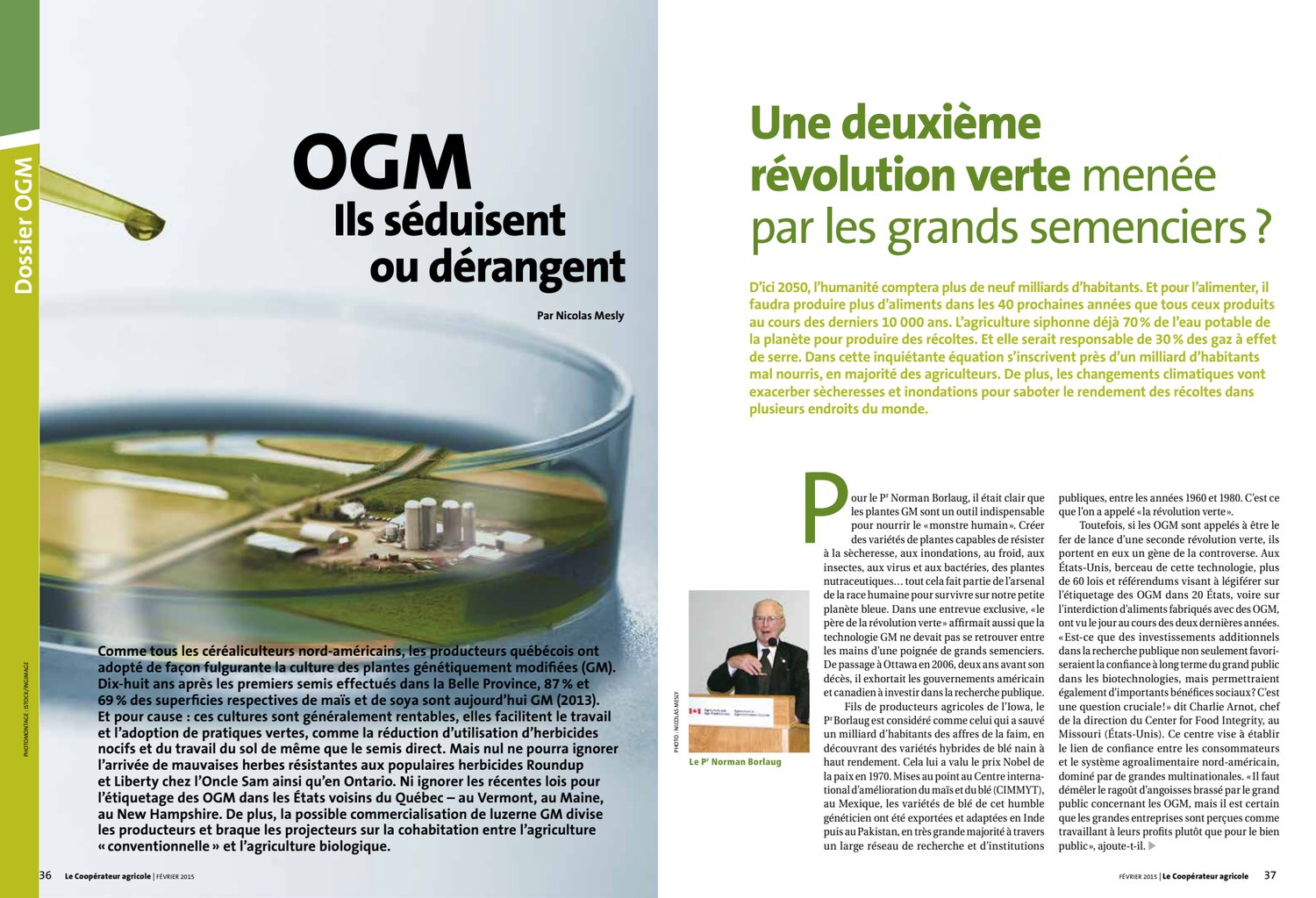
PHOTOMONTAGE : ISTOCK/INGIMAGE By Nicolas Mesly PHOTO : NICOLAS MESLY our Professor Norman Borlaug, it was clear that GM plants are an indispensable tool for feeding the "human monster". Creating varieties of plants capable of resisting drought, floods, cold, insects, viruses and bacteria, nutraceutical plants... all this is part of the arsenal of the human race to survive on our small blue planet. In an exclusive interview, "the father of the green revolution" also claimed that GM technology should not be found in the hands of a handful of great seeders.
When he was in Ottawa in 2006, two years before his death, he urged the U.S. and Canadian governments to invest in public research. Son of agricultural producers in Iowa, Borlaug was considered the one who saved a billion people from hunger, by discovering hybrid varieties of high-yield dwarf wheat. This earned him the Nobel Peace Prize in 1970. Developed at the International Centre for the Improvement of Corn and Wheat (ICIMMYT), Mexico, the varieties of wheat of this humble geneticist were exported and adapted to India and then Pakistan, by a large majority through a broad network of research and public institutions, between the 1960s and 1980s.
This is what has been called the "green revolution." However, if GMOs are to be the driving force behind a second green revolution, they are a gene of controversy. In the United States, the cradle of this technology, more than 60 laws and referendums to legislate on the labelling of GMOs in 20 states, or even on the ban on foods made with GMOs, have emerged over the past two years. "Will additional investments in public research not only promote long-term public confidence in biotechnology, but also provide important social benefits?
"It's a crucial issue," says Charlie Arnot, CEO of the Center for Food Integrity in Missouri, United States. "It's about building trust between consumers and the North American agri-food system, dominated by large multinationals."We need to unravel the food stew brewed by the general public about GMOs, but it's certain that large companies are perceived as working for their profits rather than for the public good," he adds. u P Like all North American grain growers, Quebec producers have adopted GM crops in a tremendous way.
Eighteen years after the first plantings in the Belle Province, 87% and 69% of the respective areas of corn and soybean are now GM (2013). And because of the fact that these crops are generally profitable, they facilitate the work and adoption of green practices, such as reducing the use of harmful herbicides and soil tillage as well as direct seeding. But no one will be able to ignore the arrival of weeds resistant to the popular Roundup and Liberty herbicides at Uncle Sam and in Ontario.
Nor ignore the recent laws for labelling GMOs in the neighbouring states of Quebec – Vermont, Maine, New Hampshire. Moreover, the possible marketing of GM alfalfa divides producers and focuses on cohabitation between "conventional" agriculture and organic agriculture. By 2050, humanity will have more than nine billion inhabitants. And to feed it, more food will have to be produced in the next 40 years than all of those produced in the last 10,000 years.
Agriculture is already siphoning 70% of the world's drinking water to produce crops, and it is said to be responsible for 30% of greenhouse gases. In this worrying equation, nearly one billion people are undernourished, mostly farmers. Moreover, climate change will exacerbate droughts and floods to sabotage crop yields in several parts of the world.
A second green revolution led by large seed producers? Prof. Norman Borlaug GMO They seduce or disturb FEBRUARY 2015
"Over the past 20 years, the seed industry has been rapidly focused on intellectual property changes, which have allowed the private sector to innovate and earn more income on the varieties it had developed."Since the first sales of GMOs in 1996, until 2010, the accumulated value of the GM seed market has increased to US$65 billion. A market dominated by a group of six multinationals (the G6): the Monsanto transgene goliath, followed by Pioneer (integrated in DuPont), Syngenta, Dow AgroSciences, Bayer CropScience and BASF.
According to the USDA study, investments in G6 R & D have jumped from $320 million in 1994 to more than $2.6 billion in 2010. The G6 owns the majority of GM plant patents, and four of these companies hold 50 to more than 75% of the market share of corn, soybean and cotton seed in the United States. As a poor parent under financial crises, subject to private sector funding, public research in the United States has concentrated on GM potatoes and conventional wheat.
"In France, we have one of the best public research institutes in the world, INRA, and we have not demanded that it, in partnership with private companies, conduct research on biotechnology. If there had been a public actor, I think we would have secured with the citizens the objective of the research work," explains Philippe Mangin, president of Coop de France, met in Quebec last October at the 2014 International Summit of Cooperatives. Mangin, the "precautionary principle" invoked by Europe to prohibit or limit GM culture in its territory has led to an exodus of laboratories from large cooperative seed companies, such as Limagrain and Euralis, which has led to "a loss of grey matter" in Hexagon.
Paradoxically, Europe imports some 40 million tonnes of GM maize and soybeans annually – from the United States, Brazil and Argentina – to feed its livestock. Awasthi, Managing Director of Indian Farmers Fertilizer Cooperative (IFFCO), also interviewed at the 2014 International Summit of Cooperatives, GM seeds should be sold to farmers at reasonable prices.
According to businessman, in the face of the food emergency of the early 21st century, private research is much more effective than that of the public network in India. And even the international public network co-founded by Professor Borlaug, CGIAR, because of its financial means. "GMO research requires powerful computers to process a massive amount of data," he says. "By citing the discovery of flood-resistant rice, Dr Awasthi proposes the creation of a fund under the auspices of the UN to buy these GM seeds from the large seed producers and distribute them to farmers at a lower cost.
This idea is taken up by the Managing Director of the Syngenta Foundation for Sustainable Development, Marco Ferroni. "International aid could be created by paying us the royalties on our rice seeds," he said at the opening of the Sixth Conference on World Food Security, organized by McGill University in 2013. This foundation works with agricultural cooperatives to increase rice production in four West African countries. Therefore, the major seed companies are starting the second green revolution by calating lindus - a pharmaceutical trier and developing seeds as well as, for example, expensive AIDS vaccines.
This is not the business model that Professor Borlaug would have preferred. It seems that the miracle product has reduced the guard of neighbouring producers, reducing their good practices, including crop rotation."Many phytotechnicians believe that reducing the rate of resistance to glyphosate and spreading weeds resistant to this herbicide is one of the major challenges facing American grain farmers," warns the study, "because there have been no new pesticides on the market for 20 years."
Also, there is a worrying wind blowing on the world's first agricultural power. In Ontario, three weeds - the popular herbicide aunts - were confirmed between 2009 and 2013. It is the great lice grass, the small lice grass and the orchard of Canada. "We haven't yet been diagnosed in the laboratory, but it doesn't mean that there are no weeds resistant to glyphosate in Quebec," says Danielle Bernier, a malherbologist at MAPAQ.
In the Belle Province, weed detection is done through agricultural advisors, who identify potential cases after being alerted by farmers. Since 2012, MAPAQ has implemented a free analysis service, specifically targeting glyphosate-resistant weeds. However, of the 30 samples submitted that year, none were suspected of resisting this pesticide. And in 2013, of some 40 samples collected, only one was suspected of resisting this pesticide, but the test was not conclusive.
This free analysis service, conducted in laboratories in Guelph and in Agriculture and Agria - Limentaire Canada, was sponsored by Dow AgroSciences for two years at a cost of $10,000 per year. In 2014, the multinational Monsanto took over, and this time the analyses were carried out at CEROM, Quebec. Of some 40 samples, five were collected to detect resistance to glyphosate. While in the United States the lack of rotation of GM crops explains in part resistance to popular herbicide, Quebec is certainly not sheltered.
Almost 50% of the 516 GM corn and soybean producers surveyed in 2011 admitted that they had re-seeded GM crops on the same soil (i.e. corn or GM soybeans followed by another GM crop) in 2010 and 2011. In addition, about 10% admitted to sowing either GM corn or GM soybeans on the same soil in 2010 and 2011. "It's very worrying!" explains Gale West, one of the authors of the report Study of Québec Farmers' Perceptions of GMOs after 10 years of use, submitted to MAPAQ in March 2014.
"MAPAQ and plant protection representatives remind producers to rotate herbicides. Furthermore, producers know that herbicide resistance is expensive!" replied Federation I President I. They are at our doorstep! In the United States, resistance to glyphosate (Roundup) is documented in 14 weed species, notes a report by the United States Department of Agriculture (USDA) published last February. The authors explain the emergence of this resistance by the high popularity of glyphosate, the most widely used pesticide in the United States since 2001 in GM maize, soybean and cotton crops.
Its popularity increased at the same time as its price decreased, after the expiry of the patent for glyphosate in 2000 and the appearance on the market of generic products. The barbaric invasion Danielle Bernier managed to have the theme of herbicide resistance included in the MAPAQ's Innov-Action programme. It will fund research projects. Since the first sales of GMO, in 1996, until 2010, the accumulated value of the GM seed market has increased to US$65 billion.
FEBRUARY 2015: The Agricultural Co-operator 3938 The Agricultural Co-operators: FEBRUARY 2015 GMO PHOTO: INGIMAGE PHOTO: NICOLAS MESLY of the Quebec commercial crop producers, Christian Overbeek. He recalls the salt bill due to resistance to l'atrazine, a popular herbicide overused in the production of corn. Christian Overbeek believes that the new seeds expected on the market as early as 2015 will help producers better manage the rota - tion of herbicides. The fashion is stacking up the characters (traits), i.e. the development of seeds capable of resisting, for example, one or two insects and glyphosate, but also one or more other pesticide families, such as 2,4-D, in the absence of new molecules.
The trend of future GM plants is multi-character (gene stacking), which is seed that can withstand several pesticide families and different insects."We will have the first varieties of RR [Roundup Ready] soybean and resistant to dicamba in 2017," says Alexandre Mailloux, Director of Research and Development of the Plant Production Sector in La Coop federated. Coop buys technology from Monsanto, for example, to produce its own cultivars. Developing a corn or GM soybean adapted to Quebec can take about ten years.
GI, headquartered in Idaho, USA, has reinvented alfalfa DNA, the "Queen of Forage." Since 2011, the company has been marketing a RR alfalfa at Uncle Sam, where it estimates that it has won 20 to 25% of the certified alfalfa seed market. Its customers are dairy and hay producers. But in Canada, FGI has known its Waterloo.
Even though the Canadian Food Inspection Agency (CFIA) has given the green light to the marketing of this alfalfa RR in 2013, it is that in the West, where 73% of the country's alfalfa occurs, seed producers fear genetic pollution such as plague, which would jeopardize an annual seed export market of $37 million, according to the Canadian Biotechnology Action Network (CBAN, 2013). Canada is also one of five global exporters of dehydrated alfalfa, in the form of granules or cubes.
In addition, alfalfa hay is exported to the United States or the Arab Emirates. Canadian exports of alfalfa are close to $80 million per year, according to the RCAB. The eastern part of the country has also gone up to barricades, although Ontario produces only 8% of alfalfa and Quebec slightly less than 4%. Members of the Fédération d'agriculture biologique du Québec, the milk producers in the first place, fear losing their organic certification if GM alfalfa is introduced into the Quebec campaign.
The organic sector quee - becoise – grains, milk, meat – estimates an annual turnover of $170 million. A CONTESTED COEXISTENCE PLAN (FOR LUSSE CANADIAN) "Bees do not distinguish between GM alfalfa and non-GM alfalfa fields," explains Gilbert Halde, the two feet planted in his alfalfa, clover and fescue field. Since 1995, his 230 ha of land has been cultivated as an island, surrounded by a hay band of eight metres wide to separate his crops from those of his neighbours.
The Halde farm is located in Saint-Mathias-sur-Richelieu, in Montérégie, in the heart of Quebec's productive agriculture. And its neighbours, conventional producers, have always respected its choice."When I plant a parcel of corn, my neighbour will sow a parcel of soybean near our area of separation. We avoid the risk of cross-pollination," continues the producer.
But with the introduction of RR alfalfa, the risk of contamination is extremely high, says the producer. He describes the 1.5 km separation distance between a GM alfalfa field and another non-GM alfalfa in a 2013 coexistence plan recommended by the F Association, which was cut off by the negative reception of certain agricultural groups with respect to Roundup Ready alfalfa (RR), the head of new genetic traits at Forage Genetics International (FGI), Mike Thompson, does not dwell on the telephone on the possible marketing of a new transgenic alfalfa.
"I'll be happy to talk about the benefits of low-ligin alfalfa, but only after it's approved by the U.S. and Canadian authorities, perhaps in 2015," he says. "The second take is that the alfalfa GM is a little bit more than a few months ago. However, Mother Nature is a tricky place to be, so weeds may adapt to this lethal cocktail in 20 or 30 years. "Yes, we have to alternate pesticide groups, but we also need to rotate crops and find other ways to de-stock," says Danielle Bernier.
According to the expert, there is an extremely efficient market for root-seeders."If this machinery is proven in organic farming, why wouldn't it do so in advanced agriculture?" she says. And to counter barbaric invasion, it encourages producers to return to the principles of agronomy 101. Global area of GM crops by character Gilbert Halde, producer of organic milk, fears that the cultivation of GM alfalfa will contaminate its fields. 1996 1998 2000 2002 2004 2006 2008 2010 2012 Source: Clive James, 2012 • Herbicide resistance / insect resistance M ha M acres • Herbicide tolerance • insect resistance (Bt) Europe imports about 40 million tonnes of GM corn and soybeans annually from the United States, Brazil and Argentina to feed its livestock.
Science is not enough! With thousands of studies proving the safety of GMOs for health and the environment, Pre France Brunelle, a biotech scientist at MAPAQ, would like Quebec to "go to something else." But for Charlie Arnot, head of the Center for Food Integrity, science is not enough: "Consumers have the right to information, and industry has to respond to GM labelling requests."At this time, 20 US states are holding referendums or legislating to this end.
The promise of mandatory labelling of food products manufactured with GMOs, made by Jean Charest's Liberal government, has never been realized. A study by MAPAQ conducted in 2004 estimated the cost of this at $162 million. According to Charlie Arnot, Quebec and Canada will not escape this powerful current. He believes it is very important to discuss the issue of GMOs with civil society.
L的UPA and the Order of Agronomists also started this debate at a first forum in November 2013. For more information: www.ogm.gouv.qc Center for Food Safety: goo.gl/vFqcKV Charlie Arnot PHOTO: CENTER FOR FOOD INTEGRITY FEBRUARY 2015
"The alfalfa grains are not harvested for forage, and the alfalfa stems and leaves are harvested, which are at all points similar to the mother plant." According to the professor, who regularly visits Quebec and Ontario, six weeks are spent between pollination of a alfalfa plant by an insect and the formation of a viable seed. The three or four successive alfalfa crops in the year are in themselves a policy of insurance, as they do not allow alfalfa to make seeds.
However, the risk of contamination with GM alfalfa is much greater in western Canada, where seed is produced. According to the expert, conventional and American hay and dairy producers who grow pure alfalfa adopt RR alfalfa because glyphosate is economical and practical: "They do not have to change nozzles or clean the equipment used for soy and corn."The RR alfalfa is obviously not suitable for conventional producers who grow hay blends, both in the United States and Canada.
The research, which is based on FGI, suggests that low levels of lignin can be harvested in three crops instead of four, with an additional 20% yield. The reason is that this low-lignin alfalfa (LL, for low lignin) is an added character to FGI's RR alfalfa.
And to obtain it, conventional producers will have to buy RR alfalfa, he concedes. OF FRUSTRATION IN TWO CAMPS Coexistence between those who are for and those who are against GM alfalfa is a challenge, because both in the United States and Canada "there is no regulatory remedy for compensation once a plant species has been contaminated. The only recourse for organic producers is legal, a process that is extremely complicated and costly," says Professor René Van Acker, a biosafety specialist at the University of Guelph.
Both sides could agree if the seed contamination rate was not zero, as required in organic production. Because the best co-existence system will not eliminate the risk of contamination, on the one hand because alfalfa is pollinated by insects. On the other hand, it is a perennial plant, with wild cousins that are very difficult to eliminate, Van Acker says. "Our experience with canola is that once the genius has come out of the bottle, we live in a different world."
Canola, which has become the largest crop in the country in front of wheat, is almost exclusively GM. And it is now almost impossible to grow organic canola in the country. FGI is now back in marble with its alfalfa RR-LL. It remains to be seen whether in Canada the company will take a second shot or hit a ball in the field.
Dr. Dan Undesander predicts that the future GM alfalfa will contain several characters, but not that of cold resistance. According to him, plant breeders work on this resistance with traditional methods. In Quebec, research on non-GM soybeans (left) is a matter of public and private actors, while research on GM corn (right) is a matter of a handful of "big players." GM crops conquered the world Since 1996, the area planted with GM crops has grown 100 times on the planet, to 175 million hectares, or 12% of all crops planted in 2013.
Eighteen million producers grow these plants in 27 countries. The four largest GM crops grown in the world are: • Soybean: almost 80% of this crop is GM. Crop area: 84.5 million hectares in 11 countries. • Cotton: 70% of this crop is GM. Crop area: nearly 24 million hectares in 15 countries. • Corn: 32% of this crop is GM.
Crop area: nearly 58 million hectares in 17 countries. • Canola: 24% of this crop is GM. Crop area: over 8 million hectares in 4 countries. The five largest users of this technology per seeded area are the United States (70.1 million hectares), Brazil (40.3 million hectares), Argentina (24.4 million hectares), India (11 million hectares) and Canada (10.4 million hectares). (Sources: World Situation of Commercial Crops of GM Plants: 2013 , by Clive James, International Service for the Acquisition of Agri-biotech Applications, March 25, 2014; and MAPAQ, www.ogm.gouv.qc.ca) 1996 1998 2000 2002 2004 2006 2008 2010 2012 Source: Clive James, 2012 • Cotton • Colza M ha M acres • Soy • Maize Future characters of transgenic luzerne • Amount of higher digestible protein • Resistance to dryness • Retention of foliage • Delayed flowering • Resistance to disease (Source: Dan Undersander, agronome not in the forage field, Wisconsin University) "Do not-Do not-Do not-Do not-Do-Do-Do-Do-Do-Do-Do-Do-Do-Do-Do-Do-Do-Do-Do-Do-Do-Do-Do-Do-Do-Do-Do-Do-Do-Do-Do-Do-Do-Do-Do-Do-Do-Do-Do-do-Do-Do-Do-Do-Do-Do-Do-Do-Do-Do-Do-Do-Do-do-do-Do-Do-Do-Do-Do-Do-Do-Do-do-do-do-do-do-do-do-do-do-do-do-do-do-do-do-do-do-do-do-do-do-do-do-do-do-do-do-do-do-do-do-do-do-do-do-do-do-do-do-do-do-do-do-do-do-do-do-do-do-do-do-do-do-do-do-do-do-do-do-do-do-do-do-do-do-do-do-do-do-do-do-do-do-do-do-do-do-do-do-do-
The automotive, mining, drug and grocery sectors are a handful of big players," says Christian Overbeek, President of the Fédération des producteurs de cultures commerciales du Québec (FPCCQ). "The latter sweeps the back of the hand and prevents the discovery of non-GM corn seeds in Quebec, referring to De Dell, a company specializing in this grain. However, the producer concedes that expensive research on GM corn and soybeans is a private sector issue.
The FPCCQ, in conjunction with La Coop fedérée, is involved in funding the Grain Research Centre (CEROM), where wheat and non-GM soybeans are concentrated, "because there is a demand and a consumer market." The producer would like the annual budget of less than $3 million from CEROM to be doubled or even tripled by the injection of capital from Quebec and Ottawa, "but economic reality does not allow it." As for the contractual relations between producers and large seed producers, they are respected by the vast majority of producers.
According to a reliable source, who wants to remain anonymous, between 2010 and 2013 two lawsuits involving two farmers in Quebec and Monsanto have settled amicably, and 11 cases are still under discussion in Ontario. Finally, regarding food labelling, Christian Overbeek does not argue against it, provided consumers bear the cost. Global area of the main GM crops by species FEBRUARY 2015
Complete original publication
The complete facsimile presents the publication in its original editorial design.
Open original PDF ↗