The complete story
PHOTO: ISTOCK launched its Lets Move campaign in February, the first lady of the United States, Michelle Obama, began to stop the epidemic of childhood obesity in the country of abundance, in less than a generation. One third of American children are obese. The monopolise campaign parents, community leaders, teachers and school directors, institutions, governors... The cost of obesity and the diseases it causes – diabetes, heart problems, cancer – amounts to more than US$ 147 billion a year.
Barack Obama has put his salt grain in his wife's cause because "the health of a nation depends on the health of his children." The president has created a special bipartisan committee to fight childhood obesity with a budget of US$350 million. And he has put on the sling his Secretary of Agriculture, Tom Vilsack, in charge of the United States Department of Agriculture (USDA), who is to administer a budget of US$781 billion over ten years voted in the last Farm Bill in 2008.
With 60% of this budget allocated to food programs, Vilsack could change the name of the Department of Agriculture to that of Food Department. One in five Americans depends on the USDA to feed themselves. In one year, the crisis has jumped from 31 to 38 million – the equivalent of the Canadian population – the number of people receiving one of the food aid. The cost: $56 billion.
Vilsack intends to take the junk food out of schools, without taxing soft drinks in the same way as alcohol and tobacco, both considered to be harmful to health. In a speech given to the National Press Club, the Secretary of Agriculture also indicated that he was working on a reform of the food pyramid, a kind of food Bible advocated by the USDA. Based on a study by the Institute of Medicine, this pyramid will include more fruits and vegetables, cereals and low-fat dairy products.
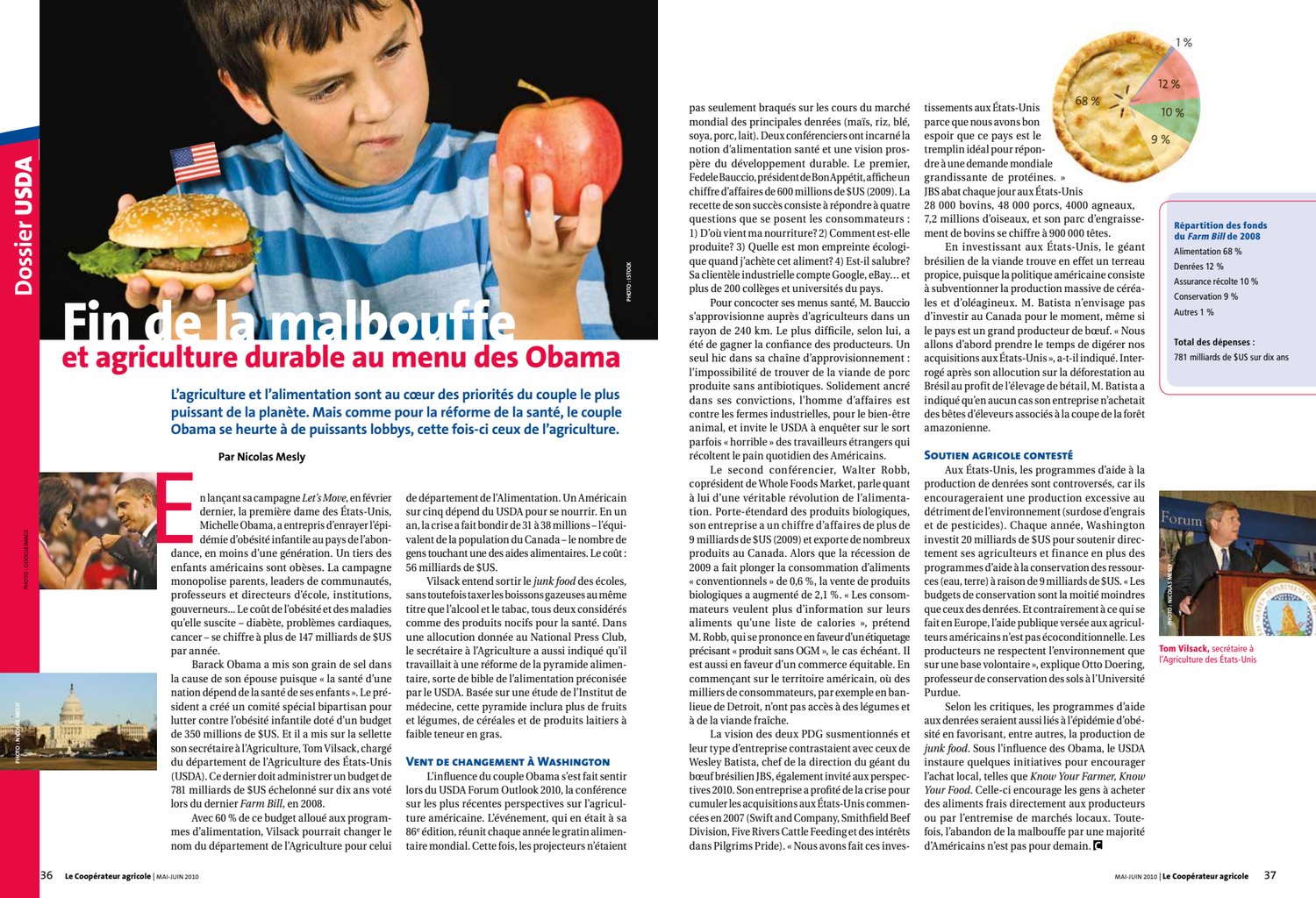
The influence of the Obama couple was felt at the USDA Outlook 2010 conference on the latest prospects for agriculture in Washington. The event, which was at its 86th edition, brings together the world's food gratin every year. This time, the spotlights were by Nicolas Mesly Ending junk food and sustainable agriculture on the Obama agriculture and food menu are at the heart of the priorities of the world's most powerful couple. But as with health reform, Obama's couple are facing powerful lobbys, this time those of agriculture.
E not only on the world market prices of the main commodities (maize, rice, wheat, soy, pork, milk). Two speakers embodied the concept of healthy diet and a pro - father vision of sustainable development. The first, Fedele Bauccio, president of Bon Appetit, has a turnover of US$600 million (2009). The recipe for its success consists in answering four questions that consumers ask themselves: 1) Where does my food come from? 2) How is it produced? 3) What is my ecologic footprint - that when I buy this food? 4) Is it safe?
His industrial clientele includes Google, eBay... and more than 200 colleges and universities across the country. To create his health menus, Mr. Bauccio supplies farmers within 240 km of the market. The most difficult thing he says was to gain the confidence of the producers.
A single tic in its supply chain: the impossibility of finding pork meat produced without antibiotics. Strongly rooted in its convictions, the businessman is against industrial farms, for animal welfare, and invites the USDA to investigate the sometimes "horrorous" fate of foreign workers who harvest the daily bread of the Americans. The second speaker, Walter Robb, co-president of Whole Foods Market, speaks of a real food revolution.
As a standard holder of organic products, his company has a turnover of more than US$9 billion (2009) and exports many products to Canada. While the 2009 recession led to a 0.6% rise in "conventional" food consumption, the sale of organic products has increased by 2.1%. "Consumers want more information about their food than a list of calories," says Robb, who supports labelling that specifies "GMO-free", where applicable.
It is also in favour of fair trade. Starting in the US, where thousands of consumers, for example in Detroit's Ban - league, do not have access to vegetables and fresh meat. The two CEOs' vision and their type of business contrasted with those of Wesley Batista, CEO of the Brazilian beef giant JBS, also invited to the 2010 prospects. His company took advantage of the crisis to accumulate acquisitions in the US started in 2007 (Swift and Company, Smithfield Beef Division, Five Rivers Cattle Feeding and interests in Pilgrims Pride).
"We have made these investments in the United States because we are confident that this country is the ideal springboard for growing global demand for protein." JBS has killed 28 000 cattle, 48 000 pigs, 4000 lambs, 7.2 million birds every day in the United States, and its cattle feedlot is 900,000 head. By investing in the United States, the Brazilian meat giant finds a suitable soil, since American policy is to subsidize massive grain production - the oil and gas oil.
Batista does not consider investing in Canada at this time, even though the country is a major beef producer."We're going to take the time to digest our acquisitions in the United States," he said. Asked after his speech on deforestation in Brazil for livestock farming, Batista said that in no case did his company buy cattle from farmers associated with the Amazon forest cutting.
Controversy of agricultural support In the United States, food production aid programs are controversial, as they would encourage excessive production at the expense of the environment (overdose of fertilizer and pesticides). Each year Washington invests US$20 billion to support its farmers and finances in addition to US$9 billion in resource conservation aid programs.
And unlike in Europe, public aid to American farmers is not eco-conditional. Producers only respect the environment on a voluntary basis," says Otto Doering, professor of soil conservation at Purdue University. "There are criticisms that food aid programs are also linked to the obesity epidemic by promoting, among other things, the production of junk food. Under Obama's influence, the USDA is introducing a few initiatives to encourage local buying, such as Know Your Farmer, Know Your Food.
The latter encourages people to buy fresh food directly from producers or through local markets. All - all - all - all - all the time, the abandonment of junk food by a majority of Americans is not for tomorrow. Distribution of the 2008 Farm Bill Funds Food 68% Densities 12% Crop Insurance 10% Retention 9% Other 1% Total expenditure: US$781 billion over 10 years PHOTO: GOOGLEIMAGE Tom Vilsack, Secretary of Agriculture of the United States PHOTO: NICOLAS MESLY PHOTO: NICOLAS MESLY 12% 10% 9% 68% 1% 36 Agricultural Co-operators 2010 MAI-JUIN USDA file MAY-JUIN 2010
In 2007, by adopting the Energy Independence and Security Act, former President G.W. Bush put full gas on ethanol production, first to wean the enemy's oil America, then to reduce greenhouse gas (GHG) emissions. Under this Act, the Americans - they are producing 136 billion litres (36 billion gallons) of ethanol by 2022. The agreement provides for a ceiling of 57 billion litres of ethanol made from maize.
This ceiling is almost reached and, in 2009, 24% of yellow grain production was destined to feed the US fleet. The remaining 79 billion litres must be filled by second generation ethanol production, called "cellulosic." "We must set realistic targets for ethanol production in the United States instead of throwing taxpayers' money out the window," says Amy Myers Jaffe, one of the authors of the study on the basis of a sustainable biofuel policy in the United States, published by Rice University, Texas, last January.
According to the study, Washington spent US$4 billion on biofuel subsidies in 2008, replacing about 2% of US demand for fuel."Increasing ethanol production from corn in the Midwest could be at the expense of the environment and exacerbate damage to ecosystems and fisheries along the Mississippi and the Gulf of Mexico, and create a water shortage in areas where crops are irrigated," the report argues. "The authors calculate that to produce the 57 billion litres of ethanol corn, producers will need an additional 2.17 million tonnes of nitrogen, or 16% of all nitrogen used, to grow other American crops.
By Nicolas Mesly "We are very aware of the problem and we encourage producers to use new technologies and good cropping practices, such as direct seeding," says John Scoll, Illinois corn and soybean producer and also president of the American Farmland Trust (AFT), a producer organization dedicated to the conservation of natural resources. According to AFT, nearly 50% of US corn production is produced on rotation, 20% is made under direct seeding and 30% is irrigated.
In 2010, maize production will reach a record high of 333 million tonnes, according to USDA estimates. With regard to cellulosic ethanol, it is expected that the technology for its manufacture will not be in place for at least five years. According to Joseph Glauber, USDA chief economist, demand for these 79 billion litres of ethanol that cannot be produced by maize risks compromising USDA conservation programmes, which include some 38 million hectares.
"I don't think that all this land will be converted to energy production," says Scholl. "The demand for cellulosic ethanol may encourage producers to include new production in their rotation, such as the built-up panic, which would allow better soil cover and limit erosion.As for the possibility of harvesting corn residues in the field to produce this second generation ethanol, "there is a recognition that there will be a limit to what can be taken without having a negative effect on soil quality," says Scholll.
The study published by Rice University found that it is very doubtful that the United States can achieve its goal of producing cellulosic ethanol by 2022. More than 96% of ethanol is produced from corn in the Midwest, in the heart of America. The biofuel must then be transported by train, truck and barge to be mixed with gasoline by refiners. Although the producer of ethanol Poet, from Midwest, recently announced the construction of a pipeline to reduce transportation costs, the study recommends that it be more economical to import ethanol from Brazil, or potentially from Cuba, manufactured from sugar cane, to mix it in petroleum termi - petroleum waters near large coastal cities, where markets are located. durable L Éthanol and agriculture PHOTOS: ISTOCK 1981 1985 1993 1997 2001 2005 2009 2013 2017 2021 Ethanol to be produced under the Act on Sugar Cane, made from CAGS, to mix it in petroleum termi - petroleum waters, in the midwest, where markets are located.
The parties must submit to a series of conditions: 1) to provide the history of their crop yields and areas; 2) to have crop insurance; 3) to agree to adopt good environmental practices. The producer's goal is obviously to remove the maximum compensation. Professor Zulauf's program is praised by the American Farmland Trust, the National Corn Growers Association (NCGA) and senators from Illinois and Ohio, powerful players in the Corn Belt area.
The ACRE program has made a notable entry into the 2008 Farm Bill, which has been in effect since last year. Concern among producers "The rate of membership in the ACRE program is very disappointing, because the agrico programs - they are increasingly numerous and complex," says Vince H. Smith, Professor of Agroeco - nominated at the University of Montana. In Iowa alone, he says, farmers are asked to select from 150,000 insurance options - harvests in addition to choosing between the DCP or ACRE programs.
In introducing the ACRE program, Washington is seeking to save the money paid by the CPDs without a requirement to produce, which is $5 billion a year; but by forcing producers to produce, it is embarking on the unknown. According to various studies, the ACRE program could cost the US Treasury between 2 and 10 billion. And this same program may not get the consent of the World Trade Organization (WTO), since it encourages production. American grain producers have never been so confused. The Direct Counter-cyclical Payments (DCP) program of grain support is strongly criticized in the United States.
On the one hand, this program allows for the collection of subsidies without cultivating land, which is a problem for many taxpayers. On the other hand, farmers complain about the lack of protection in the event of loss of yield. In fact, the federal government should only pay money when prices fall. Yet, despite record food prices in 2008, the United States Department of Agriculture (USDA) has paid generous subsidies.
To remedy this situation, American auto-ties have relied on a new tool with the 2008 Farm Bill: the "Average Crop Revenue Election" (ACRE) program, which consists of income insurance. Direct payments to the dead and Bugs Bunny Since 2000, more than US$1.3 billion have been paid to people who do not grow the land. Producers of about ten large crops – cotton, maize and soybeans in the lead – can receive these subsidies. Three journalists from the Washington Post have spent more than a year investigating the allocation of agricultural subsidies.
As a result, they found that even the dead are receiving subsidies! Bugs Bunny – this is not a joke – a religious organization, too, benefits. "It's true, it just took a name to get the grant," says Brent Orr, a specialist in DCP/ACRE programs, from the Farm Service Agency (FSA), a division of the USDA. ACRE to correct the situation?
"The traditional DCP program does not provide an adequate safety net in the current context," says Carl R. Zulauf, Professor of the University of Ohio's Agricultural Departement and Designer of the ACRE program, who intends to use the prices of the most recent two years as a benchmark.
By Khamla Heminthavong, Economist Sustainable Development Sector The Federal Co-op Khamla.heminthavong@lacoop.coop L 40 The Agricultural Co-operators , MAY-JUIN 2010 MAY-JUIN 2010 , The Agricultural Co-operator 41 USDA 1 MORGAN, Dan, Gilbert M. GAUL and Sarah COHEN, "Farm Program Country $1.3 Billion to People Who Don , Washington Post, July 2, 2006, p. A1 PHOTO: PRECIOUSING A Discreet Superstar In an interview, Mr. Glauber said he was not sure that he would be able to meet President Obama's call to double US exports within five years.
U.S. agricultural exports have already more than doubled from about US$50 billion to US$115.3 billion, a record record. In 2009, the collapse of the world economy caused US exports to fall below US$100 billion; however, by 2010, they are expected to again outpace this trend. China is helping to boost the business of U.S. farmers. In itself, the demand for soybeans from the Middle Empire represents 54% of the world's trade in this plant.
According to Joseph Glauber's colleague Jim Miller of the Foreign Agricultural Service (FAS), bilateral agricultural trade in the United States – China will soon surpass the combined trade in the United States with the other two NAFTA members, Canada and Mexico. Joseph W. Glauber, the Chief Economist of the United States Department of Agriculture (USDA), forecast to influence the price of agricultural commodities on the Chicago, Winnipeg and World Stock Exchanges. The Agricultural Co-operator met with him at his office in Washing - Ton, capital of the world's first agricultural and military power.
An exclusive interview held in the aftermath of the conference on the annual outlook for the American agricultural economy, which brought together the world food gratin."In 2010, American grain and animal producers will be gaining record-breaking dreams, the third largest ever," predicted Joseph W. Glauber, USDA's chief economist, at the 86th edition of the Outlook Forum, a cult conference held earlier this year in a Washington hotel two-way across. By Nicolas Mesly L Agricultural exports are vital for the Obama administration, which cumulates the US$14 trillion ( ) titanium deficit.
The agricultural trade surplus (exports minus imports) is a bit of a boost to Washington's chests. In 2008, before the crisis, the surplus had reached US$36 billion. It is expected that it will be US$22.5 billion in 2010. WTO priority Joseph Glauber was also Washington's trusted man as a special envoy from the US agricultural sector to the WTO Doha Round negotiations for two years, from 2007 to 2009.
Despite the failure of the process (started in 2001), the chief negotiator continues to favour a multilateral approach to increasing world agricultural trade."It took a little, the last time, for the Doha Agreement to be ratified, but it is not the US agricultural sector, concerned about the cuts in subsidies and market access, but other sectors that have prevented this ratification. President Obama has made it clear that he wants to conclude these negotiations," he says.
Milk The 2009 global recession has had a strong impact on the U.S. dairy sector. The price of milk paid to producers has melted to US$12.81 per 100 lb. Glauber predicts that this price will rebound between US$16.20 and US$16.90 per 100 lb. due to the recovery of dairy exports on the international scene. Farmers have slaughtered 252,000 cows in the last year in the hope of reducing production and raising prices.
In support of their businesses, they received more than US$1 billion in 2009 from the various USDA support programs. Despite all their difficulties, the majority of U.S. producers are not inclined to adopt a quota system modelled on Canada's, says Mr. If negotiations resume at the WTO, the WTO believes that Canadian producers have the tools to adequately protect their supply management system.
Glauber plans to resume exports of pork and beef in 2010; however, poultry exports will decline, partly due to restrictions imposed by Russia. End of the pig turmoil? In 2010, the USDA chief economist forecast a 2% decrease in U.S. pork production, but a substantial increase in exports by 9% due to the global economic recovery.
The US pork industry is expected to grow at a rate of US$140 to US$150 per head.
The USDA Chief Economist estimates that the savings would amount to US$200 million per year, or US$1 billion in five years. The USDA Chief Economist, Joseph W. Glauber, relies on an experienced team of analysts in Washington and across the United States to predict the income of American farmers and the price of the main commodities marketed around the world: corn, soybeans, rice, wheat, cotton, sugar, milk, pork and other commodities. The leading economist also relies on the formidable network of the Foreign Agricultural Service (FAS), which is made up of agricultural specialists deployed at US embassies and consulates in 90 countries.
It also relies on information transmitted by American satellites able to detect the effects of climate change – floods, droughts – or to determine what types of insects or fungi infect the world's fields. In short, Joseph Glauber's gaze is like an X ray sweeping the world's agri-food markets. His predictions are kind of gospel words in brokers' offices around the world. Joseph Glauber Net income of US producers (source: USDA) 2010: US$76.3 billion (prevision) 2009: US$71.3 billion PHOTO: NICOLAS MESLY 42 The Agricultural Co-operator: MAY-JUIN 2010 MAY-JUIN 2010: The Agricultural Co-operator: USD 43
Complete original publication
The complete facsimile presents the publication in its original editorial design.
Open original PDF ↗