The complete story
"I'm not going to grow my land anymore, so they'd be easier to dezone!" says Édouard Desjar - dins, a proud 82-year-old farmer. His farm is set in a stretch between Highway 15 and the village of Saint-Janvier in Mirabel. Over time, the rows of houses have quietly grubbed the five farms that separated his property from the clo-chef of the village church.
And he had to abandon the breeding of cows, because the smell of manure bothered his new neighbours. Today, life has become "infernal." ATVs drive on his leased land, destroying part of the crops of corn and soybeans. When it is not snowmobile drivers who cut off his fences to break a path in his fields.
The traffic that has become constant on the road between his house and his barn has made him suck - and for the life of his three children. No one has wished to take over. This worthy farmer, who has "O Condos, residences, highways... the main tool of farmers, the land, disappears at a frightening speed, especially in the fertile plain of the St. Lawrence, the food basket of Quebecers. Does the government of Quebec intend to rule to stop the bleeding?
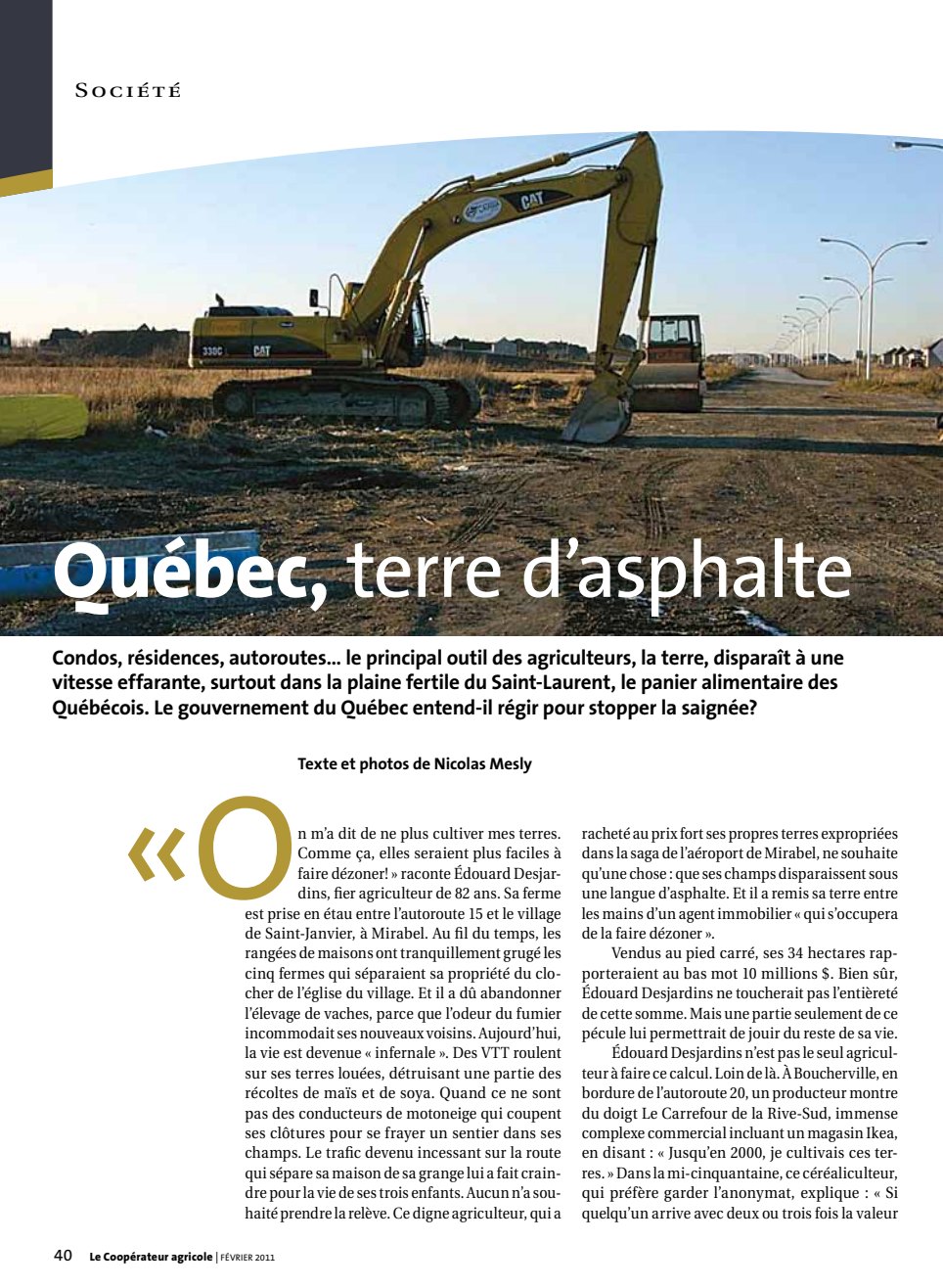
Text and photos of Nicolas Mesly Québec, a land bought at a high price from his own land expropriated in the Mirabel airport saga, only wants one thing: that his fields disappear under an asphalt language. And he handed his land back to a real estate agent "who will take care of it to de-zone it." Sold by square foot, his 34 hectares rap - would carry the low word $10 million. Of course, Édouard Desjardins would not receive the entire amount.
But only part of this pecule would allow him to enjoy the rest of his life. Édouard Desjardins is not the only farmer to do this calculation. In Boucherville, on the edge of Highway 20, a producer points out Le Carrefour de la Rive-Sud, a huge commercial complex including an Ikea store, saying: "Until 2000, I was cultivating these ter - res."In the mid-fifties, this cereal farmer, who prefers to keep anonymity, explains: "If anyone arrives with two or three times the value 40 Le Coopérateur agricole garde È FEBRUARY 2011 Société At the head of the Coalition pour la protection du territoire agricole, Christian Lacasse, also president of l'UPA, regularly alerts Québec on the issues related to the disappearance of the agricultural territory.
He is here at a press conference in March 2009, with Sylvie Cloutier, President and CEO of the Conseil de la transformation agricole et des produits de consommation du Québec (CTAC), Pierre Laliberté, political advisor at the FTQ, and Réjean Parent, president of the Centrale des syndicats du Québec (CSQ).This 400 hectares of land makes it a pension fund."This producer does not encourage his son to take over. A multitude of factors have been behind his passion for the profession: the lack of recognition of this occupation, the low price of cereals for 30 years, the difficult cohabitation with the city dwellers, etc.
So that sooner or later, a battery of May - sounds will rise on the lands surrounding this mall. But can we blame the producers for the disappearance of their main tool of work, the earth? This phenomenon accelerates particularly - in the Montreal Metropolitan Community (MMC), the food basket of Quebecers. Everywhere in the north and south crowns of the metropolis, the scenario of the Carrefour de la Rive-Sud or the Dix30 district repeats itself.
The promoters are pushing a cinema, a "horse of Troy", to which a real estate estate is attached, on the best agricultural land in the province. In addition, the economic recovery plan of OttawaQuébec, with a $4 billion envelope and focused on the construction of highways and viaducts, nibbles the meagre bank of agricultural land in the Belle Province. Not to mention the gas pipelines or LNG ports promoted by Quebec, which also amputate the land for food. "Agricultural soils are a non-renewable resource.
Once under the bitumen, they are irrecoverable!" explains Professor Martin Chantigny, President of the Association québécoise des spécialisants en sciences du sol (AQSSS). "Each hectare sacrificed for a vocation other than agriculture represents a net and irrevocable loss of our food capacity." "C'est indésert !" surges Sylvie Cloutier, President and General Director of the Conseil de la transformation agroali-mentaire et des produits de consumé du Québec (CTAC). Formed by 400 companies and 1400 establishments, members of the CTAC generate 72,000 direct jobs and $20 billion in turnover annually.
And the dispersal of agricultural land risks falsification - expensive grass under the foot of the first employer in the manufacturing sector of Quebec. If Quebec contains France three times, barely 2% of its territory is arable – two million hectares – 14 times less than the Hexagon. Aware of this vulnerability, Quebec nevertheless had the Agricultural Land Protection Act (AQL) in 1978 and a guard dog, the Commission sur la protection du territoire agricole (CPTAQ).
"It's more like a dezoning commission!" mocks 30 years after Jean Garon, the father of LPTAQ and former Minister of Agriculture under the Pequist government of René Lévesque. Despite these two tools "that help avoid the worst", the small northern garden queé - becois is amputated at 4000 hectares per year, that is the area of the island of Mon-trail every 10 years. Since 1994, more than 56,000 ha have been excluded from agriculture, most of which in the CMM. "It is all the more unacceptable that an almost equivalent extent (30 000 hec - tares) is still available in a white area for urbanization in the triple crown of Montreal," denounced the president of the UPA, Christian Lacasse, who is also at the head of the Coalition for the Protection of Agricultural Territory, a vast grouping of the living forces of the Belle Province (La Coop fedéréée, CTAC, CSQ, FTQ, Fondation québécoise en envi - ronnement, etc.).
Why this voracious appetite for agricultural land in the CMM? "Agriculture is perceived by municipalities as a barrier to development. We are able to draw on land as well as on a cheese plate. Yet, the agricultural sector is as important an economic lever as a nanotechnology park," says Jean-Robert Grenier, former mayor of Calixa-Lavallée, a village of 500 inhabitants located northeast of Montreal, on the South Shore.
Robert Grenier, former Chair of the CMM Agricultural Advisory Committee, imputes the FEBRUARY 2011: Le Coopérateur agricole 41 Édouard Desjardins, de Saint-Janvier (Mirabel), wishes only one thing: to dezone his land in order to be able to sell it to a real estate developer. As mandated by Québec to reform the Agricultural Land Protection Act (AQPL), Bernard Ouimet advocates the end of piece-tening and a collective dezoning. To protect the land in the fertile plain of Saint-Laurent, the former president of the Commission de la protection du territoire agricole (CPTAQ) proposes that Québec impose "a moratorium on residential construction". The disappearance of agricultural land under the current tax regime, which encourages unbridled competition between municipalities: "When a developer presents a project for the construction of 300 to 400 houses, it means illico of transfer rights, and then annual revenue revenues.
In addition, the construction of utilities, such as sewers and electricity, is at the expense of the promoter. It is not only an attractive dish, but also a recipe for re-election!"The CMM swims in the direction of contraire Claude Marois, professor in the Department of Geography at the University of Montreal, surprises that the "wild" urban sprawl is realized in a context where the growth rate of the Quebec population is rather slow. Moreover, according to this geographer, periurbai agricultural lands - not only have a strong economic and commercial vocation, creating short circuits close to the major markets, but they also play a role in conserving biodiversity.
In addition, agricultural land, according to FAO, can be a weapon for the fight against greenhouse gases (GHGs), by sequestering CO2. In this sense, many of the world's major cities – Berlin, San Francisco, Toronto, etc. – are equipped with a green belt. Nearly 58% of the MMC's territory, or 220,000 ha, are agricultural land, "a phenomenon unique in North America," says Bernard Ouimet, former president of the CPTAQ. "Instead of asking whether we need shopping centres or real estate lots to develop ourselves, we should ask ourselves what are the good agricultural land we want to keep within 30 to 50 years," continues the man who was mandated by Quebec to modernize the LPTAQ, as part of the laying of a new agricultural policy.
This latest agricultural policy is now in the hands of Laurent Lessard, who combines the roles of Minister of Agriculture and Minister of Municipal Affairs, Regions and Land Use, who inherited a tool that could perhaps save the agricultural land of the CMM: Bill 58 on Planning and Urban Development, passed in June 2010. This bill is a tool that calls on the CMM to make its agricultural land sacred and to concentrate on urban sprawl.
She is expected to present her action plan in Quebec City in the fall of 2011. "I don't believe it," says Mr. La CMM has had 10 years since its inception to present a development plan and has never done so. The only way to enforce this new schedule is to impose a moratorium on residential construction.
Can we realistically expect Laurent Lessard to impose a moratorium on residential construction on the president of the CMM and the current mayor of Montreal, Gérald Tremblay, to stop the bleeding of the best lands in the province? By 2021, if the trend continues, Quebec will lose, in the midst of a global food crisis, an extent of nourishment land equivalent to the area of the island of Montreal. 42 Le Coopérateur agricole chervrier 2011 Photo : Pierre cadoret
Complete original publication
The complete facsimile presents the publication in its original editorial design.
Open original PDF ↗